How to Master Question-to-Competency Mapping

How to Master Question-to-Competency Mapping
The Core of Structured Hiring & A Real-World Crisis
Defining Question-to-Competency Mapping
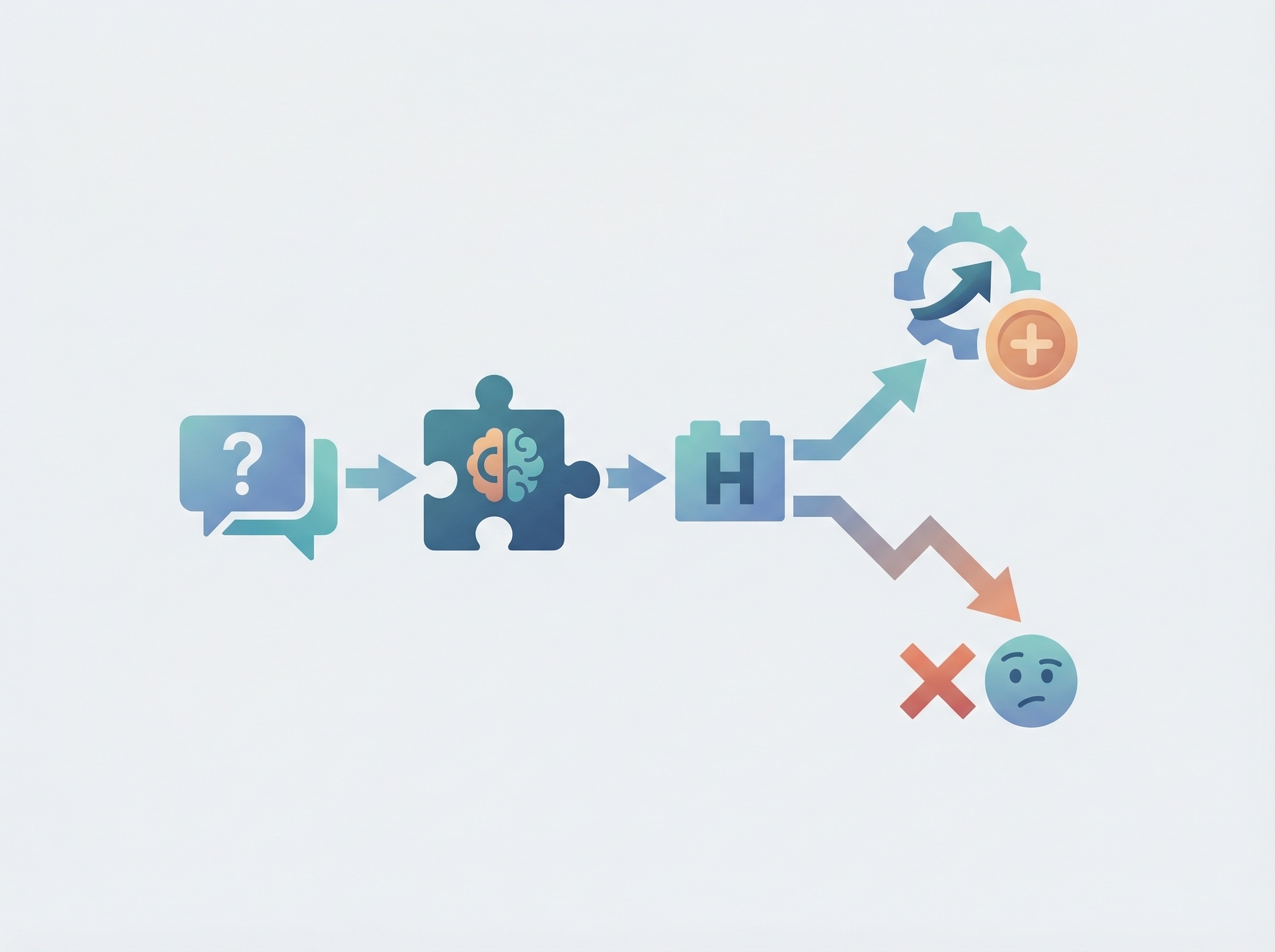
What is question-to-competency mapping? It is the deliberate alignment of every interview question to a specific required skill, trait, or behavioral indicator. In modern talent acquisition, this foundational practice matters because it transforms subjective, unstructured conversations into objective, data-driven evaluations. Ultimately, mapping improves critical hiring outcomes: it accelerates speed, elevates quality of hire, ensures evaluation consistency, and guarantees a fairer candidate experience by eliminating redundant inquiries. Rather than relying on gut feelings, interviewers utilize a standardized framework to measure exactly what matters for the role.
However, without this alignment, hiring pipelines inevitably break down. Consider Sarah, an engineering Hiring Manager, and David, a Lead Recruiter, who found themselves drowning in an escalating hiring crisis. Despite high application volumes and countless hours spent reviewing portfolios, they were paralyzed by a dismal 20% pass-through rate from the panel interview to the final offer stage, coupled with an agonizingly bloated 45-day time-to-hire.
A Tale of Two Interviews
To understand the depth of Sarah and David’s problem, we have to look closely at their broken workflow. Their process followed a standard, yet deeply flawed trajectory: Intake → Screening → Interview → Decision → Offer. During the intake session, Sarah provided David with a generic list of requirements—mostly technical skills with a vague request for "good culture fit." David dutifully translated this into his initial resume screening, but because the core competencies were never clearly defined or weighted, the top of the funnel was filled with candidates who looked good on paper but lacked specific execution skills.
The real disaster, however, unfolded during the interview stage. Because there was no question-to-competency mapping in place, the four interviewers on the panel were left to their own devices. Candidate after candidate experienced the exact same frustrating loop: three different interviewers would ask some variation of, "Tell me about a time you failed," or "How do you handle conflict?" Meanwhile, critical technical competencies and system architecture skills were entirely skipped because each interviewer assumed someone else was covering them.
The measurable inefficiency was staggering. Candidates were dropping out of the process due to interview fatigue, sensing the disorganization. When the panel finally gathered for the decision stage, the debriefs were chaotic. One interviewer would vote "No" based on a candidate's quiet demeanor, while another would vote "Yes" based on a shared alma mater. They were comparing apples to oranges because no one asked standardized questions mapped to a unified rubric. This misalignment directly caused their 45-day time-to-hire; they were forced to constantly restart the search, wasting dozens of expensive engineering hours and losing top talent to faster competitors.
Best Practices, Pitfalls & The Breakthrough
Actionable Heuristics for Mapping
To escape this cycle of inefficiency, talent leaders must adopt rigorous, structured methodologies. Here are four actionable heuristics for applying question-to-competency mapping effectively:
- One question, one primary competency: Never ask double-barreled questions. If you want to assess "Stakeholder Management," ask a targeted behavioral question specifically about navigating stakeholder pushback. If you also need to assess "Technical Problem Solving," create a separate question. Blurring them makes it impossible to score accurately.
- Anchor questions using structured interview scorecards: A mapped question is useless if the evaluator doesn't know what a "good" answer sounds like. Build robust interview scorecards that include a 1-to-5 rating scale, complete with positive and negative behavioral indicators for every single question.
- Leverage an ATS and AI interview platform for calibration: Modern hiring workflow automation makes it easier to enforce mapping. Use your ATS to assign specific competency tracks to specific interviewers. Furthermore, an AI interview platform can assist in conducting initial behavioral baselines, ensuring that every candidate receives the exact same baseline questions before meeting the human panel.
- Map across the entire candidate lifecycle: Competency mapping shouldn't just exist in the interview phase. It should start at the job description, weave through resume screening, dictate the interview scorecards, influence the final offers, and even inform the parameters of reference and background checks to ensure holistic alignment.
Common Pitfalls to Avoid
Even with good intentions, organizations frequently stumble when implementing structured hiring frameworks. Be aware of these three common pitfalls:
- Overloading a single question with multiple competencies: Many hiring managers try to save time by asking complex, multi-layered questions (e.g., "Tell me about a time you led a project, how you managed the budget, and how you dealt with a difficult engineer"). This confuses the candidate and makes it impossible for the interviewer to cleanly grade leadership, financial acumen, and conflict resolution simultaneously.
- Failing to train interviewers on the new rubric: You can build the most elegant question-to-competency mapping matrix in the world, but if the panel isn't calibrated, it will fail. Interviewers often revert to their favorite "go-to" brainteasers unless they are strictly trained on why they must stick to the assigned scorecard.
- Ignoring post-offer data to close the feedback loop: A major misconception is that competency mapping ends when the candidate signs the offer. In reality, you must validate your maps. If you scored a candidate perfectly on "Attention to Detail," but their background checks and first-quarter performance reviews show severe negligence, your mapping framework—or your grading rubric—needs immediate recalibration.
The Turning Point
For Sarah and David, the breakthrough happened when they halted their active searches and spent one week completely overhauling their strategy. They mapped out the five non-negotiable competencies for the engineering role. They assigned two specific, pre-written questions to each interviewer, equipped with detailed scorecards outlining what a poor, adequate, and exceptional response looked like. They enforced strict rules: no overlapping questions, and no off-script brainteasers.
The before-and-after impact was transformative. Because candidates were no longer subjected to redundant questions, the candidate experience skyrocketed, leading candidate drop-offs to decrease to near zero. Decision alignment between the four interviewers hit an unprecedented 90%, transforming previously agonizing hour-long debriefs into efficient 15-minute consensus meetings. Most importantly, their time-to-hire plummeted by 15 days, and their pass-through rate doubled. By simply aligning their questions to their required competencies, they unlocked a streamlined, predictable hiring engine.

Career Advantage: Mapping for Talent Leaders
Differentiating Yourself in HR
In the highly competitive landscape of 2026, mastering question-to-competency mapping is a profound career differentiator for recruiters, hiring managers, and talent acquisition leaders. It is the distinct dividing line between tactical order-takers and strategic talent advisors. When you shift from simply scheduling interviews to actively architecting the evaluation framework, you elevate your value within the organization. Business leaders rely on data; by implementing competency mapping, you replace the subjective "I just didn't like their vibe" with objective, defensible data points. This mastery proves to executive leadership that you understand how to mitigate bias, reduce expensive hiring mistakes, and drive operational excellence.
Q: “How have you applied question-to-competency mapping to improve outcomes?”
A: “I standardized our interview scorecards across the engineering department, which calibrated our hiring panels, eliminated redundant questions, and reduced time-to-fill by 25% while significantly improving our offer acceptance rates.”
Demonstrating Impact on a Resume
When positioning yourself for a promotion or a new role in talent acquisition, your resume must reflect your ability to operationalize structured hiring. Use strong action verbs and concrete metrics. Here are powerful examples of how to format this impact:
- Architected a comprehensive question-to-competency mapping framework, improving interviewer alignment by 90% and reducing post-interview debrief times by half.
- Streamlined hiring workflow automation via ATS integration, reducing unconscious bias and improving candidate pass-through rates by 30%.
- Calibrated structured interviews and standardized interview scorecards across 5 global departments, directly decreasing time-to-hire by 15 days.
- Partnered with engineering leadership to map core competencies to performance evaluations, ensuring continuity from initial resume screening through final offers and onboarding.
Pros and Cons Table
While the strategic advantages are clear, it is important to understand the realities of implementing this methodology. Here is an honest look at the tradeoffs:
| Benefit | Tradeoff |
|---|---|
| Generates Objective Data & Reduces Bias: By standardizing evaluations, every candidate is judged on the exact same criteria, leading to fairer and more predictable hiring outcomes. | High Initial Setup Time: Creating distinct competencies, writing behavioral questions, and building detailed scorecards for every single role requires significant upfront labor from HR and hiring managers. |
| Eliminates Interview Redundancy: Candidates experience a professional, comprehensive interview loop where their time is respected and different facets of their expertise are explored. | Requires Strict Interviewer Discipline: Interviewers must be heavily trained to stay on script; the system breaks down if panelists deviate from the assigned competency map. |
FAQs & Future-Proofing Your Hiring Workflow
Frequently Asked Questions
What is question-to-competency mapping?
It is the strategic HR practice of designing and assigning specific interview questions to evaluate predefined skills, traits, or behaviors required for a job. This ensures that every question serves a distinct purpose, eliminating redundancy and generating objective data to evaluate a candidate’s true capabilities.
Can question-to-competency mapping backfire?
Yes, if poorly implemented. If the mapped competencies don't accurately reflect the daily realities of the job, you will hire people who excel at the interview but fail at the actual work. It can also backfire if scorecards are overly complex, causing interviewers to abandon the framework altogether.
How does it integrate with modern resume screening and AI tools?
Modern hiring workflow automation relies on competency mapping as its foundation. AI interview platforms use these predefined competencies to conduct unbiased initial screenings, while ATS platforms use them to automatically parse resumes and prompt interviewers with the correct scorecards, seamlessly connecting the entire talent acquisition process.
Creating a Durable Advantage
In an era where the cost of a bad hire continues to rise and the competition for top talent remains fierce, relying on unstructured, conversational interviews is a massive operational risk. Mastering question-to-competency mapping creates a durable, data-backed hiring advantage that protects your organization from bias, inefficiency, and costly turnover. It shifts the entire paradigm of talent acquisition from a guessing game into a precise, repeatable science. By ensuring that every question asked is a strategic tool designed to uncover a specific, necessary trait, you build stronger, more resilient teams.
If you want to operationalize question-to-competency mapping with structured workflows (Sourcing → resume screening → AI interviews → scorecards → offers → background checks), try tools like Foundire (https://foundire.com).