How to End Time Zone Scheduling Pain

Intro: The Hidden Cost of Global Delays
Defining the Core Problem
Time zone scheduling pain is the operational friction that occurs when recruiters and hiring managers struggle to coordinate interviews across multiple geographic regions. This logistical nightmare results in endless communication lags, manual calendar adjustments, and drastically prolonged hiring cycles. Why does it matter? Because this friction single-handedly ruins the candidate experience, damages your employer brand, and directly sabotages hiring results. By eliminating time zone scheduling pain through advanced automation and structured workflows, talent acquisition teams can immediately improve hiring speed, assessment quality, and operational consistency. In today’s hyper-competitive global market, solving this administrative burden isn't just a convenience—it is the fastest, most reliable way to secure top-tier talent before your competitors do.
A Recruiter's Worst Nightmare
Consider David, a senior talent leader tasked with hiring a principal engineer for a critical product launch. The perfect candidate was quickly identified, but coordinating a simple panel interview across PST, EST, and CET turned into a complete logistical disaster. After countless emails and mismatched availability, David finally secured a time slot. However, the two-week delay proved fatal: the top engineer had already accepted an offer from a faster competitor. The process was fundamentally broken, the effort was entirely wasted, and the business impact was measurable in delayed product milestones.
The Global Hiring Scenario and Breakthrough
The Anatomy of Inefficiency
When hiring globally, traditional processes often collapse under the heavy weight of manual coordination. Let's look at the standard, broken workflow: it begins with the initial Intake, moves to manual resume screening, descends into endless calendar ping-pong, finally reaches the interview stage, and hopefully concludes with a decision. This outdated model simply cannot scale across borders.
The metrics behind this inefficiency are alarming. Industry data indicates that the average time-to-hire has ballooned to 43 days, with a significant portion of that time wasted on logistics. A mere 72-hour scheduling lag can drop the candidate pass-through rate by up to 30%, simultaneously inflating the overall cost-per-hire. Every delayed email across oceans extends the critical feedback loop. By the time recruiters chase down interviewers, gather the necessary interview scorecards, and finally push toward extending offers, the absolute best candidates have already lost interest and moved on to organizations that respect their time.
The Automation Turning Point
The breakthrough moment happens when talent organizations deliberately shift from manual calendar math to intelligent hiring workflow automation. When David’s team realized their current system was costing them elite talent, they completely overhauled their approach. By implementing an AI interview platform and seamless automated calendar syncs, they transformed their daily operations.
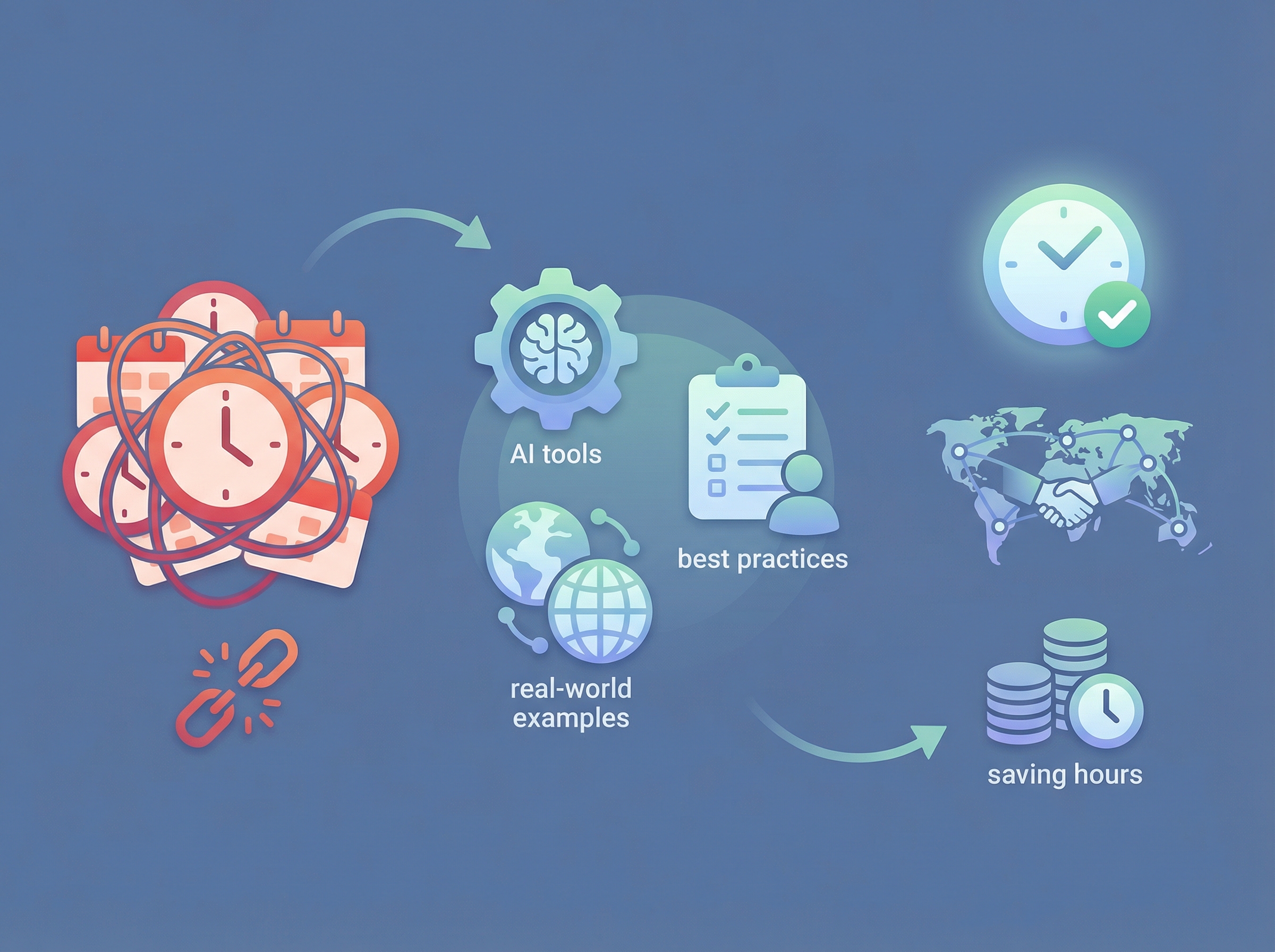
The before-and-after impact was staggering to witness. The critical metric—time-to-schedule—plummeted from an agonizing four days to just four minutes. Instead of hunting for elusive open calendar slots, candidates were empowered to select pre-calibrated times that instantly and accurately synced with the company's ATS. This fundamental shift not only eliminated their time zone scheduling pain but also radically improved structural consistency. The team experienced higher pass-through rates, better decision alignment among hiring managers, and virtually zero candidate drop-offs due to logistical friction. Suddenly, the recruiting team wasn't just filling seats; they were operating a high-performance talent machine.
Best Practices and Critical Pitfalls
Actionable Heuristics
To master global coordination and permanently eliminate time zone scheduling pain, talent teams must adopt structured, highly repeatable systems. Here are the core heuristics to implement today:
- Establish "Golden Overlap" Hours: Dedicate specific, recurring blocks of time each week where all core regions (e.g., US, EMEA, APAC) naturally overlap. Reserve these highly valuable windows exclusively for critical panel interviews or final calibration sessions to prevent scheduling bottlenecks.
- Utilize Asynchronous Video Screening: Replace difficult-to-schedule initial phone screens with one-way AI interviews. This allows candidates to record their responses in their own time zones, drastically accelerating the top-of-funnel resume screening and assessment process.
- Integrate ATS Automation: Connect your scheduling tools directly to your core operational systems. A tight ATS integration can trigger seamless background checks, instant calendar invites, and automated interview scorecards without requiring any manual data entry from your recruiters.
- Deploy Self-Serve Candidate Workflows: Empower candidates with real-time booking links that automatically convert time zones and check interviewer capacity, effectively removing the recruiter as the middleman in the scheduling equation.
Common Misconceptions
Even well-meaning talent acquisition teams frequently fall into traps when navigating the complexities of global hiring. Avoid these common operational pitfalls:
- Assuming Candidates Will Sacrifice Sleep: Expecting top-tier talent to interview at 11 PM or 5 AM local time severely degrades the candidate experience and virtually guarantees poor interview performance due to fatigue.
- Relying on Manual Timezone Math: Trying to mentally calculate daylight saving time shifts across three different continents is a recipe for disaster. It invariably leads to embarrassing no-shows, frustrated hiring managers, and wasted hours of administrative cleanup.
- Failing to Standardize Calibration: Regional teams often evaluate candidates using vastly different criteria. Without structured interviews and standardized scorecards strictly enforced across all regions, global hiring becomes chaotic, heavily biased, and impossible to scale.
Pros & Cons Table
- Benefit: Unmatched Speed and Scale — Automated, asynchronous scheduling allows for 24/7 interviewing capabilities, dropping the time-to-schedule from days to mere minutes.
Tradeoff: High Initial Setup — Requires dedicated change management and proper tech stack integration to ensure systems communicate flawlessly. - Benefit: Reduced Candidate Drop-off Rates — Candidates can book their times instantly, maintaining high momentum, enthusiasm, and engagement throughout the hiring cycle.
Tradeoff: Perceived Loss of Personalization — The highly automated process may occasionally feel less customized than having a dedicated recruiting coordinator manually guide the candidate via email. - Benefit: Consistent, Centralized Data Capture — Automated routing ensures that your ATS, interview scorecards, and AI interview platform data are perfectly synced without human error.
Tradeoff: Calendar Discipline Dependency — The system is only as good as the data it receives; it requires interviewers to rigorously maintain their real-time calendar availability to prevent double-booking.
Career Impact, FAQs, and Conclusion
Resume Power and Interview Q&A
For forward-thinking recruiters and talent leaders, mastering the operational side of global hiring is a major career differentiator. Knowing exactly how to cure time zone scheduling pain proves to executive leadership that you can handle high-volume, high-complexity environments with strategic poise.
Q: “How have you applied time zone scheduling pain to improve outcomes?”
A: “I completely eliminated time zone scheduling pain by integrating our ATS with an automated AI interview platform. By establishing ‘golden overlap’ hours and deploying candidate self-scheduling, I standardized our structured interviews across three continents. This calibrated our feedback loops, reduced our overall time-to-fill by 14 days, and increased candidate satisfaction scores by 40%.”

To showcase this high-level operational impact on a resume, use metric-driven, action-oriented bullet points:
- Standardized cross-regional hiring workflows by integrating ATS and automated scheduling tools to permanently eliminate time zone scheduling pain.
- Streamlined the talent acquisition funnel from initial resume screening to final offers, reducing the average time-to-schedule from 4 days to 4 minutes.
- Calibrated global interview scorecards and asynchronous video assessments, successfully boosting the candidate pass-through rate by 30%.
- Reduced administrative overhead by 40% through the implementation of hiring workflow automation for background checks and panel coordination.
Frequently Asked Questions
- What is time zone scheduling pain?
Time zone scheduling pain is the severe friction, delay, and administrative burden caused by attempting to coordinate interviews across different global regions. It leads to calendar conflicts, prolonged hiring cycles, high candidate drop-off rates, and significantly increased cost-per-hire. - Can automated scheduling backfire?
Yes, automated scheduling can backfire if improperly configured. If hiring managers and interviewers do not maintain strict calendar hygiene, automated systems can double-book them or schedule interviews during protected deep-work hours. It requires organizational discipline to function correctly. - How does time zone scheduling pain impact employer brand?
Candidates increasingly view logistical chaos as a direct reflection of internal company culture. A slow, error-prone, manual scheduling process signals disorganization and disrespect for their time, causing elite global talent to abandon the pipeline for faster, more efficient competitors.
Final Takeaways
Solving the profound logistical friction of global recruitment is no longer an optional luxury—it is a baseline requirement for modern business success. Mastering the operational challenge of time zone scheduling pain creates a durable, long-term hiring advantage, allowing your organization to move faster, capture better talent, and scale globally without burning out your administrative staff. When you begin to treat interview scheduling not as a tedious administrative chore, but as a highly strategic candidate experience touchpoint, your entire talent acquisition engine accelerates.
If you want to operationalize time zone scheduling pain with structured workflows (Sourcing → resume screening → AI interviews → scorecards → offers → background checks), try tools like Foundire (https://foundire.com).