How to Master Interview Schedule Orchestration

How to Master Interview Schedule Orchestration
What is Interview Schedule Orchestration?
Defining the Intent Behind the Query
If your hiring funnel is leaking top talent, the culprit usually isn't the role or the compensation—it's the logistics. Interview schedule orchestration is the strategic automation and alignment of multi-stage interview logistics to improve speed, quality, and candidate experience. Rather than treating scheduling as a purely administrative task, orchestration treats it as a mission-critical workflow. It matters because high-value candidates are off the market in less than 10 days, yet traditional coordination often stretches for weeks. By deploying hiring workflow automation to sync calendars, standardize availability, and route candidates through a frictionless process, you directly improve key hiring outcomes: a drastically reduced time-to-hire, a higher candidate pass-through rate, and unmatched consistency in your employer brand. When you eliminate the friction of scheduling, you allow your team to focus on what actually matters—evaluating talent and making great hires.
Understanding this concept goes beyond simply buying an automated calendar link software. It requires a holistic view of the talent acquisition ecosystem. Orchestration ensures that every touchpoint flows without human intervention or delay. As modern applicant tracking systems (ATS) evolve, treating scheduling as an interconnected web of triggers and actions is what separates elite hiring teams from the rest.
The Cost of Scheduling Chaos
Meet Sarah, a senior recruiter for a rapidly growing tech firm. Last quarter, she spent a grueling 14 days playing email ping-pong trying to align three hiring managers for a final panel interview. By the time she finally locked in a time slot, her top candidate had already accepted a competing offer. This isn't just an isolated anecdote; according to recent 2025 benchmark reports, 60% of organizations reported longer time-to-hire, with interview cancellations and scheduling delays identified as their top bottlenecks. Furthermore, data indicates that 42% of candidates drop out of the pipeline specifically because scheduling interviews takes too long.
Before Sarah's team implemented orchestration, the process was entirely manual. The measurable problem was undeniable: a 14-day average time-to-schedule for panel interviews, a 45% candidate drop-off rate post-screening, and an exhausted recruiting coordination team spending nearly half their week playing calendar Tetris. The lack of standardized availability meant every interview request was treated as a bespoke project, leading to inconsistency, misalignment on interview panels, and ultimately, wasted effort across the entire department. The sheer inefficiency was costing the company its most valuable asset: speed to market for top-tier talent.
The Breakthrough: A Real-World Hiring Scenario
The End-to-End Workflow
To understand how to fix the broken process, let's look at Sarah's revamped end-to-end recruiting scenario. The process begins at the intake meeting, where the hiring manager defines the ideal profile and proactively sets aside recurring block times for interviews over the next month.
When a candidate applies, the system triggers automated resume screening. Qualified candidates are instantly invited to complete a preliminary evaluation via an AI interview platform like Foundire. Because this step is asynchronous, candidates can complete it on their own time, completely bypassing the first round of scheduling friction.
Once the candidate passes the AI screening, the orchestration engine takes over. The candidate receives a single, unified scheduling link that cross-references the availability of three different panel interviewers simultaneously. The ATS automatically holds the selected time on everyone's calendar, dispatches preparation materials, and attaches the required interview scorecards to the calendar invites.
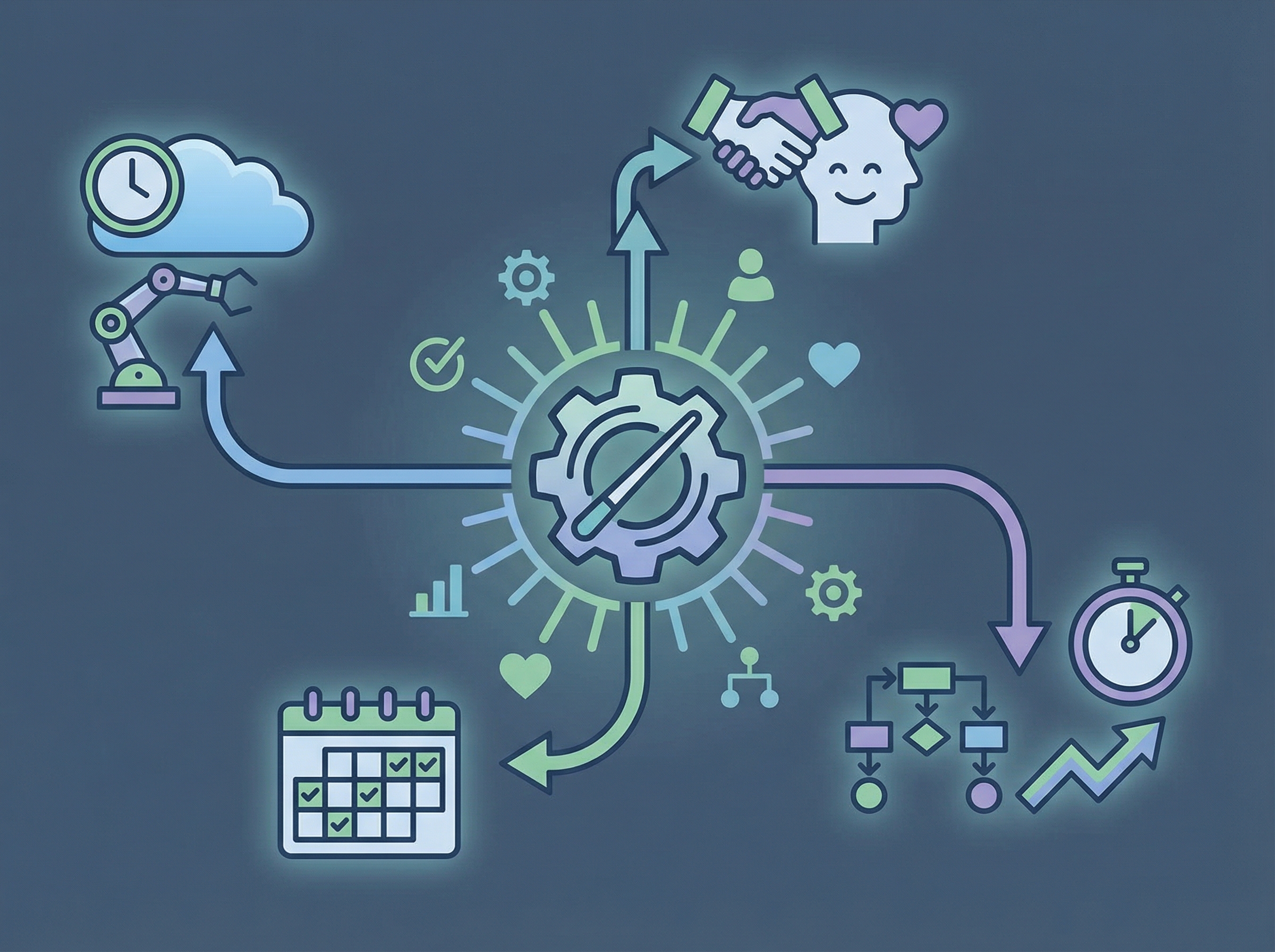
The workflow is completely seamless: Intake → Resume Screening → AI Interviews → Orchestrated Panel Interviews → Calibration Decision → Offers → Automated Background checks. There is no manual email chasing, no double-booking, and no candidate left in the dark. Every step is governed by structured interviews, ensuring that all interviewers know exactly which competencies they are assigned to evaluate.
The Turning Point
The breakthrough moment for Sarah's team happened during a high-stakes hiring sprint for five senior engineering roles. In the past, coordinating 15 separate panel interviews would have taken three weeks of administrative overhead. With the orchestration system in place, all 15 interviews were locked onto the calendar within 48 hours of the candidates passing their initial screens.
The before-and-after metrics were staggering. By applying orchestration, Sarah's team saved an average of 18 hours per week on coordination tasks. The candidate pass-through rate from screening to panel interview jumped from 55% to 85%, directly attributed to fewer candidate drop-offs. Because the system automatically appended interview scorecards to the calendar events, interviewer compliance skyrocketed. Hiring managers submitted their feedback within 24 hours of the interview, enabling the team to move straight to the offer stage. This alignment proved that when logistics get out of the way, human decision-making becomes sharper, faster, and more unified.
The true power of interview schedule orchestration isn't just saving time—it's preserving the momentum of candidate excitement and turning speed into a competitive advantage.
Core Insights, Pitfalls, and Tradeoffs
Actionable Heuristics
Applying these systems requires discipline. Here are four actionable best practices to master interview schedule orchestration:
- Standardize Availability Windows: Force hiring managers to block out 4–6 hours of dedicated "interview time" per week during active searches. The orchestration software can only book seamlessly if there is guaranteed inventory on the calendar.
- Utilize Structured ATS Workflows: Ensure your stages are tightly defined. A candidate should automatically receive a scheduling link the moment they are moved into the "Interview to be Scheduled" stage in your ATS.
- Centralize Your Tech Stack: Use comprehensive tools rather than disjointed apps. Integrate your AI interview platform directly with your calendar and scorecard system so data flows without manual data entry.
- Automate Post-Interview Logistics: Orchestration doesn't end at the interview. Trigger automated reminders for interviewers to complete their feedback, and automatically initiate background checks the moment offers are verbally accepted.
Common Misconceptions
Even the best strategies can fail if implemented poorly. Avoid these common pitfalls:
- Over-automating without a human touch: Relying purely on automated links can feel cold. Always include personalized messaging variables and provide an easy way for candidates to reach a human if they run into technical issues.
- Ignoring time zone complexities: In a remote-first world, assuming everyone operates on the same local time is a fatal error. Failing to configure your system to detect and adjust to the candidate's local time zone will lead to missed interviews and frustration.
- Failing to calibrate interview scorecards: Orchestrating the time is useless if the evaluation is disorganized. A major pitfall is scheduling a seamless panel interview but forgetting to assign specific, calibrated questions to each interviewer, resulting in overlapping questions and poor candidate experience.
Pros and Cons
While the benefits are vast, talent leaders must weigh the operational realities before fully committing to new systems.
| Benefit | Tradeoff |
|---|---|
| Drastic reduction in time-to-hire and administrative hours spent on calendar coordination. | Requires heavy initial setup time to map workflows, integrate the ATS, and train hiring managers on calendar hygiene. |
| Significantly lower candidate drop-off rates due to frictionless, real-time self-service scheduling. | Strict reliance on up-to-date calendars; if hiring managers do not maintain their availability accurately, the system breaks down and causes friction. |
| Enhanced data tracking for bottlenecks and better interviewer compliance with structured interviews. | Can feel impersonal to senior-level or executive candidates who may expect high-touch, concierge-level coordination. |
Career Relevance and Orchestration FAQs
Differentiating Your Career
For recruiters, HR teams, and talent leaders, mastering interview schedule orchestration is a major career differentiator. In an era where hiring workflow automation is paramount, professionals who can architect seamless systems are elevated from tactical administrators to strategic talent leaders. If you are interviewing for a Talent Acquisition Operations or Senior Recruiter role, you need to speak the language of scale, velocity, and efficiency.
Q: "How have you applied interview schedule orchestration to improve outcomes?"
A: "I standardized hiring manager availability blocks and calibrated our ATS triggers. This streamlined our panel coordination, reduced our time-to-schedule by 60%, and improved our candidate pass-through rate, all while ensuring 100% compliance on interview scorecards."
To stand out in the job market, include resume bullets like these:
- Architected an end-to-end interview schedule orchestration process, reducing time-to-schedule from 14 days to 48 hours.
- Streamlined talent acquisition workflows by integrating an AI interview platform with existing ATS infrastructure, decreasing candidate drop-off by 30%.
- Standardized and calibrated structured interviews across 15 departments, resulting in faster decision-making and a 40% reduction in overall time-to-hire.
- Automated post-interview workflows, including scorecard reminders, offers, and background checks to ensure a frictionless candidate experience from start to finish.
Frequently Asked Questions
What is interview schedule orchestration?
It is the strategic automation and alignment of multi-stage interview logistics. By syncing calendars, standardizing availability, and using automated triggers within an ATS, orchestration removes manual coordination, accelerates time-to-hire, and ensures a seamless candidate experience.
Why is candidate drop-off so high during scheduling?
Candidates lose interest or accept competing offers when communication is slow. Research confirms that 42% of candidates abandon the hiring process due to scheduling delays. Orchestration solves this major bottleneck by enabling real-time, self-service booking.
Can interview schedule orchestration backfire?
Yes. If hiring managers fail to keep their calendars updated, the system will double-book or offer unavailable slots. Additionally, over-automation without personalized communication can alienate executive candidates who expect a high-touch, concierge scheduling experience.
How does this integrate with structured interviews?
Orchestration systems automatically attach specific rubrics and interview scorecards to the calendar invites of designated interviewers. This ensures every panel member knows exactly which competencies to evaluate before the interview even begins.
Conclusion and CTA
The future of recruitment belongs to those who view logistics not as a barrier, but as a lever for growth. Mastering interview schedule orchestration creates a durable hiring advantage by prioritizing speed, respecting the candidate's time, and liberating your team to focus on human connection rather than calendar management.
If you want to operationalize interview schedule orchestration with structured workflows (Sourcing → resume screening → AI interviews → scorecards → offers → background checks), try tools like Foundire (https://foundire.com).