How to Create a Hiring Manager Screen Guide

How to Create a Hiring Manager Screen Guide
What is a Hiring Manager Screen Guide?
Defining the Screen Guide
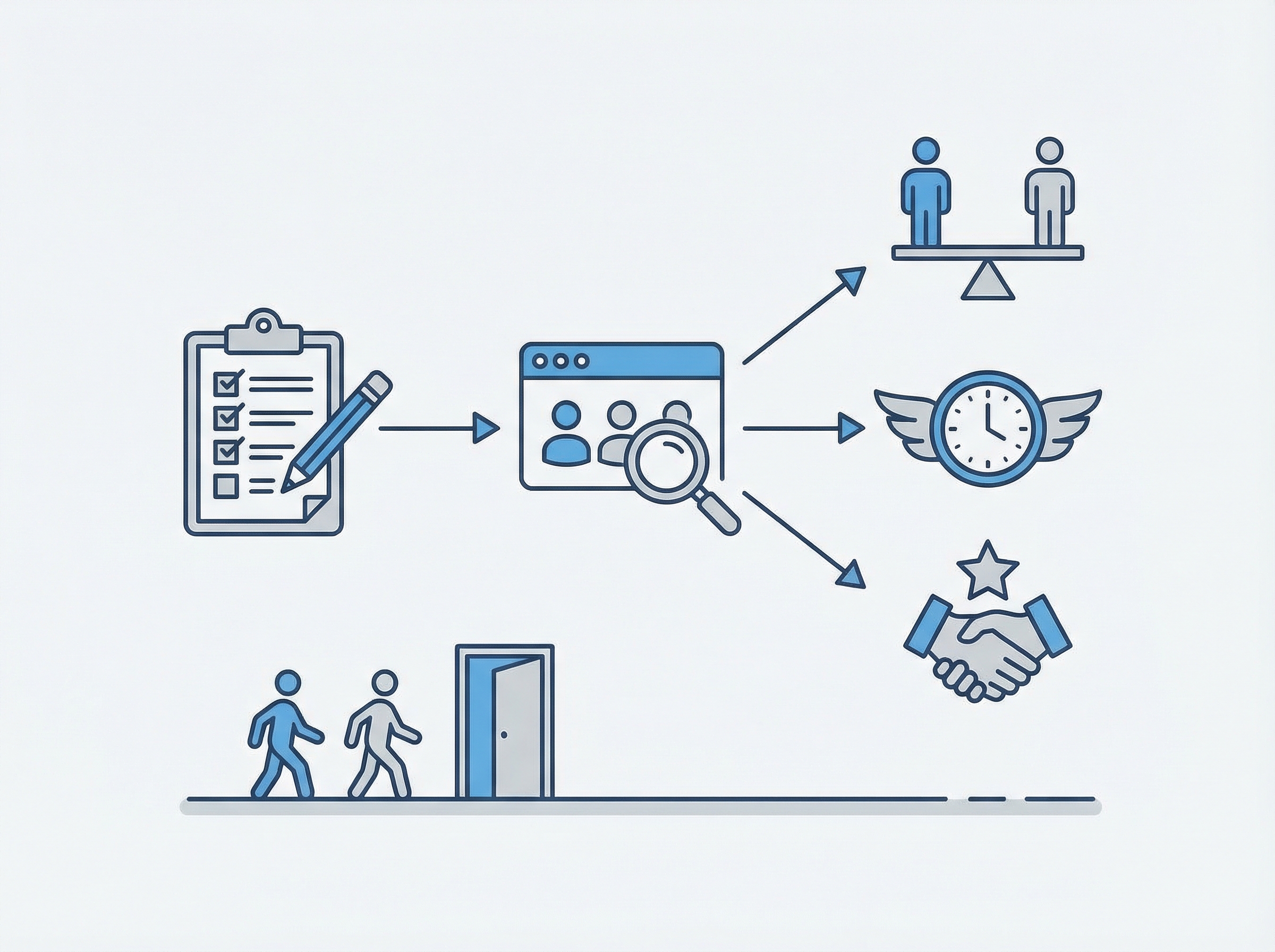
A hiring manager screen guide is a structured, standardized document used to evaluate job candidates during their initial interview with a hiring manager. It matters because it transforms subjective, gut-feeling conversations into objective, data-driven assessments. By defining exact questions, core competencies, and a clear scoring rubric, a hiring manager screen guide directly improves the candidate experience, accelerates speed-to-hire, and drastically enhances overall hiring results. Without this framework, talent acquisition teams suffer from inconsistent feedback, biased decision-making, and lengthy delays. In an era where a single job posting can attract hundreds of applicants, having a systematic approach to screening is no longer optional; it is the foundation of effective talent acquisition.
Consider Sarah, a VP of Sales at a rapidly scaling SaaS company. Last quarter, she was drowning in interviews, yet her team’s open roles remained unfilled for over 60 days. Her process was entirely ad-hoc: she would quickly glance at a resume minutes before dialing into a call, asking whatever questions came to mind in the moment. The result was pure inefficiency. Because she lacked a standardized way to evaluate candidates, her feedback to recruiters was vague, leading to constant misalignment, repeated candidate drop-offs, and dozens of wasted hours. This is the exact problem a hiring manager screen guide is designed to solve.
The Cost of Inconsistency
When hiring managers wing their interviews, the financial and operational costs are staggering. According to 2025 and 2026 data from the U.S. Department of Labor and SHRM, the average cost of a bad hire is at least 30% of the employee’s first-year earnings. For specialized roles, that number can skyrocket to over $200,000 when factoring in lost productivity, onboarding expenses, and team disruption. Without a hiring manager screen guide, companies practically invite these costly mistakes into their organizations.
Furthermore, unstructured interviews are notorious for introducing unconscious bias. When a hiring manager lacks a structured baseline, they tend to hire candidates they personally like or who share similar backgrounds, rather than those most qualified for the job. By implementing a standardized guide, organizations ensure that every candidate is evaluated against the same criteria. This not only protects the company from compliance risks but also creates a more equitable and inclusive hiring environment that top talent expects in today's competitive job market.
Real-World Scenario: Fixing a Broken Process
The Workflow Breakdown
To understand the transformative power of a hiring manager screen guide, let’s look at a concrete recruiting workflow before and after its implementation. Meet David, a Senior Technical Recruiter, and Marcus, the Director of Engineering. Their typical hiring workflow looked like this: intake, sourcing, resume screening, the hiring manager screen, a technical panel interview, a final decision, offers, and background checks. In theory, this funnel makes sense. In practice, it was deeply broken at the manager screening stage.
Because Marcus didn't use an interview scorecard or a structured guide, his pass-through rate from the manager screen to the technical panel was an abysmal 15%. Out of 40 candidates that David sourced and vetted, Marcus would reject 34 of them based on arbitrary criteria like "they didn't seem passionate enough" or "they didn't know the exact syntax I prefer." Even worse, because the questions varied wildly from candidate to candidate, David could never calibrate his sourcing strategy to find what Marcus actually wanted. This misalignment resulted in a bloated time-to-hire of 75 days, massive candidate frustration, and approximately 30 wasted interview hours per month for the engineering leadership team.
The Breakthrough Moment
The turning point arrived when David introduced a formal hiring manager screen guide integrated directly into their ATS. Together, David and Marcus built a standardized 30-minute interview protocol. The guide included an opening script to set expectations, three mandatory behavioral questions tied to company values, two technical probing questions, and a strict 1-to-5 scoring rubric. They explicitly agreed that this screen was meant to assess core competencies and team fit, not to serve as an exhaustive technical deep-dive.
The impact was immediate and measurable. By applying the hiring manager screen guide, Marcus eliminated his improvisational style. The pass-through rate from the screening stage to the final panel jumped from 15% to 45%, meaning fewer candidates were unfairly rejected early on. Candidate drop-offs plummeted because applicants felt they were treated fairly and evaluated on job-relevant skills. Most importantly, the breakthrough moment saved Marcus over 15 hours of interview time per month, allowing him to focus on managing his team rather than endlessly repeating misaligned interviews. The hiring decision became a unified, data-backed consensus rather than a debate over conflicting gut feelings.
Best Practices & Career Impact of Screening Guides
Core Insights and Pitfalls
Implementing a successful screening strategy requires more than just writing down a few questions. Talent leaders and hiring managers must adhere to proven heuristics. Here are four actionable best practices:
- Leverage Structured Interviews: Research shows that structured interviews are twice as effective at predicting job performance compared to unstructured conversations. Ensure your guide maps every question to a specific skill or competency required for the role.
- Utilize Interview Scorecards: Do not rely on narrative feedback. Force interviewers to use standardized scorecards within your ATS. This quantifies candidate performance and makes calibration meetings infinitely more productive.
- Integrate with Modern Tech: Use an AI interview platform or hiring workflow automation to transcribe and summarize screens. This allows the manager to remain fully engaged with the candidate instead of furiously typing notes.
- Calibrate Early and Often: After the first three screens, the recruiter and hiring manager should review the scorecards together to ensure the guide is actually filtering for the right talent.
Despite these best practices, teams often stumble. Here are three common pitfalls and misconceptions to avoid:
- Treating the Screen Like a Final Interview: A screen is a mutual exploration, not an interrogation. Trying to cram a three-hour technical assessment into a 30-minute call will alienate candidates and damage your employer brand.
- Ignoring the Candidate's Questions: If your guide doesn't leave 5 to 10 minutes at the end for the candidate to ask questions, you are failing at candidate experience. Top talent is interviewing you just as much as you are interviewing them.
- Rigidity Over Rapport: While structure is critical, reading questions like a robot ruins the conversational flow. The guide should act as a reliable compass, not a rigid script that prevents human connection.
Pros & Cons Table
| Benefit | Tradeoff |
|---|---|
| Higher Predictive Validity: Standardized questions drastically improve your ability to predict future job performance and reduce the risk of costly bad hires. | Initial Setup Time: Designing customized guides, defining rubrics, and securing alignment from busy hiring managers requires significant upfront effort. |
| Eliminates Unconscious Bias: Every candidate is measured against the same objective scorecard, ensuring fairness and legal compliance in your hiring practices. | Perceived Loss of Flexibility: Some veteran managers may push back, feeling that structured frameworks prevent them from following their "gut instinct." |
| Faster Decision Making: Quantifiable data from ATS scorecards allows recruiting teams to make confident, rapid decisions, reducing time-to-hire. | Requires Continuous Updating: As the role or market evolves, the guide must be actively maintained so questions remain relevant to current business needs. |
Career Relevance for Recruiters
For recruiters and talent leaders, mastering the design and implementation of a hiring manager screen guide is a massive career differentiator. In a market flooded with applications, executives want talent acquisition partners who operate like strategic consultants, not just order-takers. When you can prove that your structured workflows save engineering hours and increase retention, your value skyrockets.
Q: “How have you applied a hiring manager screen guide to improve outcomes?”
A: “I standardized our initial evaluation phase by designing customized interview scorecards and structured guides for our engineering leadership. By calibrating our rubrics and streamlining the feedback loop inside our ATS, we reduced manager interview hours by 20%, improved our pass-through rate to the final panel by 30%, and ultimately eliminated systemic bottlenecks that were delaying our offers.”
To showcase this strategic capability on your profile, consider adding these concise resume bullets:
- Standardized hiring workflows by creating role-specific hiring manager screen guides, reducing average time-to-fill by 18 days.
- Calibrated interview scorecards across 5 departments, eliminating gut-based decisions and increasing early-stage pass-through rates by 25%.
- Streamlined talent acquisition operations from sourcing to background checks, integrating structured interviews into the ATS for seamless reporting.
- Reduced first-year attrition by 15% through the implementation of objective, competency-based screening rubrics.
Frequently Asked Questions & Closing
Essential FAQs
What is a hiring manager screen guide?
A hiring manager screen guide is a structured template used during the first official interview. It outlines the specific behavioral and technical questions to ask, the core competencies to evaluate, and a standardized scoring rubric to ensure every candidate is judged fairly and objectively.
Can a hiring manager screen guide backfire?
Yes, if it is implemented too rigidly. If a manager reads the guide like a script without building rapport, it creates a cold, robotic candidate experience. Furthermore, if the guide is packed with unrealistic requirements, it can prematurely screen out highly capable talent.

How long should the hiring manager screen take?
Typically, this screen should last between 30 and 45 minutes. It is meant to assess high-level alignment, team fit, and baseline technical competency, leaving deeper evaluations for later panel rounds or dedicated assessments.
Why is an interview scorecard necessary?
An interview scorecard forces the hiring manager to quantify their feedback immediately after the call. This prevents "halo" or "horn" biases and gives recruiters actionable data to make quick decisions on advancing or rejecting the candidate.
Creating a Durable Hiring Advantage
In the end, hiring is not a guessing game; it is a critical business operation. Relying on unstructured conversations and intuition is a surefire way to bleed resources, frustrate your talent acquisition team, and lose top tier candidates to competitors who move with conviction. Mastering the hiring manager screen guide creates a durable hiring advantage because it builds an engine of consistency. When you standardize your evaluations, you strip away bias, you accelerate your decision-making, and you dramatically elevate the candidate experience.
If you want to operationalize a hiring manager screen guide with structured workflows—from sourcing and resume screening to AI interview platforms, scorecards, offers, and background checks—try tools like Foundire (https://foundire.com).