How to Build an Interview Prep Packet

How to Build an Interview Prep Packet
What is an Interview Prep Packet and Why It Matters
Defining the Interview Prep Packet
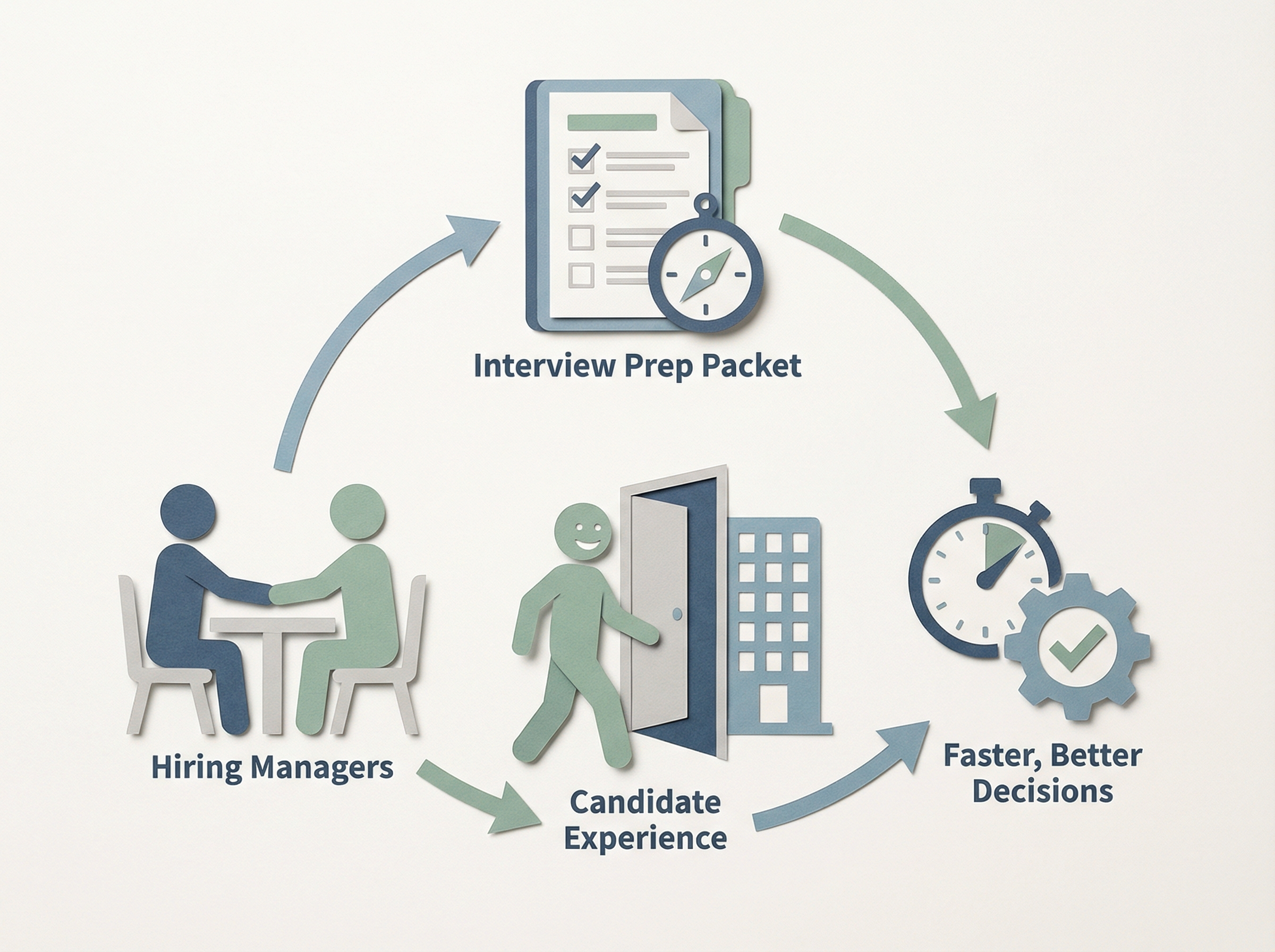
An interview prep packet is a centralized guide containing role context, structured interview questions, evaluation scorecards, and logistical details designed to align interviewers and candidates. In the modern talent acquisition landscape, disorganized hiring is incredibly costly. A comprehensive interview prep packet ensures interviewers know exactly what to ask and candidates understand how they will be evaluated. This eliminates duplicate questions, standardizes the evaluation criteria, and vastly improves the candidate experience.
Why does this matter? According to recent data from 2026, structured interviews can produce a 52% increase in the quality of hire while reducing hiring bias. For HR teams looking to improve hiring speed, consistency, and overall results, creating an interview prep packet is the foundational step before scaling with hiring workflow automation or an AI interview platform. By standardizing these essential assets, recruiters remove the guesswork from the hiring process and replace it with a measurable, scalable engine.
A Real-World Recruiting Nightmare
To understand the sheer value of this tool, consider the story of Sarah, a Lead Recruiter at a fast-growing tech enterprise. Sarah was drowning in a chaotic, disorganized engineering hiring loop. Her initial job intake was highly detailed, and the first stage of resume screening went perfectly. However, the moment candidates reached the panel interview stage, the entire system fractured.
Because there was no unified documentation, hiring managers and panel members were forced to wing their questions. Three different engineers would ask the candidate the exact same generic questions about their coding background, completely neglecting essential behavioral and system design queries. The results were disastrous. Candidate drop-off rates spiked to 40% mid-funnel, largely because top talent felt their time was being wasted and disrespected. Furthermore, hiring decisions were delayed by weeks because interviewers couldn't agree on what they were evaluating. Without clear interview scorecards and a standardized process, Sarah’s team was bleeding top-tier engineering talent to faster, more organized competitors.
Core Insights and Practical Takeaways
Actionable Best Practices
Building an effective interview prep packet requires more than just throwing a job description into a document. It requires strategic alignment. Here are four actionable heuristics to ensure your packets actually improve hiring outcomes:
- Standardize intake data and scorecard criteria directly inside your ATS: Do not rely on scattered emails or isolated documents. Embed your interview prep packet components—especially the specific competencies and interview scorecards—directly into your Applicant Tracking System (ATS). This ensures that every interviewer has immediate, frictionless access to the evaluation criteria before they jump on a call.
- Incorporate calibration notes and structured interview guidelines: Over 72% of companies now use structured interviews to ensure a standardized approach to candidate evaluation. Your prep packet should explicitly state who is asking what. Assign specific topics (e.g., technical skills, cultural add, conflict resolution) to distinct interviewers to prevent overlap and ensure comprehensive candidate evaluation.
- Create a tailored, candidate-facing version: Interview anxiety prevents great candidates from showing their true potential. Build a condensed version of the interview prep packet specifically for candidates. Include logistical details, names and LinkedIn profiles of the interviewers, and the core themes they should be prepared to discuss. Transparency equalizes the playing field.
- Connect the packet to downstream actions: Ensure the packet links naturally to the next steps in your hiring workflow automation, such as transitioning successfully evaluated candidates to the offers stage and initiating background checks without delay.
Common Pitfalls to Avoid
Even well-intentioned talent acquisition teams make mistakes when deploying these packets. Watch out for these three common pitfalls:
- Overloading the packet with jargon: A prep packet should be a quick reference guide, not a dense novel. If it takes a hiring manager more than five minutes to digest the core questions and rubrics, they simply will not use it. Keep the language concise and action-oriented.
- Ignoring behavioral competencies: While technical skills are vital, failing to include structured behavioral questions (such as those using the STAR method) leaves massive gaps in candidate evaluation. Ensure your packet clearly defines what a "good" versus "bad" behavioral response looks like.
- Failing to update the guide as role requirements shift: A stagnant prep packet is a useless one. As the needs of a role pivot during a prolonged search, recruiters must calibrate and update the interview prep packet. Interviewers using outdated questions will generate conflicting scorecard data, stalling the final hiring decision.
Pros & Cons Analysis
| Benefit | Tradeoff |
|---|---|
| Drives hiring consistency: Standardized questions and rubrics eliminate bias and ensure every candidate is evaluated fairly on the exact same metrics. | Requires upfront time investment: Talent leaders and hiring managers must dedicate significant time during the intake phase to build comprehensive guidelines. |
| Accelerates hiring decisions: Clear scorecards mean debriefs take minutes instead of days, drastically reducing overall time-to-hire. | Risk of robotic interviews: If interviewers read strictly from the packet without conversational flow, the candidate experience can feel overly scripted and unnatural. |
| Boosts candidate experience: Providing a candidate-facing packet reduces anxiety, limits duplicate questions, and signals high organizational competence. | Requires manager enforcement: The system only works if managers actually read and adhere to the packet. Lack of compliance renders the packet useless. |
The Breakthrough Moment and Career Relevance
Turning the Hiring Loop Around
Let’s return to Sarah. Realizing that the lack of structure was destroying her talent pipeline, she halted the engineering hiring loop and enforced a mandatory interview prep packet for every open requisition. She mapped out specific question banks for each interviewer, implemented strict ATS-integrated scorecards, and sent out a candidate-facing brief 48 hours before every interview.
The breakthrough was immediate and measurable. Because interviewers were no longer duplicating questions or relying on gut feelings, post-interview debriefs became highly objective, data-driven conversations. Sarah dropped her average time-to-hire by 12 full days. More importantly, candidate feedback scores skyrocketed, and the pass-through rate from panel to offer stage boosted by 25%. Candidates felt respected, managers felt prepared, and the chaotic hiring nightmare was transformed into a sleek, predictable machine.
Mastering Prep Packets for Career Growth
For recruiters and talent leaders, the ability to build and enforce an interview prep packet is a massive career differentiator. It signals the transition from a transactional recruiter (someone who just sources resumes) to a strategic talent advisor (someone who engineers high-performing hiring systems).
Mastering the creation of structured interview assets elevates your professional brand. It proves you understand how to align cross-functional teams, reduce operational drag, and directly impact a company's bottom line through better hiring efficiency.
If you are interviewing for a senior talent acquisition or HR leadership role, you must be prepared to articulate this impact. Consider this Q&A snippet:
Q: "How have you applied an interview prep packet to improve outcomes?"
A: "In my previous role, our engineering interviews were highly unstructured, leading to a 40% mid-funnel drop-off. I designed and deployed a standardized interview prep packet that assigned specific technical and behavioral competencies to each panelist, backed by clear scorecards. This calibrated our hiring managers, streamlined our debriefs, and reduced our overall time-to-hire by 12 days while boosting our offer acceptance rate."
To highlight this expertise on your resume, use concrete, action-oriented bullets such as:

- Standardized interview prep packets across 15 departments, aligning cross-functional hiring panels and reducing time-to-hire by 20%.
- Calibrated evaluation metrics by integrating targeted interview scorecards into the ATS, eliminating duplicate questioning and reducing interviewer bias.
- Streamlined the candidate experience by designing transparent pre-interview guides, resulting in a 25% increase in positive candidate feedback scores.
- Partnered with engineering leadership to build structured interview frameworks, transitioning the team from gut-feeling decisions to data-driven hiring.
Frequently Asked Questions and Next Steps
Essential FAQs
What is an interview prep packet?
An interview prep packet is a comprehensive document used in talent acquisition that provides interviewers with job context, structured questions, and evaluation scorecards. It ensures hiring panels are aligned, prevents duplicate questions, and establishes objective criteria for evaluating candidates, ultimately driving faster and fairer hiring decisions.
Can an interview prep packet backfire?
Yes. If hiring managers rely too rigidly on the packet and read questions verbatim without engaging in active listening, the interview can feel robotic and impersonal. Additionally, if the packet is overloaded with complex jargon or isn't updated as the role evolves, it can create misalignment rather than solving it.
How does it integrate with an AI interview platform?
An interview prep packet serves as the foundational data layer. When using an AI interview platform, the structured questions, desired competencies, and baseline rubrics defined in the prep packet are fed into the AI. This allows the system to conduct consistent preliminary screenings and generate accurate, objective data for human recruiters to review.
Operationalizing Your Hiring Strategy
Building an interview prep packet is not a one-time administrative task; it is the cornerstone of a modern, data-driven hiring framework. By standardizing your interview process, you eliminate the friction that causes top talent to abandon your pipeline. You empower your hiring managers to make confident, unbiased decisions, and you build a reputation as an employer that respects a candidate's time and effort.
Mastering the interview prep packet creates a durable hiring advantage. It is the bridge between sourcing great talent and successfully closing them.
If you want to operationalize an interview prep packet with truly structured workflows—seamlessly moving from sourcing to resume screening, utilizing an AI interview platform, leveraging integrated scorecards, extending offers, and managing background checks—try tools like Foundire (https://foundire.com).