How to Build a Risk Flags Checklist

How to Build a Risk Flags Checklist for Smarter Hiring
Understanding the Risk Flags Checklist
What It Is and Why It Matters
In the high-stakes world of talent acquisition, what is a risk flags checklist? It is a standardized, objective tool used by recruiters and talent leaders to identify potential candidate issues or deal-breakers as early as possible in the hiring workflow. By systematically scoring early warning signs, a risk flags checklist dramatically improves hiring speed, assessment quality, and process consistency. More importantly, it enhances the overall candidate experience by preventing misaligned talent from enduring weeks of rigorous interviews, ultimately improving final hiring results and reducing costly late-stage drop-offs.
Picture this scenario: a dedicated recruiter spends hours sourcing, screening, and shepherding a brilliant candidate through four rounds of late-stage interviews. The hiring committee is thrilled and ready to extend an offer. However, during the final sync, they discover a basic background issue—a non-compete agreement or an absolute salary misalignment—that should have been caught during the initial intake call. The time wasted on these dead-end interviews is a brutal drain on organizational resources, pulling engineers away from building products and souring the candidate's view of the company.
The Cost of Ignoring Early Warning Signs
Without a structured approach to risk identification, recruiting teams often rely on subjective gut feelings and scattered, unstructured notes. This creates a deeply inefficient environment where true red flags—such as severe timeline mismatches, fundamental communication hurdles, or unverified technical claims—slip through the cracks until the final stages of the process. The financial and operational cost of ignoring early warning signs is astronomical. According to industry analyses of hiring workflow automation, replacing a bad hire or restarting a mature search can cost a business upwards of 30% of that role's first-year salary.
When you implement a risk flags checklist, you are fundamentally shifting your talent acquisition strategy from reactive to proactive. You empower your team to ask the difficult questions during the initial resume screening and early conversations, ensuring that only the most viable, aligned candidates progress to the costly phases of deep technical evaluations and executive interviews.
Real-World Scenario: Catching Red Flags Early
The Traditional vs. Checklist-Driven Workflow
To see how transformative this can be, let’s look at a concrete, end-to-end hiring scenario. Mark, a Senior Recruiter at a fast-growing tech company, and Elena, the VP of Engineering (and the Hiring Manager), were navigating a critical engineering hiring sprint. They needed to hire six senior full-stack developers within a quarter. Initially, their workflow followed a traditional path: basic intake, rapid resume screening, an AI video interview, a deep-dive technical interview, a final executive decision, the offer stage, and finally, background checks.
The traditional method was faltering. Candidates were breezing through the resume screening stage, but they were fundamentally misaligned on core working hours, remote-work expectations, and baseline system-design knowledge. Mark was spending hours conducting uncalibrated phone screens, passing candidates to Elena based on a "good feeling." Elena’s team was overwhelmed with technical interviews for candidates who never should have advanced.
Measuring the Funnel Impact
Before implementing a structured risk flags checklist, the metrics were bleak. A staggering 60% of candidates were failing at the technical screen, meaning engineers were wasting dozens of hours per week assessing unqualified talent. Furthermore, 15% of candidates who actually passed the technical bar ended up rejecting the final offer due to timeline or compensation mismatches that were present from day one.
Realizing the process was broken, Mark and Elena collaborated to build a comprehensive risk flags checklist during their next intake session. They mapped out specific, objective behavioral and logistical risks: evasiveness on compensation, lack of clarity on past project ownership, and refusal to undergo standard background checks. Once implemented, Mark used the checklist during the initial screening phase. The impact on the funnel was immediate and measurable. By disqualifying misaligned candidates early, the checklist reduced wasted engineering interviews by 40%, while the pass-through rate from the technical screen to the final offer skyrocketed. Elena’s team interviewed fewer people but hired at a significantly faster and more consistent velocity.
Core Insights and Practical Takeaways
Actionable Heuristics for Application
Applying a risk flags checklist effectively requires more than just jotting down a few bullet points. It requires strategic integration into your existing hiring architecture. Here are several actionable heuristics to maximize its impact:
- Link risk flags directly to job requirements during intake: Do not use a generic list for every role. During the initial intake meeting with the hiring manager, define what constitutes a critical risk for that specific position. For a sales role, reluctance to discuss quota attainment is a flag; for engineering, an inability to articulate past architectural trade-offs is a flag.
- Automate initial flags using an AI interview platform: Leverage modern hiring workflow automation. You can set up your AI interview platform to automatically flag candidates who fail to answer baseline logistical questions or whose responses lack the depth required for the role, saving human recruiters hours of manual review.
- Standardize evaluations with interview scorecards: A risk flags checklist is most effective when paired with structured interview scorecards. Ensure every interviewer knows exactly which potential flags they are probing for and require them to rate the candidate based on standardized criteria.
- Trigger automated background checks seamlessly: Link the resolution of late-stage risk flags directly to your background screening provider through your ATS, ensuring compliance without stalling the momentum of the offer stage.
Common Pitfalls to Avoid
While a risk flags checklist is a powerful tool, misusing it can severely damage your talent acquisition efforts. Be mindful of these common pitfalls:
- Confusing a "skills gap" with a "risk flag": A candidate lacking experience in a specific, highly teachable software tool is a skills gap. A candidate who lies about their employment history is a risk flag. Do not arbitrarily disqualify great candidates because you confuse trainability with toxicity.
- Relying on subjective gut feelings: The entire point of the checklist is objectivity. If your checklist includes vague items like "bad cultural fit" or "weird vibe," you are inviting unconscious bias back into your process. Flags must be measurable and behaviorally rooted.
- Applying the checklist inconsistently: If you only run the checklist on certain candidates and not others, you open your organization to compliance risks and undermine the integrity of your structured interviews. It must be a uniform step in your ATS workflow.
The Breakthrough Moment and Career Impact
Transforming the Hiring Outcome
The breakthrough moment in any hiring transformation occurs when the hiring committee experiences their first calibration meeting post-implementation. Before the risk flags checklist, calibration meetings were often arguments based on differing interpretations of a candidate's personality. After implementation, the conversation shifts to objective data. The team can clearly see that a candidate triggered a "flight risk" flag during the recruiter screen and a "collaboration" flag during the technical screen. The decision alignment becomes instantaneous.
This level of structured assessment ensures that fewer candidates drop off due to unexpected surprises, and time-to-hire is significantly reduced. It fundamentally protects the integrity of the offer stage, ensuring that by the time an offer is drafted, all critical hurdles—including expectations regarding background checks—have been thoroughly cleared.
| Benefit | Tradeoff |
|---|---|
| Measurable consistency and alignment across all candidates | Requires significant initial setup time and stakeholder alignment |
| Faster resume screening and elimination of early-stage bottlenecks | Needs regular updating and auditing to remain relevant to the market |
| Reduces subjective bias and gut-feeling rejections | Can lead to false negatives if rigidly applied without human nuance |
Differentiating Yourself in Talent Acquisition
For recruiters and talent leaders, mastering the development and execution of a risk flags checklist elevates your career from a purely operational function to a deeply strategic partnership. It proves to business leaders that you understand how to protect their time and their bottom line.
Q: “How have you applied a risk flags checklist to improve hiring outcomes?”
A: “I standardized our early-stage assessment by building a role-specific risk flags checklist integrated directly into our ATS scorecards. By calibrating our team on these objective criteria, I streamlined the initial screening process, reduced late-stage drop-offs, and improved our technical pass-through rate by 35% within one quarter.”
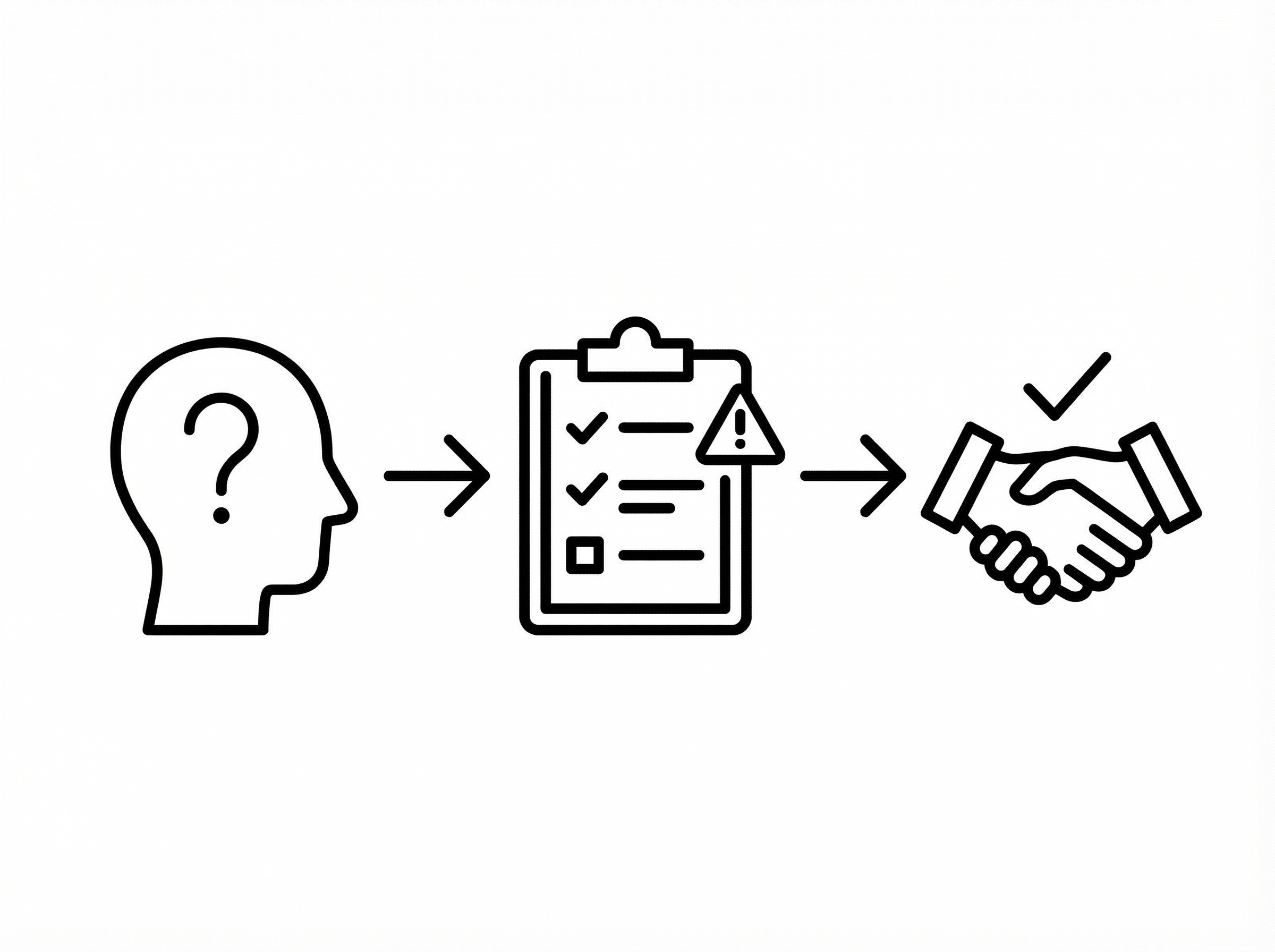
To effectively showcase this expertise on your resume or LinkedIn profile, consider using these concise, impact-driven bullet points:
- Designed and implemented a standardized risk flags checklist, reducing late-stage candidate drop-offs by 25% and saving 40+ engineering hours per month.
- Calibrated hiring managers on objective structured interviews, eliminating subjective bias and improving offer acceptance rates to 92%.
- Integrated early-warning risk assessments into AI interview platform workflows, streamlining the talent pipeline from initial sourcing to background checks.
- Partnered with executive leadership to redefine intake procedures, aligning early-stage candidate screening strictly with core business objectives.
Essential FAQs and Conclusion
Frequently Asked Questions
What is a risk flags checklist?
A risk flags checklist is a standardized, objective tool used by recruiters and hiring managers to proactively identify candidate deal-breakers early in the hiring process. It maps out specific behavioral, logistical, and technical warning signs—such as severe compensation misalignment or evasive answers—preventing unqualified candidates from advancing to costly late-stage interviews and improving overall hiring consistency.
Can a risk flags checklist backfire?
Yes, it can backfire if the criteria are overly rigid or rooted in subjective bias. If recruiters use the checklist to automatically disqualify diverse candidates based on non-essential traits rather than objective behavioral data, it creates false negatives and shrinks your talent pool artificially. It requires human nuance to interpret the flags correctly.

When should the checklist be introduced in the workflow?
The checklist should be developed during the initial intake meeting with the hiring manager. It must then be actively applied during the very first interaction with the candidate, typically during resume screening or the initial recruiter phone screen, long before any deep technical assessments.
How does this integrate with modern ATS platforms?
A strong checklist is built directly into the interview scorecards within your Applicant Tracking System. This ensures that every interviewer is prompted to evaluate the same potential risks, creating an auditable, data-driven trail that simplifies final calibration meetings.
Operationalizing Your Checklist
Mastering the risk flags checklist creates a durable hiring advantage for your organization. By moving away from gut-feeling recruiting and embracing structured, objective data, you protect your most valuable resources: your team's time and your company's culture. Systematic early detection is the absolute foundation of scaling a high-performing talent acquisition engine.
If you want to operationalize your risk flags checklist with structured workflows—from sourcing and resume screening through AI interviews, interview scorecards, offers, and automated background checks—try tools like Foundire (https://foundire.com).