Why Semantic Matching Beats Keywords

Why Semantic Matching Beats Keywords
The Evolution of Resume Screening
Defining the Core Difference
If you have ever felt the frustration of rejecting hundreds of applicants only to realize you missed the perfect hire, you are likely a victim of keyword matching. The fundamental difference between keyword matching and semantic matching comes down to one concept: syntax vs. intent.
Keyword matching (the old standard) relies on exact character strings. If you search for "Java Expert" and a candidate writes "Senior Backend Engineer with 10 years in Spring Boot," a keyword-based ATS (Applicant Tracking System) often filters them out. It looks for the letters, not the meaning.
Semantic matching (the AI-driven standard) uses vector-based search to understand the intent behind the words. It knows that "Spring Boot" implies "Java" and that "Client Relations" is semantically similar to "Account Management."
The Search Intent Behind the Shift
Why are recruiters and talent leaders searching for this comparison now? Because the "apply blast" phenomenon—where candidates use AI to spam applications—has broken traditional filtering. According to reports from late 2025, nearly 95% of inbound applications in high-volume roles are now considered "inaccurate matches" when filtered by keywords alone. The industry is pivoting to semantic matching not just for speed, but to solve the massive "false negative" problem where qualified talent is invisible to the system.
The Outcome: Shifting to semantic matching typically results in a 40% increase in qualified candidates identified without spending a penny more on ads, simply by surfacing the people you already have.
The Hook: Imagine rejecting a candidate who built the exact system you need, simply because they called it "distributed ledger technology" and your search string demanded "Blockchain." That is the silent killer of hiring efficiency.
Scenario: The Cost of Rigid Filtering
The 'Sarah' Scenario
Let’s look at a real-world scenario involving Sarah, a Lead Technical Recruiter at a mid-sized fintech company. Sarah is tasked with hiring a "Principal Java Developer."
The Workflow (Before):
- Intake: Hiring Manager demands "Java," "Microservices," and "AWS."
- Configuration: Sarah inputs these exact terms into her legacy ATS as required Boolean strings.
- Inbound: 400 resumes arrive in 48 hours.
- Screening: The ATS filters out anyone missing "Microservices" or "AWS" exactly as written.
- Result: 350 candidates are auto-rejected. Sarah manually reviews the remaining 50. Most are "keyword stuffers"—candidates who listed every buzzword but lacked depth.
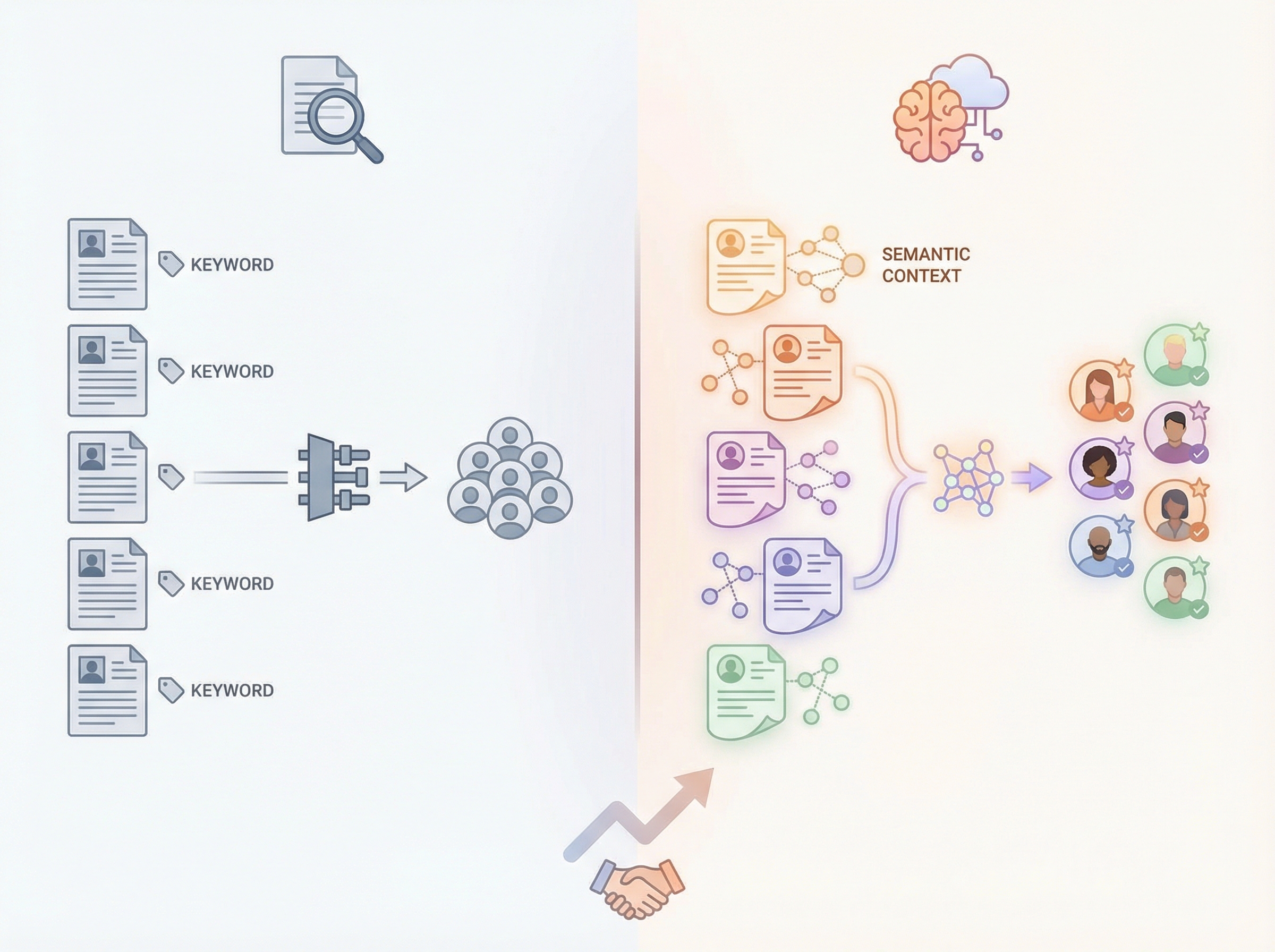
The Missed Opportunity: Hidden in the rejected pile was "Marcus." Marcus didn't list "Microservices." His resume said, "Architected event-driven distributed systems using Lambda and Kinesis." To a human expert, this is superior to generic "microservices" experience. To the keyword matcher, Marcus is a zero-match.
Measuring the Funnel Leak
The cost of this rigidity is measurable. In Sarah’s case:
- False Negatives: approximately 15% of the "rejected" pile were actually qualified.
- Time-to-Fill: Extended by 3 weeks because the "perfect" candidates were filtered out, forcing a second round of ad spend.
- Cost: $4,500 in additional agency fees and LinkedIn Recruiter seats to hunt for people who had already applied.
Core Insights: Context vs. Syntax
How Semantic Engines 'Read'
Semantic matching engines, often powered by Large Language Models (LLMs) or vector databases, treat skills as a graph rather than a checklist. They utilize Natural Language Processing (NLP) to map relationships between concepts.
Heuristic 1: Implicit Skill Recognition
If a candidate mentions "building CI/CD pipelines with Jenkins," the semantic engine infers skills like "DevOps," "Automation," and "Software Development Lifecycle," even if those words are missing.
Heuristic 2: Seniority Calibration
Keywords are blind to level. A "Manager" and an "Associate" might both list "Sales." Semantic analysis looks at the context of that word—did they "lead a team of 10 driving $5M revenue" (Senior) or "assist in generating leads" (Junior)?

3 Common Pitfalls of Keyword Reliance
- The Synonym Trap: Rejecting a "Content Marketer" because you searched for "Copywriter."
- The "Keyword Stuffing" Game: Candidates are now savvy; they paste job descriptions in white text or list every skill under the sun to beat the bot. Keyword matchers rank these liars at the top. Semantic matchers penalize them for lack of contextual depth.
- Boolean Fragility: Complex Boolean strings (e.g.,
("Java" AND "Manager") NOT "Intern") are brittle. One typo or unexpected job title variation breaks the entire search.
The Breakthrough: Operationalizing AI
Turning Point Metrics
When Sarah’s organization switched to a hiring workflow automation platform with semantic capabilities (like Foundire), the breakthrough was immediate.
Before/After Impact:
- Candidate Discovery: The system flagged Marcus (from the scenario above) as a 95% match based on his architectural experience, despite missing the exact keywords.
- Screening Efficiency: Sarah reduced her daily resume screening time by 15 hours per week.
- Pass-Through Rate: Candidates pushed to the structured interview stage increased from 12% to 22%, indicating higher quality matches.
Integration in the Tech Stack
Semantic matching doesn't live in a vacuum. It powers the entire funnel:
- Resume Screening: AI ranks candidates by fit, not keyword density.
- AI Interview Platform: The system generates dynamic interview questions based on the gaps identified in the semantic scan.
- Interview Scorecards: Human interviewers receive a "match report" highlighting areas to probe, ensuring calibration between the resume and reality.
Career Relevance for Recruiters
Mastering semantic workflows is no longer just a "nice to have"—it is a career differentiator. Hiring managers want Talent Acquisition partners who act as consultants, not just list-builders.
Q: "How have you applied semantic matching to improve outcomes?"
A: "I transitioned our screening process from rigid Boolean strings to semantic analysis. This allowed us to capture 'false negatives'—diverse candidates who didn't use standard industry jargon—improving our interview-to-offer ratio by 18%."
Resume Bullet Examples
If you are a recruiter updating your own resume, use these bullets to show your expertise:
- "Implemented semantic search workflows to reduce time-to-hire by 20% while increasing candidate pipeline quality."
- "Optimized ATS configuration to prioritize intent-based matching, recovering 40+ qualified applicants per month from the rejection pile."
- "Partnered with engineering leadership to calibrate AI scoring models, reducing false positives in technical screening by 35%."
Pros & Cons Analysis
| Benefit | Tradeoff |
|---|---|
| High Recall (Finds More People): Identifies candidates who use synonyms, different job titles, or describe skills implicitly. | Explainability: Unlike a keyword match ("It matched because 'Java' is there"), semantic matches can sometimes feel like a "black box" to hiring managers. |
| Resistant to Gaming: Harder for candidates to trick with "keyword stuffing" since the AI looks for coherent experience narratives. | Calibration Required: Requires initial tuning to ensure the AI understands company-specific nuances (e.g., "Culture Fit" definitions). |
| Reduced Bias: Focuses on skills and experience graphs rather than pedigree or specific buzzwords that favor insiders. | Cost: Vector-based semantic search tools are generally more expensive than basic text-matching scripts. |
FAQ
What is the main difference between keyword and semantic matching?
Keyword matching (syntax) looks for exact words or phrases. Semantic matching (meaning) uses AI to understand the relationship between words, identifying candidates who possess the skills even if they don't use the exact terms.
Can semantic matching backfire or hallucinate?
Yes, if the model creates a "false association." For example, assuming a candidate knows "Python" because they know "Data Science" when they might only know R. However, modern interview scorecards and human-in-the-loop verification mitigate this risk effectively.
Do I still need Boolean search strings with AI?
Generally, no. In modern platforms, natural language queries (e.g., "Find me a senior backend engineer who has led teams") perform significantly better than complex Boolean strings, which are prone to user error and rigidity.
How does this impact background checks?
Indirectly but positively. By filtering for authentic experience narratives rather than keyword lists, semantic matching tends to pass fewer "fake" candidates to the offer stage, reducing the failure rate during background checks.
Closing Insight
The era of "Ctrl+F" recruiting is over. Mastering semantic matching creates a durable hiring advantage by allowing you to see the talent that your competitors' rigid systems are blindly rejecting. It shifts the recruiter's role from "resume scanner" to "talent architect."
If you want to operationalize these insights with structured workflows—from Sourcing and resume screening to AI interviews, scorecards, offers, and background checks—try tools like Foundire (https://foundire.com) to automate the intelligence behind your hiring.