Why AI Resume Screening Beats Manual Review

Why AI Resume Screening Beats Manual Review
AI resume screening vs manual screening is the decisive battleground in modern talent acquisition. At its core, this comparison weighs algorithmic speed and semantic matching against human intuition and visual review. While manual screening allows a recruiter to spot unique formatting or creative flair, it is plagued by fatigue and cognitive bias. Conversely, AI resume screening utilizes machine learning to parse, rank, and grade thousands of candidates in milliseconds, fundamentally solving the "volume problem" that creates bottlenecks in hiring funnels.
For recruiters and HR leaders, understanding the distinction is critical. Manual screening is the traditional process where a human spends approximately 6 seconds to 2 minutes reviewing a single CV. AI screening automates the top-of-funnel by scoring candidates against job requirements instantly. The shift to AI doesn't just improve speed; it enhances consistency, ensuring that every applicant receives the same level of scrutiny, ultimately improving quality of hire and candidate experience.
The Screening Bottleneck: AI vs Manual Reality
The debate between AI resume screening vs manual screening is no longer just about technology; it is about the mathematics of attention. In the current hiring landscape of 2026, where remote roles can attract upwards of 1,000 applicants in 48 hours, manual review is mathematically impossible to sustain without sacrificing quality.
Defining the Core Conflict
To optimize your hiring workflow automation, you must first acknowledge the limitations of the human brain. The "Black Hole" problem—where roughly 75% of resumes submitted to an ATS are never truly read by a human—is a direct result of manual screening limitations. When a recruiter faces a queue of 300 applicants, they are not reading; they are skimming. They look for recognizable school names, familiar past employers, or specific keywords.
AI resume screening changes the nature of this interaction. Instead of skimming, the AI performs a "deep read" of every single document. It analyzes semantic context, inferring that "client relations" is synonymous with "customer success," and mapping skills to the job description with a consistency no human can match after lunch on a Friday.
The Cost of Human Fatigue
There is a hidden tax on manual screening: decision fatigue. Research indicates that the quality of human decision-making deteriorates as the number of decisions increases. By the time a recruiter reaches the 50th resume of the day, their criteria for what constitutes a "good fit" has subtly shifted compared to the first resume they reviewed that morning.
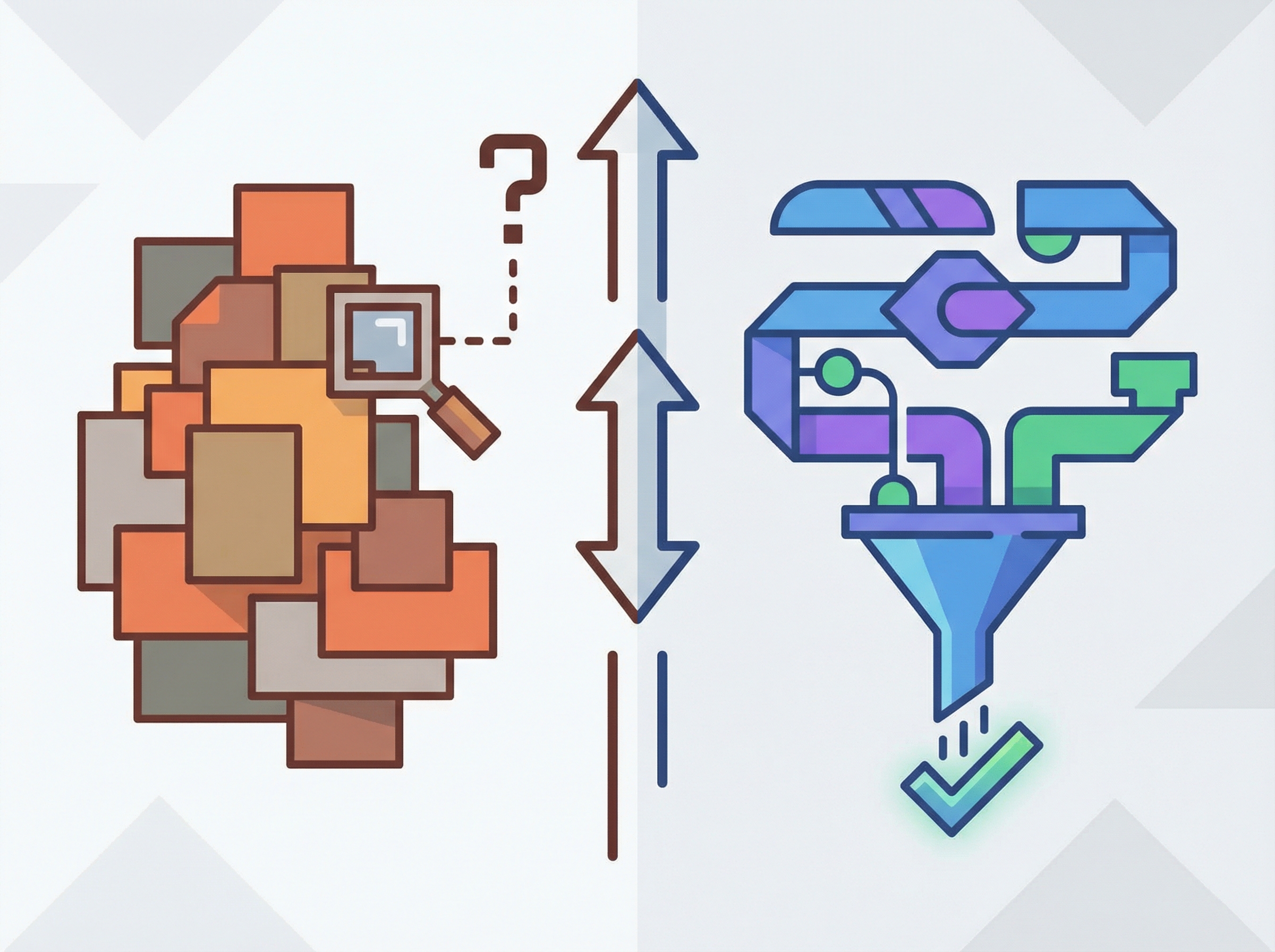
Key Takeaway: Manual screening is linear and subject to fatigue; AI screening is parallel and infinitely scalable. The efficiency metric is stark: Manual review takes ~6 seconds (optimistic) to 2 minutes per resume; AI takes milliseconds.
Scenario: The 500-Applicant Nightmare
To understand the practical impact of AI resume screening vs manual screening, let’s look at a real-world scenario involving "Sarah," a Senior Talent Acquisition Manager at a mid-sized tech firm.
The Overwhelmed Recruiter
Sarah opens a requisition for a "Senior Project Manager." Within three days, the role receives 512 applications. In a manual screening world, Sarah’s week is effectively destroyed. She blocks out four hours on Tuesday and Thursday just to "clean the queue."
By resume #120, Sarah is exhausted. She starts rejecting candidates for minor formatting errors just to reduce the pile. She unconsciously biases toward candidates from universities she recognizes. The tragedy of this manual workflow is that the perfect candidate—someone with 90% skills overlap but a non-traditional background—was sitting at resume #480. Sarah never got there. She closed the role after finding three "good enough" candidates in the first 200.
Implementing the AI Solution
Now, let's replay this scenario with an AI interview platform and screening tool like Foundire. When the 512 applications arrive, Sarah doesn’t open the PDFs one by one.
The new workflow:
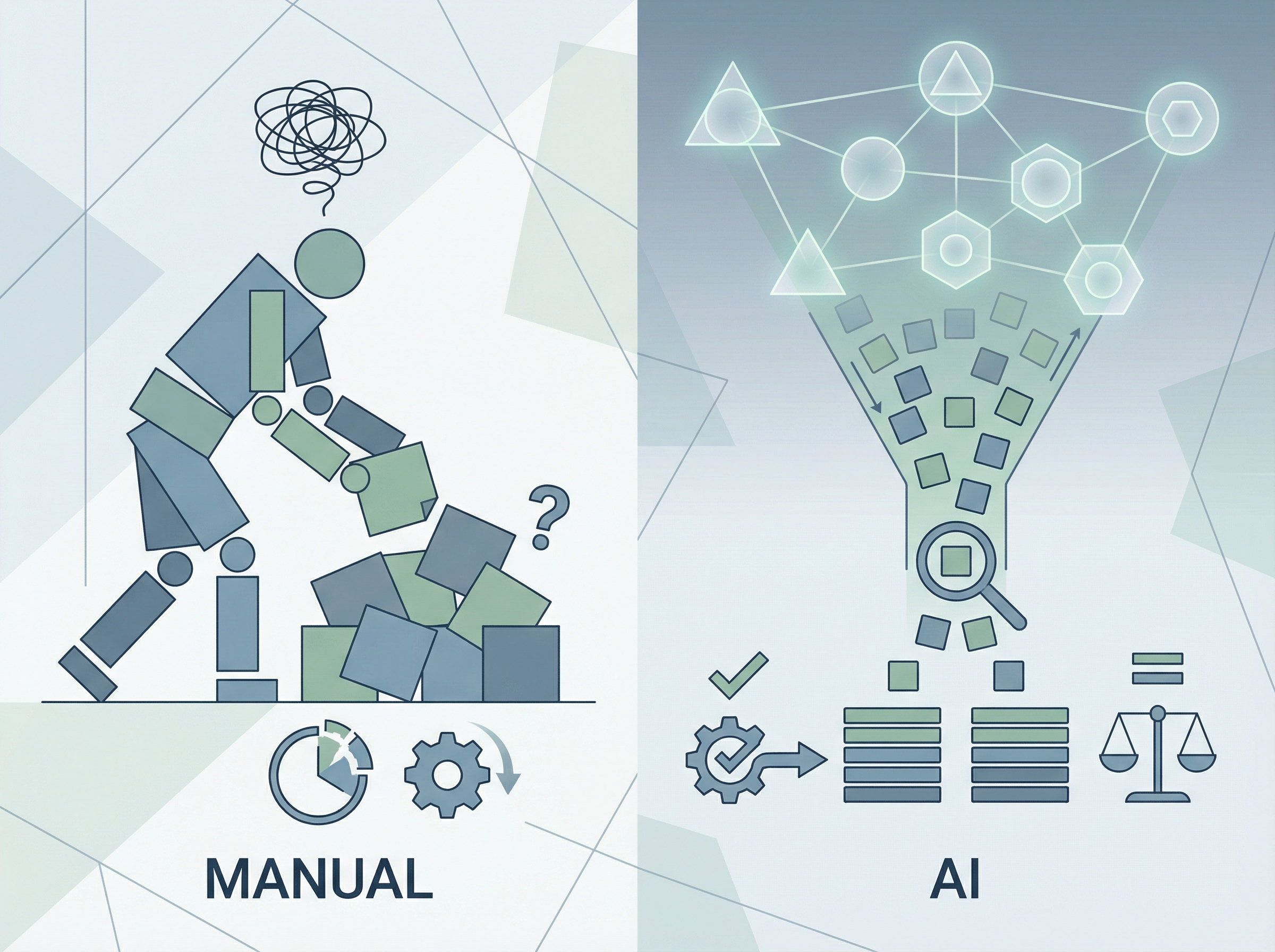
- Intake & Calibration: Sarah sets the parameters, weighing "Agile Certification" higher than "Years of Experience."
- AI Parsing: The system screens all 512 resumes instantly. It doesn't just look for keywords; it scores them based on the calibration.
- Instant Shortlist: The system presents the top 10% (50 candidates) who statistically match the high-performer profile.
- Automated Engagement: The top 50 receive an invite for a structured audio or video interview to verify communication skills.
In this scenario, resume #480 (the hidden gem) is surfaced immediately because the AI identified the skills match regardless of when the application was submitted. Sarah spends her time interviewing the top 10 candidates rather than reading the bottom 500.
Core Insights: Best Practices for Hybrid Screening
Transitioning from manual to AI screening requires a shift in strategy. It is not about "set it and forget it." It requires active management of the algorithm.
3 Actionable Heuristics
To maximize the value of AI resume screening vs manual screening, follow these heuristics:
- Use AI for 'Inclusion,' Not Just 'Rejection': Most recruiters use ATS filters to exclude people (e.g., "Must have 5 years experience"). Instead, configure your AI to rank by match strength. This ensures you see the high-potential candidates who might miss one specific criterion but excel in five others.
- Calibrate Based on Success, Not Just the JD: A job description is a wish list; your actual hires are the reality. Feed your AI tool examples of resumes from employees who have succeeded in the role. This teaches the system to look for the traits of your best performers.
- The 'Human-in-the-Loop' Rule: Never allow an AI to send a rejection letter to the top 10-15% of matched candidates without a quick human glance. Use AI to handle the obvious mismatches, but keep a human eye on the borderline cases to ensure nuances aren't lost.
Common Pitfalls to Avoid
While powerful, AI is not infallible. Avoiding these pitfalls is essential for a fair hiring workflow:
- The "Black Box" Trust: Do not blindly trust the score. Periodically audit the "rejected" pile to ensure the AI isn't biasing against certain resume formats or non-standard job titles.
- Ignoring False Negatives: Great candidates often have terrible resumes. If you rely 100% on AI parsing, you may miss a genius who doesn't know how to optimize for SEO. This is why coupling resume screening with AI interviews or skills assessments is superior to resume screening alone.
- Over-indexing on Keywords: Older AI models relied heavily on keywords. Modern semantic AI understands context. Ensure your tool is using updated Natural Language Processing (NLP) so it knows that "managing a budget" and "P&L responsibility" are related concepts.
The Breakthrough: Metrics That Matter
The turning point for most organizations comes when they look at the data. In the debate of AI resume screening vs manual screening, the numbers tell the most compelling story.
From Operational to Strategic
When Sarah implemented the AI workflow, the time-to-interview dropped by 60%. This is an operational metric. The strategic breakthrough, however, was in the Pass-Through Rate. In manual screening, the pass-through rate from "Resume Review" to "Phone Screen" was often erratic. With AI, the candidates arriving at the phone screen stage were pre-qualified and ranked.
The Data Difference
Consider the impact on Quality of Hire. By using standardized AI scoring, every candidate is measured against the same yardstick. This reduces the variables of unconscious bias (such as affinity bias, where a recruiter prefers a candidate with shared hobbies).
The Turning Point Story: Remember resume #480? Let's call him Marcus. Marcus had a gap in his employment due to caregiving and used a functional resume format that usually annoys recruiters. The AI, however, identified that his skills in "Stakeholder Management" and "Risk Mitigation" were in the top 1 percentile of the applicant pool. Sarah interviewed him based on the AI score. Marcus turned out to be the strongest hire of the year. Manual screening would have filtered him out; AI screening surfaced him.
Career Advantage: Leveraging AI Proficiency
For recruiters and talent leaders, mastering AI resume screening is a career accelerator. It shifts your role from "Resume Reviewer" to "Talent Strategist."
Recruiter Resume Builders
If you are looking for a new role in Talent Acquisition, you must highlight your ability to manage AI workflows. Here are examples of how to phrase this on your resume:
- "Reduced time-to-hire by 40% by implementing AI-driven resume parsing and scoring workflows, saving 15 hours of manual review per week."
- "Increased candidate funnel quality, resulting in a 25% higher interview-to-offer ratio by utilizing structured AI calibration."
- "Managed the transition from manual screening to automated top-of-funnel operations, integrating Foundire to reduce unconscious bias."
Q&A Strategy
Interviewer: "How do you handle high-volume roles without missing quality candidates?"
You: "I move away from manual 'read-and-react' methods. I implement AI resume screening to handle the initial volume, ensuring 100% of applicants are scored. I calibrate the AI against successful past hires to rank the pool, then I focus my manual attention on the top 20% and the 'borderline' cases. This ensures efficiency without sacrificing the human touch for the most promising candidates."
Pros & Cons: The Trade-off Analysis
| Benefit (AI Screening) | Tradeoff (Manual/Risks) |
|---|---|
| Speed & Scalability: Can process 1,000+ resumes in minutes, instantly identifying top matches. | Loss of Nuance: Algorithms may miss "potential" or "grit" that isn't explicitly written in standard keywords. |
| Consistency: Applies the exact same criteria to every candidate, reducing human fatigue and mood-based bias. | Algorithmic Bias: If the AI is trained on biased historical data, it will replicate those biases at scale (e.g., favoring certain universities). |
| Cost Efficiency: Frees up recruiters to focus on selling the role and closing offers rather than administrative filtering. | Implementation Cost: Requires budget for software and time for proper calibration/integration with ATS. |
Frequently Asked Questions (FAQ)
What is AI resume screening exactly?
AI resume screening is the application of machine learning and natural language processing (NLP) to automatically read, parse, and rank job applications. Unlike simple keyword matching, modern AI understands the context of skills and experience, grading candidates based on their likelihood to succeed in the role relative to the job description.
Can AI resume screening backfire or exclude good candidates?
Yes, if not calibrated correctly. AI can produce "false negatives" if a candidate has a poorly formatted resume or uses unconventional job titles. To prevent this, it is crucial to use tools that utilize semantic matching rather than strict keyword filters and to maintain a human review for borderline candidates.
Is manual screening ever better than AI?
Manual screening is often superior for executive-level (C-Suite) or highly creative roles where the portfolio or reputation matters more than standard resume data. In these low-volume, high-touch scenarios, the human nuance is irreplaceable. However, for most high-volume professional roles, AI offers superior efficiency.
How do tools like Foundire integrate with existing ATS?
Most modern AI screening tools and interview platforms act as a layer on top of your existing Applicant Tracking System (ATS). They pull candidate data from the ATS, perform the screening/interviewing/scoring, and push the graded results back into the candidate profile, ensuring a seamless hiring workflow.
Conclusion
The debate of AI resume screening vs manual screening is settling. In an era of high-volume applications, manual screening is a bottleneck that costs companies time and talent. By leveraging AI, recruiters can ensure that every application is read, bias is reduced, and the "Black Hole" of recruiting is finally closed. Mastering these tools creates a durable hiring advantage, allowing talent teams to focus on what they do best: building relationships.
If you want to operationalize AI resume screening with structured workflows (Sourcing → resume screening → AI interviews → scorecards → offers → background checks), try tools like Foundire (https://foundire.com).