How to Win at Career Fairs: Turning Booth Traffic into Talent Pipelines

Career fairs are the high-intensity interval training of the recruiting world. For decades, they have been viewed as a necessary branding exercise—a place to hand out branded stress balls and collect stacks of paper resumes. But in 2025, the strategic intent behind these events has shifted fundamentally.
For modern talent acquisition teams, a career fair is no longer just a branding event; it is a high-velocity sourcing channel designed to compress the hiring funnel. The goal is not "attendance." The goal is qualified pipeline velocity.
Why does this matter now? According to recent data from NACE, in-person career fair attendance has climbed back to pre-pandemic levels, with over 93% of career centers holding on-site events for the 2024-25 academic year. Yet, the average time-to-fill for a new position sits stubbornly around 42 days. Career fairs offer the unique ability to slash this timeline by bypassing the digital "resume black hole" and establishing immediate human connection.
However, most recruiters leave these events with tired feet and a bag of unverified leads. The difference between a wasted afternoon and a hiring goldmine lies entirely in your operational workflow.
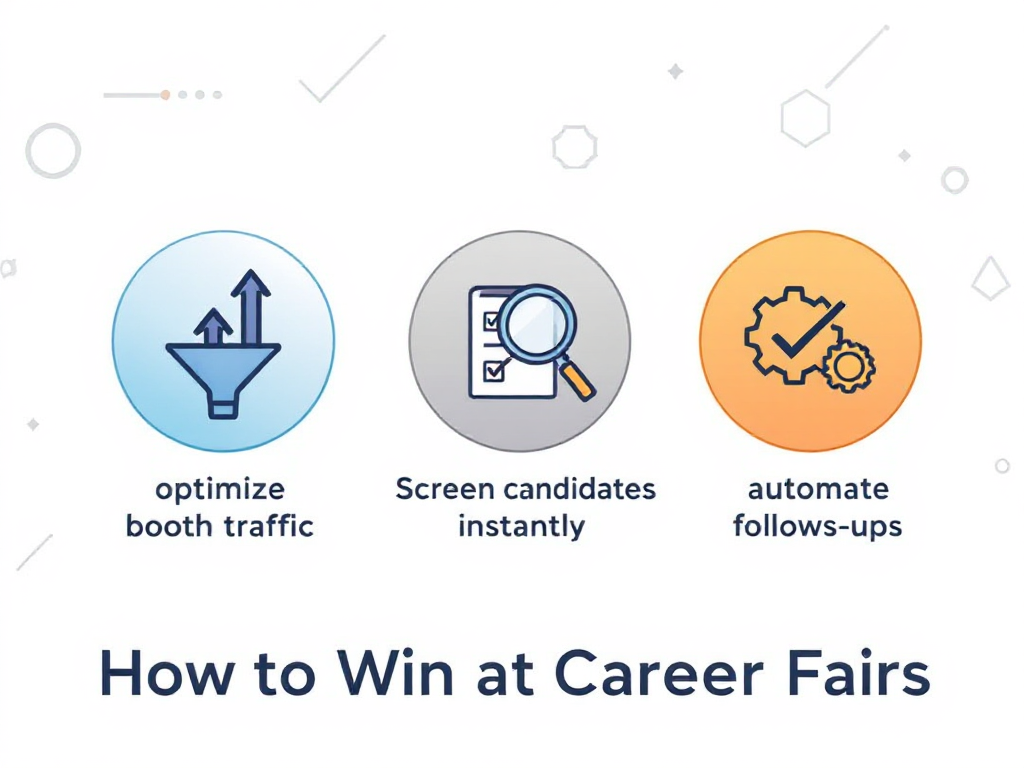
The Core Problem: Traditional career fair recruiting is linear and slow (Talk → Collect Resume → Review Later → Email → Wait). The optimized approach is parallel and instant (Talk → Digital Intake → AI Screen → Schedule Interview—all within 5 minutes).
Real-World Scenario: From "Resume Stack" to "Hired"
To understand the impact of optimizing your career fair strategy, let’s look at two different recruiters attending the same massive university expo.
The Traditional Workflow (The "Chaos" Method)
Meet Mark. He arrives at the expo hall with 500 printed brochures and a fishbowl for business cards. Over four hours, he speaks to 150 candidates. He tells 120 of them to "apply on our website" because he can’t manage the paper volume. He collects 30 paper resumes from "promising" candidates, jotting notes like "good energy" or "knows Java" on the margins.
The Result:

- Monday Morning: Mark spends 3 hours manually entering data into his ATS.
- Thursday: He finally emails the top 10 candidates.
- The Outcome: By the time his emails go out, the top 3 candidates have already scheduled interviews with competitors who moved faster. Mark’s "pass-through rate" (booth visit to interview) is less than 2%.
The Optimized Workflow (The "Velocity" Method)
Now meet Sarah. She treats the career fair as a live data-capture environment. She has no paper resumes. Instead, her booth features a prominent QR code linked to a mobile-first intake platform (like Foundire). When a candidate approaches, the workflow is immediate:
Step 1: The Triage. Sarah chats for 2 minutes. If the candidate shows potential, she asks them to scan the code.
Step 2: Structured Data Capture. The candidate answers 3 "knockout" questions on their phone right there (e.g., "Are you willing to relocate?", "Do you have Python experience?").
Step 3: Immediate Conversion. Candidates who pass the digital screen are instantly prompted to book a 15-minute interview slot for the next day. They leave the booth with a calendar invite, not a brochure.
The Result:
- Monday Morning: Sarah has 0 data entry to do. Her calendar is already booked with 15 pre-qualified screenings.
- The Outcome: Her time-to-first-interview is under 24 hours. Her pass-through rate jumps to 15%, and she secures a top-tier engineer before Mark has even logged into his ATS.
Core Insights & Best Practices for 2025
Transforming your career fair presence requires moving from "passive attendance" to "active pipeline management." Here are the heuristics that separate top-tier recruiting teams from the rest.
1. The "Zero-Latency" Heuristic
The half-life of a candidate's excitement is incredibly short. If you don't convert their interest into an action item (an interview, a test, a follow-up) within 24 hours, you lose them.
Action: Automate your "Thank You" email to trigger the moment they check in at your booth. Include a piece of high-value content (e.g., "A Day in the Life of a Jr. Dev") to keep them warm while you review their profile.
2. Use Structured Booth Scorecards
Memory is fallible, especially after meeting 50 people in a loud hall. Stop writing "nice guy" on resumes.
Action: Use a simple 1-5 rating system on your mobile intake tool for core competencies (e.g., Communication, Technical Relevance, Culture Add). This ensures that when you review the leads later, you are looking at objective data points, not vague impressions.
3. Stop The "Apply Online" Deflection
The biggest pitfall at career fairs is telling a qualified candidate to "just apply on the website." This breaks the psychological contract you just built. It tells the candidate, "Our interaction here didn't matter."
Action: If you must direct them to a general application, give them a "Fast Track" code or a specific landing page URL that tags the source as "Career Fair." This allows you to track ROI and prioritize their application in the pile.
Common Pitfalls to Avoid
- The Swag Trap: Attracting booth traffic with expensive giveaways (iPads, headphones) often yields low-intent leads. You want candidates interested in the work, not the prizes.
- The "Bodyguard" Stance: Recruiters standing behind a table creates a physical barrier. Stand in front or to the side of your table to create an open, conversational dynamic.
- Ignoring Skills-Based Hiring: In 2025, 40% of employers are prioritizing skills over degrees. Don't dismiss a candidate just because their major doesn't perfectly align. If they have the portfolio, they are worth the conversation.
The Breakthrough: Measuring Impact
The turning point for most organizations comes when they stop measuring "resumes collected" and start measuring "Cost Per Qualified Lead" (CPQL).
Consider a manufacturing firm that struggled to hire plant managers. They attended 10 career fairs a year, collecting hundreds of resumes but making zero hires. They were about to cancel the program.
They pivoted to a "Pre-Event Sourcing" model. Two weeks before the fair, they used the university's resume book to identify 20 high-potential students and invited them to a VIP breakfast before the fair opened. By pre-selling the opportunity, they used the career fair not for discovery, but for closing.
The Impact:
- Before: $15,000 spend -> 0 Hires.
- After: $15,000 spend -> 3 Hires.
- Breakthrough: They realized the career fair wasn't the start of the process; it was the accelerator for relationships they had already identified digitally.
Career Relevance for Recruiters
Mastering career fairs is a powerful differentiator for your own career as a talent professional. It demonstrates that you understand funnel metrics, employer branding, and operational efficiency.
Interview Q&A: How to Frame This Experience
Q: "How do you handle high-volume sourcing events?"
A: "I view career fairs as a data-capture opportunity rather than just a branding event. In my last role, I implemented a QR-based digital intake system that segmented candidates by role immediately. This allowed us to automate follow-ups based on priority, reducing our time-to-schedule from 5 days to 4 hours and increasing our event ROI by 30%."
Resume Bullets for Your Profile
- Orchestrated university recruiting strategy across 5 campuses, resulting in a 25% increase in engineering hires YoY.
- Implemented automated intake workflows (Foundire/ATS integration) to eliminate manual data entry and reduce candidate drop-off by 40%.
- Designed structured interview scorecards for booth interactions, improving candidate quality calibration between recruiters and hiring managers.
Pros & Cons of Career Fairs
| Benefit (Pro) | Tradeoff (Con) |
|---|---|
| High-Fidelity Screening: You can assess soft skills, communication, and enthusiasm in 3 minutes—something a resume can never convey. | Resource Intensity: Requires significant time away from desk, travel costs, and physical energy. "Recruiter burnout" is real after a 3-day roadshow. |
| Immediate Pipeline Velocity: Ability to schedule next-steps on the spot dramatically shortens time-to-fill (42 days avg reduced to <20). | Logistical Complexity: Success depends on hardware working, Wi-Fi stability, and shipping logistics. If the tech fails, you must have a paper backup. |
| Diverse Talent Pools: Access to candidates from different backgrounds who might be filtered out by strict ATS keyword matching. | Variable Quality: High volume often means high noise. You may talk to 200 people to find 5 qualified leads. |
Frequently Asked Questions
What is a career fair in a strategic context?
Strategically, a career fair is a synchronous sourcing event. Unlike job boards (asynchronous), fairs allow for real-time calibration of candidate fit. It is best used for high-volume roles (interns, grads, sales, support) where personality and soft skills are key differentiators.
Can attending a career fair backfire?
Yes. If your booth is understaffed, your recruiters look disengaged (on their phones), or you fail to follow up, you actively damage your employer brand. Word spreads fast on campus; a "black hole" reputation can hurt applications for years.
Are virtual career fairs still relevant in 2025?
Absolutely. While in-person events have returned, virtual fairs remain superior for reaching passive candidates and non-local talent. They are also more cost-effective. A hybrid strategy—using virtual for broad reach and in-person for deep engagement—is the gold standard.
How do I handle too many candidates at my booth?
Use a "Group Huddle" tactic. Instead of repeating your pitch 1:1, gather 5-10 students and do a 5-minute group intro, then break for individual Q&A. Alternatively, use digital signage to answer FAQs (salary, visa sponsorship) so you only spend verbal energy on high-value conversations.
Conclusion
The era of the "spray and pray" career fair is over. In 2025, winning at these events isn't about having the best swag or the flashiest backdrop. It is about operational excellence. It is about treating every handshake as a data point and every conversation as the first step in a structured, measurable workflow.
By integrating digital intake, automated nurturing, and structured scoring, you turn a chaotic event into a predictable revenue engine for your recruiting team. The recruiters who win are the ones who close the gap between "Hello" and "You're Hired" with speed and precision.
If you want to operationalize career fairs with structured workflows (resume screening → AI interviews → scorecards → offers → background checks), try tools like Foundire (https://foundire.com).