How to Screen Resumes Faster: 5 Proven Steps

How to Screen Resumes Faster: 5 Proven Steps
How to screen resumes faster isn't just about reading speed; it is the strategic process of rapidly evaluating candidate qualifications to filter the top 10% of applicants without sacrificing quality or fairness. In today's hiring landscape, where the average time-to-hire has ballooned to 68.5 days, mastering this skill is the difference between securing top talent and losing them to competitors.
Speed is the new currency in talent acquisition. If you are manually reviewing every single line of every single application, you are already behind.
The Bottleneck: Why Speed Matters in Screening
Efficient screening is the art of saying "no" quickly so you can spend quality time saying "yes." It is not about skimming for the sake of haste; it is about operationalizing your decision-making to reduce cognitive load.
Consider Sarah, a Senior Tech Recruiter at a mid-sized software firm. On Monday morning, she opens a requisition for a "Senior Product Manager." By Wednesday, she has 540 applications. If Sarah spends just two minutes reviewing each resume, she faces 18 hours of non-stop reading. That is two full workdays of silence for candidates who are likely applying elsewhere.
The Cost of Delay
The consequences of this bottleneck are measurable and severe. Recent data from 2025 indicates that 60% of job seekers abandon applications or withdraw from the process if it feels too lengthy or unresponsive. When Sarah takes a week to shortlist, her top three candidates—the "A-players"—have often already scheduled interviews with faster-moving competitors.
The goal isn't just to clear the queue; it is to prevent candidate drop-off. A slow screening process signals a sluggish company culture, repelling high-performers who value efficiency.
Real-World Scenario: From Chaos to Calibration
Let’s look at how Sarah transformed her overwhelming workload by shifting from manual fatigue to an automated workflow.
The Old Way: Manual Fatigue
Previously, Sarah’s process was linear and manual:
- Open PDF.
- Scan for keywords (SQL, Agile, Python).
- Check tenure gaps.
- Decide: Yes/No/Maybe.
- Repeat 540 times.
By application #50, "decision fatigue" set in. Sarah started rejecting qualified candidates for minor formatting issues simply because her brain was tired. Her "Maybe" pile grew to 200 resumes, creating a secondary bottleneck that stalled the hiring manager review.
The New Way: Automated Workflows
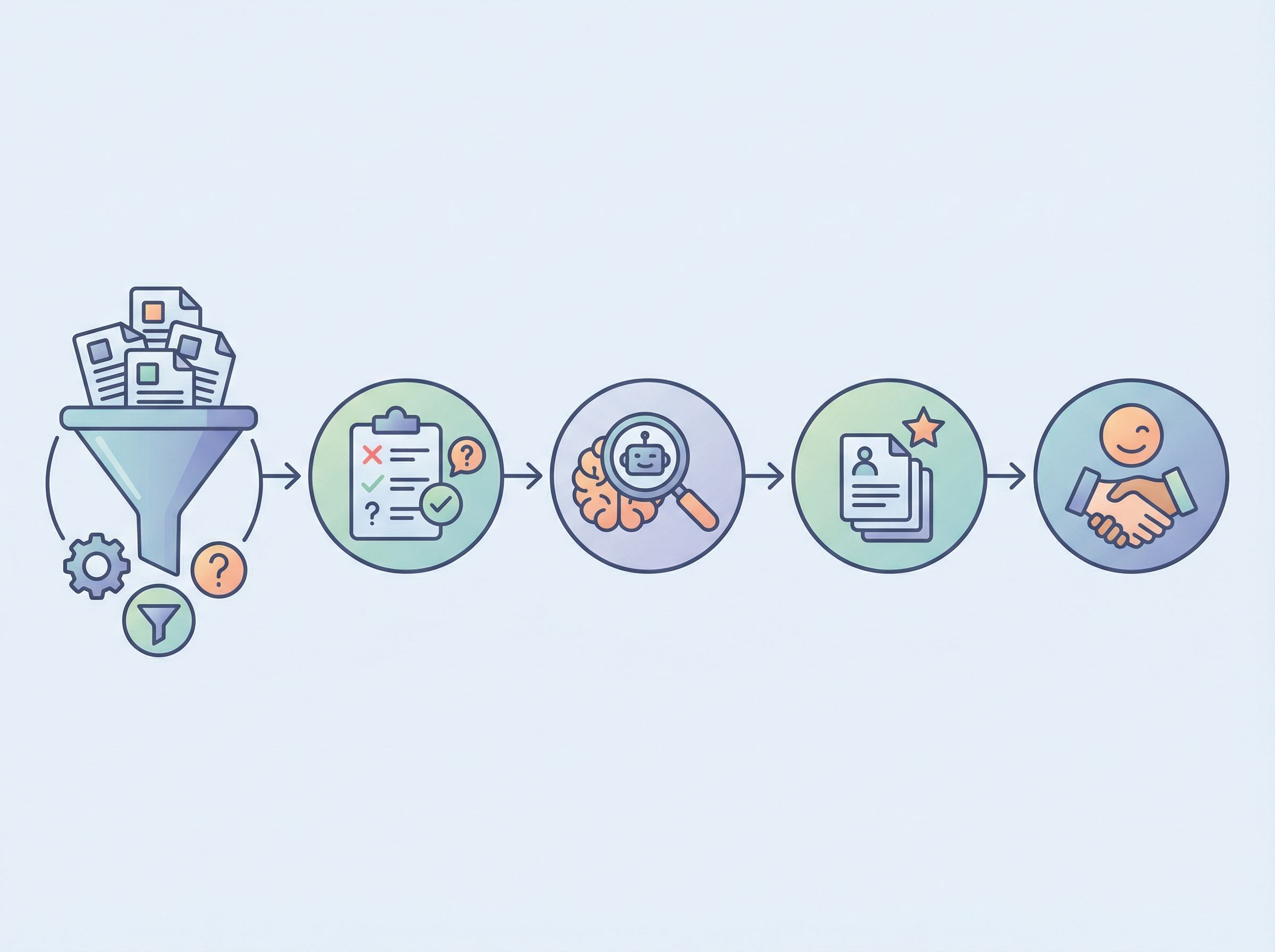
Sarah implemented a structured workflow to screen resumes faster without losing the human touch. Here is the new stack:
- Intake Calibration: She met with the hiring manager to define 3 "Knockout Criteria" (e.g., Must have shipped a B2C mobile app).
- ATS Filtering: The Applicant Tracking System (ATS) automatically archived anyone who didn't meet the knockouts. Volume reduced by 40%.
- AI Screening: She utilized an AI interview platform to invite the remaining 320 candidates to a text-based chat or asynchronous video assessment.
- Visual Shortlist: Instead of reading resumes, she reviewed the AI-generated summaries and interview scorecards of the top 50 matches.
The Breakthrough: Sarah reduced her active screening time from 18 hours to 3 hours. More importantly, her pass-through rate (candidates accepted by the hiring manager) jumped from 20% to 65% because the AI tools ensured better initial alignment.
5 Heuristics to Accelerate Your Process
You don't need a massive budget to screen resumes faster. You need better heuristics—mental shortcuts that help you process information effectively.
1. Leverage Knockout Questions Aggressively
The fastest way to screen a resume is to never have to read it in the first place. Use your ATS to ask binary, deal-breaker questions during the application process.
Example: "Do you have legal authorization to work in the US without sponsorship?" or "Do you have 3+ years of experience with React Native?"
This instantly filters the funnel, ensuring you only spend time on viable candidates.
2. Master Visual Scanning (The "F-Pattern")
Eye-tracking studies show that effective recruiters don't read; they scan in an "F-pattern." Train your eyes to look for Gold Stars and Red Flags within the first 6-10 seconds:
- Gold Stars: recognizable competitors, specific job titles, promotion arcs (Junior to Senior).
- Red Flags: Unexplained gaps >6 months, vague descriptions ("assisted with," "participated in"), inconsistent formatting.
3. Use AI & Automation Tools
Modern talent acquisition relies on tools that go beyond keyword matching. Platforms like Foundire can operationalize this by automating the initial engagement. Instead of manually reviewing a resume, you can invite candidates to a structured assessment where they validate their skills. The platform then ranks candidates based on empirical data, not just claims on a PDF.
4. Implement Scorecards for Standardization
Subjectivity slows you down. When you "go with your gut," you constantly recalibrate your internal standard. Use a simple interview scorecard for resume screening with a 1-5 scale on three specific competencies. This turns a complex judgment call into a quick data entry task.
5. Batch Your Screening Blocks
Context switching is the enemy of speed. Do not screen resumes as they come in. Block out 60 minutes daily for "Deep Screening." During this hour, turn off Slack and email. Your brain recognizes patterns faster when reviewing similar documents in a batch.
Common Pitfalls to Avoid
Warning: Speed should not come at the cost of bias.
- Keyword Over-reliance: Don't reject a candidate just because they said "Client Relations" instead of "Customer Success."
- The "Pedigree" Trap: Ignoring candidates from lesser-known schools or companies can cause you to miss high-potential talent.
- ATS Formatting Bias: Remember that some great candidates submit poorly formatted PDFs that parser tools might mangle. Always view the original file for "Maybe" candidates.
Career Advantage: Talking About Efficiency
Mastering the art of high-volume screening is a strategic skill that differentiates you in your own career. When you interview for Talent Leader roles, you need to articulate how you handle scale.
Q&A: Acing the Interview
Interviewer: "How do you handle high-volume requisitions with limited support?"
You: "I don't just work harder; I build a funnel that filters for me. I operationalize the process by setting clear knockout criteria to handle the bottom 50% automatically. For the top tier, I use time-blocked visual scanning and calibrated scorecards. In my last role, this approach reduced our time-to-screen by 40% while increasing the diversity of our shortlist."

Resume Bullets for Recruiters
- "Implemented an automated screening workflow using AI tools, reducing time-to-hire by 12 days."
- "Designed structured intake scorecards that improved hiring manager submission-to-interview ratio from 3:1 to 1.5:1."
- "Managed a high-volume pipeline of 500+ weekly applicants, maintaining a 24-hour response SLA for top candidates."
Evaluation: Pros & Cons of Rapid Screening
| Benefit | Tradeoff |
|---|---|
| Competitive Speed: You engage top talent before competitors, reducing drop-off rates significantly. | False Negatives: Rapid scanning increases the risk of rejecting a "diamond in the rough" with a non-traditional background. |
| Consistency: Using scorecards and knockouts ensures every candidate is measured against the same bar. | Impersonal Feel: Heavy automation can feel robotic if not balanced with personalized communication templates. |
| Recruiter Sanity: Prevents burnout by removing the administrative burden of reviewing unqualified applicants. | Setup Time: Requires upfront investment to configure ATS triggers, calibration meetings, and AI workflows. |
Frequently Asked Questions
What is the fastest way to screen resumes?
The fastest method combines automated "knockout" questions in your ATS to filter unqualified candidates instantly, followed by a visual scan of the remaining resumes looking for key "gold stars" (tenure, specific hard skills) rather than reading every word.
Can automated screening backfire?
Yes. If your filters are too strict (e.g., demanding 5 years of experience for a junior role) or if your ATS cannot parse certain file formats, you will reject qualified candidates. It requires regular auditing to ensure fairness.
How does AI impact candidate experience?
When used correctly, AI improves experience by providing faster feedback. Candidates prefer a quick "no" over weeks of silence (ghosting). However, the communication must be transparent and empathetic.
What are "knockout questions"?
These are mandatory questions asked during the application (e.g., "Are you willing to relocate?"). If a candidate answers incorrectly based on your requirements, they are automatically moved to the rejection pile, saving recruiter time.
Conclusion
In 2026, knowing how to screen resumes faster is less about speed-reading and more about system design. By moving from manual review to a calibrated, automated workflow, you transform the recruiting function from a bottleneck into a strategic advantage.
Operationalizing speed creates a durable competitive edge. When you treat time as your most precious resource, you not only close roles faster—you build a reputation as a recruiter who respects candidates' time.
If you want to operationalize this speed with structured workflows—from sourcing and resume screening to AI interviews and scorecards—consider trying tools like Foundire (https://foundire.com) to automate your hiring funnel without losing the human touch.