How to Score Resumes Objectively in 5 Steps

How to Score Resumes Objectively in 5 Steps
How to score resumes objectively is the process of applying a standardized, weighted rubric to candidate profiles to measure specific competencies rather than relying on intuition. This systematic approach reduces unconscious bias, improves predictive validity, and creates a defensible audit trail for hiring decisions.
Imagine Sarah, a Talent Acquisition Manager at a mid-sized tech firm. She is staring at a queue of 500 applications for a single Project Manager role. Her "gut feeling" tells her to prioritize candidates from top-tier universities, but deep down, she knows this method is flawed. Her turnover rates are high, and her hiring managers constantly complain about "culture fit" misalignment during interviews.
Sarah is drowning in the "Gut Feeling" Trap—a common scenario where vague criteria like "good communicator" or "strong potential" lead to inconsistency, affinity bias, and missed talent. The solution isn't to work harder; it's to shift from subjective scanning to quantitative scoring.
Real-World Scenario: Sarah’s Scoring Transformation
The Broken Workflow
In the old world, Sarah and Mike (the Hiring Manager) would kick off a search with a brief chat. Mike would say, "Just find me someone sharp who knows Agile." Sarah would then spend hours scanning resumes, mentally ticking boxes based on prestige markers—a recognizable company logo here, a famous university there.
The result? A hiring funnel full of "false positives." Candidates looked great on paper but failed technical assessments or quit within six months. Their pass-through rate from resume screen to initial interview was a bloated 60%, but their offer acceptance rate languished at 40% because candidates were often overqualified or misaligned with the actual day-to-day work.
Implementing the Matrix
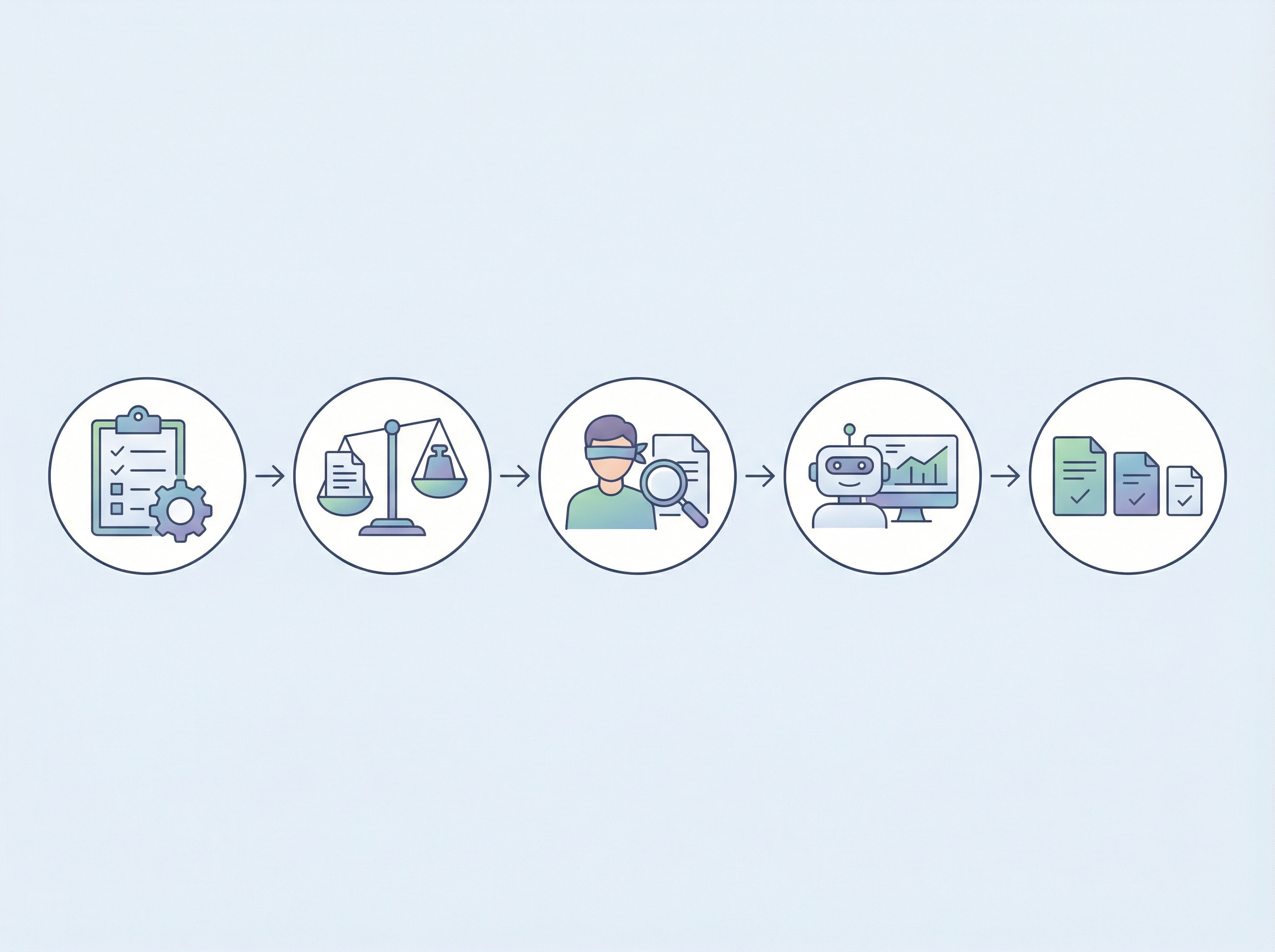
To fix this, Sarah implemented an objective resume scoring matrix. Before opening the role, she forced Mike to sit down and define exactly what "sharp" meant. They broke the role down into measurable competencies:
- Must-Have (Pass/Fail): PMP Certification, 3+ years managing budgets over $500k.
- Weighted Criteria (Scored 1–5): Experience with cross-functional teams (Weight: 40%), Technical familiarity with SQL (Weight: 30%), Remote team leadership (Weight: 30%).
Instead of glancing at a resume and thinking "looks good," Sarah now assigned a score. A candidate with "some SQL exposure" got a 2. A candidate who "wrote complex queries daily" got a 5.
The Impact: The results were immediate and measurable. The pass-through rate to the interview stage stabilized at a healthy 20%—meaning fewer, higher-quality interviews. More importantly, their offer acceptance rate jumped from 40% to 85%. By the time candidates reached the final stage, the team knew they were a functional match, allowing interviews to focus on soft skills and team dynamics rather than verifying basic competency.
Core Tactics: Building the Perfect Scorecard
To replicate Sarah’s success, you need more than just a spreadsheet; you need a system that enforces discipline. Here are three actionable heuristics to build your scoring engine.
1. Separate 'Must-Haves' from 'Nice-to-Haves'
A common mistake is treating every requirement as equal. Use a binary Pass/Fail gate for non-negotiables. If a role requires a specific license or legal authorization to work, no amount of "culture add" should compensate for its absence. This is where tools like Foundire excel—automating the preliminary sorting of these binary criteria so recruiters only score qualified profiles.
2. Use Anchored Rating Scales
Avoid a generic 1–5 scale where "3" is subjective. Create anchored rating scales where every number has a written definition. This is critical for calibration between recruiters and hiring managers.
- 1 (Low): No evidence of skill.
- 3 (Average): Meets basic requirements; has performed task with supervision.
- 5 (High): Expert level; has coached others or led complex initiatives in this area.
3. Implement Blind Screening
According to 2025 data, AI and human bias still favor demographic markers significantly. To score objectively, you must remove variables that trigger unconscious bias. Blind screening involves stripping names, graduation years, and addresses from resumes before scoring begins. This ensures you are scoring the competency (e.g., "managed a team of 10") rather than the pedigree.
Common Pitfalls to Avoid
The Halo Effect: Allowing one impressive trait (like working at Google) to unconsciously inflate the scores of unrelated skills. Stick to the rubric.
- Pedigree Bias: Assuming a degree from an Ivy League school equals competence. In objective scoring, a degree is just one data point, often weighted lower than actual work samples.
- Keyword Stuffing: Over-reliance on exact keyword matches. A scorecard should measure the application of a skill, not just its presence on the page.
The Breakthrough & Career Relevance
The Turning Point
For Sarah, the true "aha" moment came with a candidate named David. In her old process, she would have skipped him—he had a degree from a lesser-known college and a gap in his employment. But on the scorecard, David scored a near-perfect 4.8 on the weighted criteria for "Technical Project Recovery" and "Stakeholder Management."
Because the system forced her to look at the evidence of his skills rather than his background summary, David moved forward. He not only got the job but became the top-performing PM within a year, saving a stalled $2M project. This success proved that objective scoring captures the "hidden gems" that gut instinct misses.

For the Recruiter's Career
Mastering this skill doesn't just help you hire better; it helps you get hired. Modern Talent leaders look for recruiters who can operationalize data. Here is how you can frame this expertise in your own job interviews:
Q: "How do you ensure quality in your candidate pipeline?"
A: "I move beyond intuition by implementing structured scoring matrices. I work with hiring managers to define anchored rating scales for key competencies, which calibrates our expectations early and reduces bias. In my last role, this improved our interview-to-offer ratio by 30%."
Resume Bullets for Recruiters:
- Designed and implemented objective resume scorecards, reducing false-positive screenings by 25%.
- Partnered with hiring managers to create structured interview guides, ensuring 100% calibration on core competencies.
- Leveraged hiring workflow automation to eliminate demographic bias from the initial screen, increasing pipeline diversity by 15%.
Pros & Cons of Objective Scoring
| Benefit | Tradeoff |
|---|---|
| Reduced Bias: Focuses strictly on skills and evidence, democratizing access for non-traditional candidates. | High Setup Effort: Requires significant upfront time to define criteria and build rubrics with hiring managers. |
| Defensibility: Provides a clear data trail for why a candidate was advanced or rejected, protecting against liability. | Rigidity: Can feel mechanical; risks filtering out "wildcard" candidates if the criteria are too narrow. |
| Predictive Validity: structured evaluation correlates more strongly with on-the-job performance than unstructured review. | Slower Initial Screen: Reading to score takes longer than "glancing and scanning" (though it saves time downstream). |
FAQs on Resume Scoring
What is the best scale for scoring resumes?
A 1–4 or 1–5 scale is ideal. Many experts prefer a 4-point scale to force a decision (avoiding the neutral "3"). Crucially, each number must have a clear definition (e.g., "4 = Exceeds requirements with specific examples").
Can resume scoring be automated?
Yes, to a degree. AI interview platforms and tools like Foundire can automate the extraction of hard skills and "pass/fail" criteria. However, scoring complex soft skills or project outcomes often requires human judgment to verify the context of the achievement.
Does objective scoring take longer?
It slows down the start of the process but speeds up the end. By spending 5 minutes scoring a resume accurately, you save hours of wasted interview time on unqualified candidates. It is the classic "slow down to speed up" operational strategy.
Can objective scoring backfire?
Yes, if the criteria are wrong. If you optimize for the wrong skills (e.g., over-weighting "years of experience" instead of "adaptability"), you will objectively hire the wrong people. Regular calibration meetings are essential to refine the scorecard.
Conclusion: The Durable Hiring Advantage
Learning how to score resumes objectively is not just a productivity hack; it is the foundation of a modern, equitable hiring stack. By replacing "gut feeling" with weighted criteria, anchored scales, and disciplined workflows, you create a process that is fair, fast, and remarkably effective.
The future of recruiting belongs to those who can blend human insight with structural rigor. If you want to operationalize this level of precision with structured workflows—from sourcing and resume screening to AI interviews, scorecards, and offers—try tools like Foundire (https://foundire.com) to automate consistency without losing the human touch.