How to Run Effective Panel Interviews

How to Run Effective Panel Interviews: A Guide for Modern Hiring
If you have ever lost a top-tier candidate because you couldn’t align three different calendars for three different interviews, you are not alone. In a hiring landscape where the global average time-to-hire has crept up to 44 days, speed and precision are your only true competitive advantages. This is where panel interviews—when executed correctly—become a strategic weapon.
What Are Panel Interviews and Why Do They Matter?
A panel interview is a selection method where two or more interviewers assess a single candidate simultaneously. Unlike sequential interviews, which happen one after another, a panel consolidates the evaluation process into a single, cohesive session.
For recruiters and hiring managers, the primary intent behind searching for "panel interviews" is usually operational: How do I speed up hiring without sacrificing quality?
The answer lies in data. According to recent industry reports, structured panel interviews can reduce total interview hours by up to 40% while significantly increasing predictive validity (the likelihood that a hire will actually succeed in the role). By having multiple data points on the same answers, you reduce the "noise" of individual bias and get a clearer signal on candidate potential.
The "Calendar Tetris" Problem
Imagine this: You find "Alex," a perfect candidate for your Senior Product Manager role. You schedule a screen with the Recruiter (Day 1). It goes well. You schedule the Hiring Manager (Day 5). Great feedback. Now you need the VP of Product and the Lead Engineer to weigh in. The VP is at a conference; the Engineer is in a sprint.
By the time you offer Alex a slot on Day 22, they’ve already accepted an offer from a competitor who interviewed them, made a decision, and sent an offer letter in under 10 days. This scenario is the primary driver for adopting a panel interview strategy.

Real-World Scenario: The Shift from Sequential to Panel
Let’s look at a realistic hiring scenario involving "Sarah," a Director of Marketing, and "Mark," a Senior Recruiter. They are trying to fill a critical Growth Marketing Manager role.
The Bottleneck
Sarah and Mark were originally running a traditional sequential interview process:
- Step 1: Recruiter Screen (30 mins)
- Step 2: Hiring Manager Deep Dive (60 mins)
- Step 3: Peer Review with a Content Lead (45 mins)
- Step 4: Cross-functional interview with Sales Director (45 mins)
The problem wasn't just scheduling. It was data quality. The candidate was asked, "Tell me about a time you failed," four separate times. By the fourth time, the candidate's answer was rehearsed and polished, giving the final interviewer a false sense of the candidate's authenticity.
Worse, the feedback was contradictory. The Content Lead thought the candidate was "too aggressive," while the Sales Director thought they were "perfectly assertive." Without being in the same room, Sarah had no way to know if the candidate acted differently or if the interviewers simply had different baselines.
The Intervention
After losing their second finalist to a faster company, Mark proposed a structured panel interview. They replaced Steps 3 and 4 with a single 60-minute session featuring Sarah (Hiring Manager), the Content Lead (Peer), and the Sales Director (Stakeholder).
The New Workflow:
Intake → Resume Screening (via Foundire or ATS) → Recruiter Screen → Panel Interview → Decision.
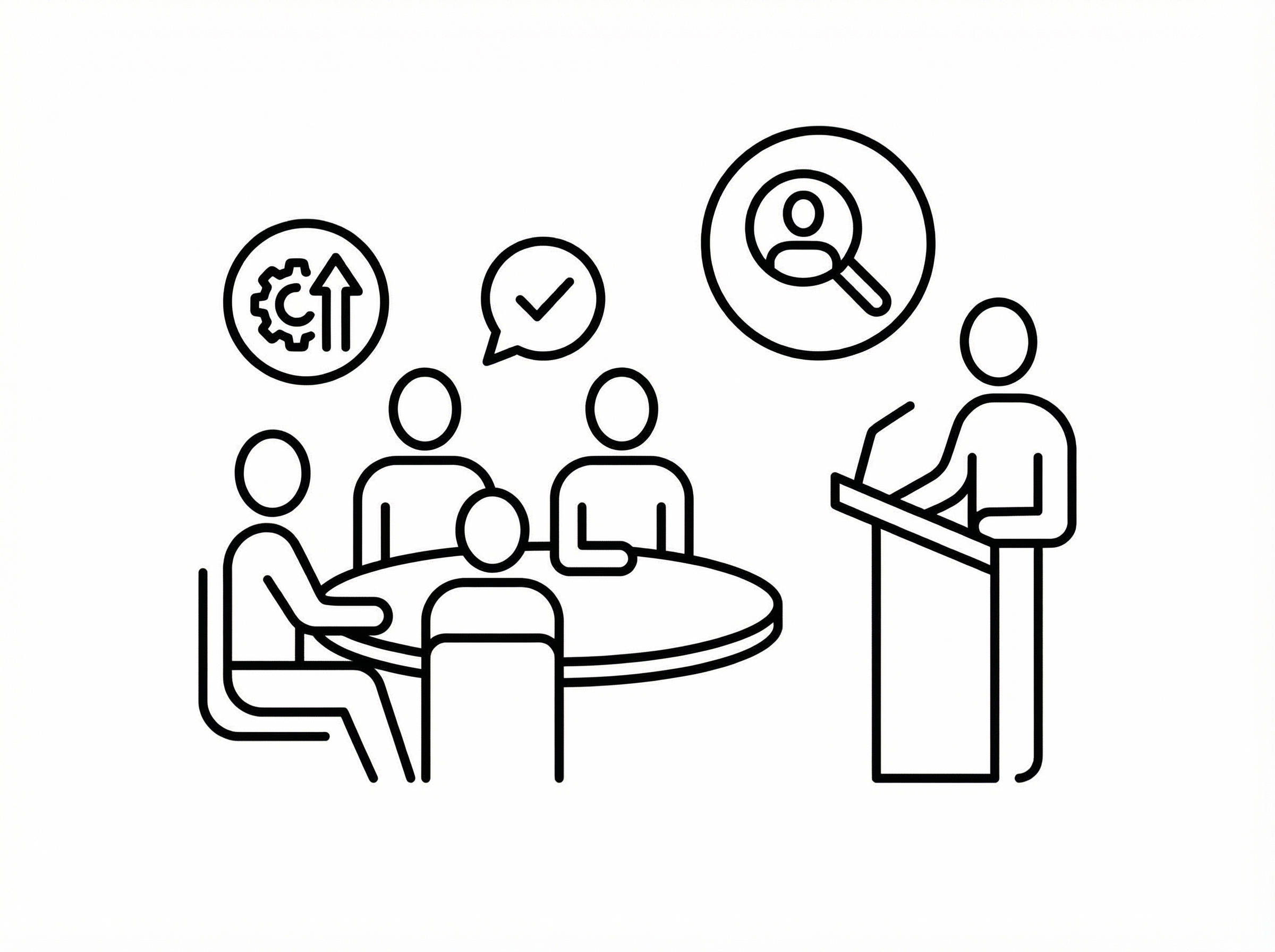
Core Insights: Best Practices for Panel Success
Running a panel is not just about putting three people in a Zoom room. That often leads to a disorganized "firing squad" dynamic. To make it work, you must apply structured interviewing principles.
1. Assign Specific Roles (The "No Overlap" Rule)
Nothing frustrates a candidate more than repeating themselves. Assign distinct roles to each panelist before the interview begins:
- The Anchor (Hiring Manager): Focuses on core competencies and behavioral questions.
- The Technical Expert: Drills down into the hard skills (e.g., "Walk us through your SEO audit process").
- The Culture Add Assessor: Looks for values alignment and cross-functional collaboration skills.
2. The "Google Rule" of Calibration
One of the biggest risks of panels is groupthink—where the most senior person speaks first, and everyone else unconsciously aligns their opinion. To solve this, adopt a strict rule: Independent Scorecards First.
Each panelist must submit their feedback and score into the ATS before the debrief discussion starts. This forces independent thought and highlights genuine disagreements, which are often where the most valuable insights lie.
3. Use Structured Scorecards
You cannot rely on memory. Interview scorecards provide a rubric for evaluating answers. If you are assessing "Strategic Thinking," the scorecard should define what a "Good" vs. "Great" answer looks like. This turns a subjective feeling ("I liked them") into an objective data point ("They cited specific metrics for their strategy").
Common Pitfalls and How to Avoid Them
The "Firing Squad" Effect
The Pitfall: Three interviewers staring blankly at a candidate can feel like an interrogation. This spikes the candidate’s anxiety, causing them to underperform.
The Fix: Designate a "Moderator." This person introduces everyone, manages the time, and ensures the conversation flows naturally. They should explicitly state: "We are all taking notes to ensure we capture your answers accurately, so please don't mind if we look down occasionally."
Wing-it Syndrome
The Pitfall: Panelists asking random questions that pop into their heads.
The Fix: A pre-briefing meeting (even just 10 minutes) is mandatory. Review the resume, assign the questions, and agree on the "must-haves."
Halo/Horn Bias
The Pitfall: One panelist loves the candidate because they went to the same university (Halo Effect), and this enthusiasm sways the others during the interview.
The Fix: Stick to the script. Structured interviews are shown to have double the predictive validity of unstructured ones because they minimize these biases.
The Breakthrough: Measuring the Impact
Back to Sarah and Mark. After switching to the panel format, the results were measurable:
- Time-to-Hire: Reduced from 45 days to 18 days.
- Pass-Through Rate: They saw fewer candidates overall but had a higher offer acceptance rate because the process felt professional and decisive.
- Calibration: In one instance, the Sales Director flagged a concern about the candidate's listening skills. Because Sarah was in the room, she witnessed the exact moment it happened. Instead of dismissing the feedback as "just an opinion," they were able to discuss the specific behavior observed.
Key Takeaway: The panel didn't just save time; it improved the quality of the hiring decision by triangulating three different perspectives on the same data set.
Career Relevance for Talent Leaders
Mastering panel interviews is a resume-differentiator for Recruiters and HR professionals. It shows you understand hiring workflow automation and organizational psychology.
Recruiter Q&A: How to talk about this in your own interview
Q: "How have you improved hiring efficiency?"
A: "I transitioned our team from sequential to structured panel interviews. This reduced our scheduling load by 40% and improved our inter-rater reliability, ensuring we made data-backed hiring decisions rather than relying on gut feeling."
Resume Boosters
- Orchestrated 50+ structured panel interviews, reducing average time-to-hire by 20% in Q4.
- Implemented bias-reduction scoring systems for cross-functional hiring panels, resulting in a 15% increase in diverse hires.
- Trained hiring managers on panel etiquette, calibration best practices, and scorecard utilization.
Pros & Cons of Panel Interviews
| Benefit (Why do it?) | Tradeoff (What to watch for) |
|---|---|
| Speed & Efficiency: Consolidates multiple steps into one, drastically reducing the "time-to-decision" gap. | Scheduling Complexity: finding a 60-90 minute slot where 3-4 busy stakeholders are free simultaneously can be difficult. |
| Bias Reduction: Diverse perspectives in the room dilute individual biases (like affinity bias). | Groupthink Risk: Without independent scoring, panelists may just agree with the loudest voice in the room. |
| Unified Context: Everyone hears the same answer, eliminating "he said/she said" debates during debriefs. | Candidate Stress: Can be intimidating for introverted candidates if the panel isn't warm and welcoming. |
Frequently Asked Questions
What is a panel interview?
A panel interview is a hiring format where a candidate is interviewed by a group of two or more people at the same time. It allows stakeholders from different departments (e.g., HR, Technical, Management) to assess the candidate simultaneously, improving efficiency and data consistency.
How many people should be on an interview panel?
The ideal number is three. This provides a tie-breaker for decisions and diverse perspectives without overwhelming the candidate. Avoid panels larger than four, as they can become difficult to manage and intimidating for the applicant.
Can panel interviews backfire?
Yes. If unstructured, they can devolve into a disorganized interrogation where panelists interrupt each other or ask overlapping questions. This creates a poor candidate experience and harms your employer brand. Success requires defined roles and a clear agenda.
How do you prepare a candidate for a panel interview?
Transparency is key. Send the candidate a list of the panelists' names and titles in advance. Explain the format (e.g., "We will spend 45 minutes on questions and 15 minutes for you to ask us questions") so they can prepare mentally.
Conclusion
Mastering the panel interview is about more than just filling a calendar slot; it is about building a durable hiring advantage. In 2025, where top talent is available for less than two weeks, the ability to gather high-quality data and make a consensus decision in a single hour is a superpower.
By moving from sequential to structured panel interviews, you respect the candidate's time, protect your company from the cost of bad hires, and elevate the role of the recruiter from "scheduler" to "talent advisor."
If you want to operationalize these workflows—from sourcing and resume screening to automated scheduling and background checks—try tools like Foundire to build a seamless, data-driven hiring infrastructure.