How to Run a Perfect Job Kickoff Meeting

How to Run a Perfect Job Kickoff Meeting
A job kickoff meeting checklist is a strategic alignment tool used by recruiters and hiring managers to define a role’s requirements, candidate persona, interview workflow, and selling points before a search begins. Unlike a standard "intake," which often just confirms a job description, a kickoff meeting establishes a service-level agreement (SLA) that prevents misalignment, reduces time-to-fill, and improves candidate quality.
According to 2026 recruitment benchmarks, unfilled roles cost companies an average of $500 per day in lost productivity. Yet, many teams skip the kickoff to "save time," only to spend months reviewing off-target resumes. If you want to stop chasing the wrong candidates, you need to start with the right conversation.
The Core Problem: Most hiring failures aren't sourcing failures—they are definition failures. A structured kickoff meeting is the single highest-leverage activity in the recruitment lifecycle.
The Alignment Gap: Why You Need a Kickoff
Imagine this scenario: Alex, a senior recruiter, receives a Slack message from Jordan, the VP of Engineering. "We need a Senior Backend Dev. Urgently. Just use the JD from last year. I need them to start next month."
Alex, eager to help, immediately scours LinkedIn, sending Jordan 15 profiles in three days. Jordan rejects all of them. "Too junior," "Wrong tech stack," "Doesn't look like a culture add."
Three weeks pass. Zero interviews. Frustration mounts. Jordan thinks Alex doesn't understand the market; Alex thinks Jordan is impossible to please.
This is the Alignment Gap. It happens when a search is treated as a transaction rather than a partnership. The job kickoff meeting is the bridge that closes this gap.
Defining the Job Kickoff Meeting
A true kickoff goes beyond "What are the requirements?" It answers "What is the business problem we are solving?" It is a 45-60 minute session where the recruiter challenges assumptions, sets realistic timelines, and agrees on how decisions will be made.
The High Cost of Misalignment
When you skip this step, the costs compound quickly:
- Wasted Recruiter Time: Hours spent screening irrelevant candidates.
- Candidate Drop-off: High-quality talent withdraws when the process feels disorganized or slow.
- Bad Hires: Rushed decisions lead to attrition. In 2026, the comprehensive cost of a bad hire can range from $17,000 to over $240,000 when factoring in opportunity costs.
Scenario: From Chaos to Clarity
Let's rewind Alex and Jordan’s story. This time, Alex pushes back. "Jordan, I know this is urgent. That’s exactly why I need 45 minutes with you on Tuesday to build a search strategy. If we don't align now, we’ll lose weeks later."
The Pre-Kickoff Struggle
Jordan is reluctant but agrees. Alex arrives prepared, not just with a blank notebook, but with labor market data showing that "Senior Backend Devs" with the specific requested stack are currently commanding 20% over budget.
Executing the Checklist
Instead of asking "What skills do they need?", Alex asks, "What will this person have accomplished in their first six months to make you say this was a home-run hire?"
They discover that Jordan doesn't actually need a generic "Senior Dev." Jordan needs someone who has specifically migrated a monolith to microservices. Suddenly, the search narrows from 10,000 candidates to 50 highly specific ones.
The Workflow Agreement
They define the "How":
- Sourcing: Alex will target competitors who recently modernized their stacks.
- Screening: They agree to use Foundire for an AI-assisted technical screen to filter for architectural understanding before Jordan sees a single resume.
- Feedback Loop: Jordan commits to reviewing shortlisted profiles within 24 hours.
The Result: Alex presents 3 candidates the next week. Jordan interviews 2. An offer is out by Day 21.
The Ultimate Job Kickoff Meeting Checklist
To replicate Alex’s success, you need a structured agenda. Use this checklist as your blueprint for every new requisition.
1. Role Reality & Logistics
Cover the non-negotiables first to avoid logistical failures later.
- Job Title vs. Market Title: Does "Data Ninja" actually mean "Data Analyst"? Use the term candidates search for.
- Salary Band & Equity: Is the budget approved? Is it competitive for 2026?
- Location/Remote Strategy: Specific in-office days? Time zone requirements?
- Start Date: Is there a hard deadline for a project launch?
2. The "Avatar" (Ideal Candidate Profile)
Move beyond keywords to behavioral traits.
- The "Must-Haves": Limit this to 3-5 hard skills. (Heuristic: If you would hire a perfect candidate without this skill, it’s not a must-have).
- The "Nice-to-Haves": Skills that can be learned on the job.
- Soft Skills/Culture Add: What personality types thrive on this specific team? (e.g., "Needs to handle ambiguity" vs. "Needs structured direction").
- Deal Breakers: What is an immediate "No"? (e.g., Job hopping every 6 months).
3. The "Sell" (EVP)
Why should a top performer leave their current job for this one?
- The Hook: What is the coolest project they will work on?
- The Career Path: Where does this role lead in 2 years?
- The Team: Who will they learn from?
4. The Interview Process Structure
Map the journey to prevent "interview fatigue."
- Assessment Layers: Resume Screen → Foundire AI Interview (for technical/behavioral filtering) → Hiring Manager Deep Dive → Final Panel.
- Who Assesses What? Assign specific competencies to specific interviewers to avoid asking "Tell me about yourself" four times.
5. Calibration & SLA
- Live Calibration: Look at 3-5 LinkedIn profiles during the meeting. Ask the manager: "Would you interview this person? Why or why not?"
- Feedback SLA: "I commit to submitting candidates by Friday. You commit to feedback within 48 hours."
Common Pitfalls to Avoid
The "Unicorn" Trap: Accepting a laundry list of requirements that doesn't exist in one human. Fix: Force rank the requirements.
Vague Culture Fit: Accepting "I'll know it when I see it." Fix: Demand behavioral examples of what "good" looks like.
Ignoring Technology: Relying solely on manual resume reviews. Fix: Integrate tools like Foundire to automate the first-round screen, ensuring only qualified candidates reach the hiring manager.
The Breakthrough: Measuring Impact
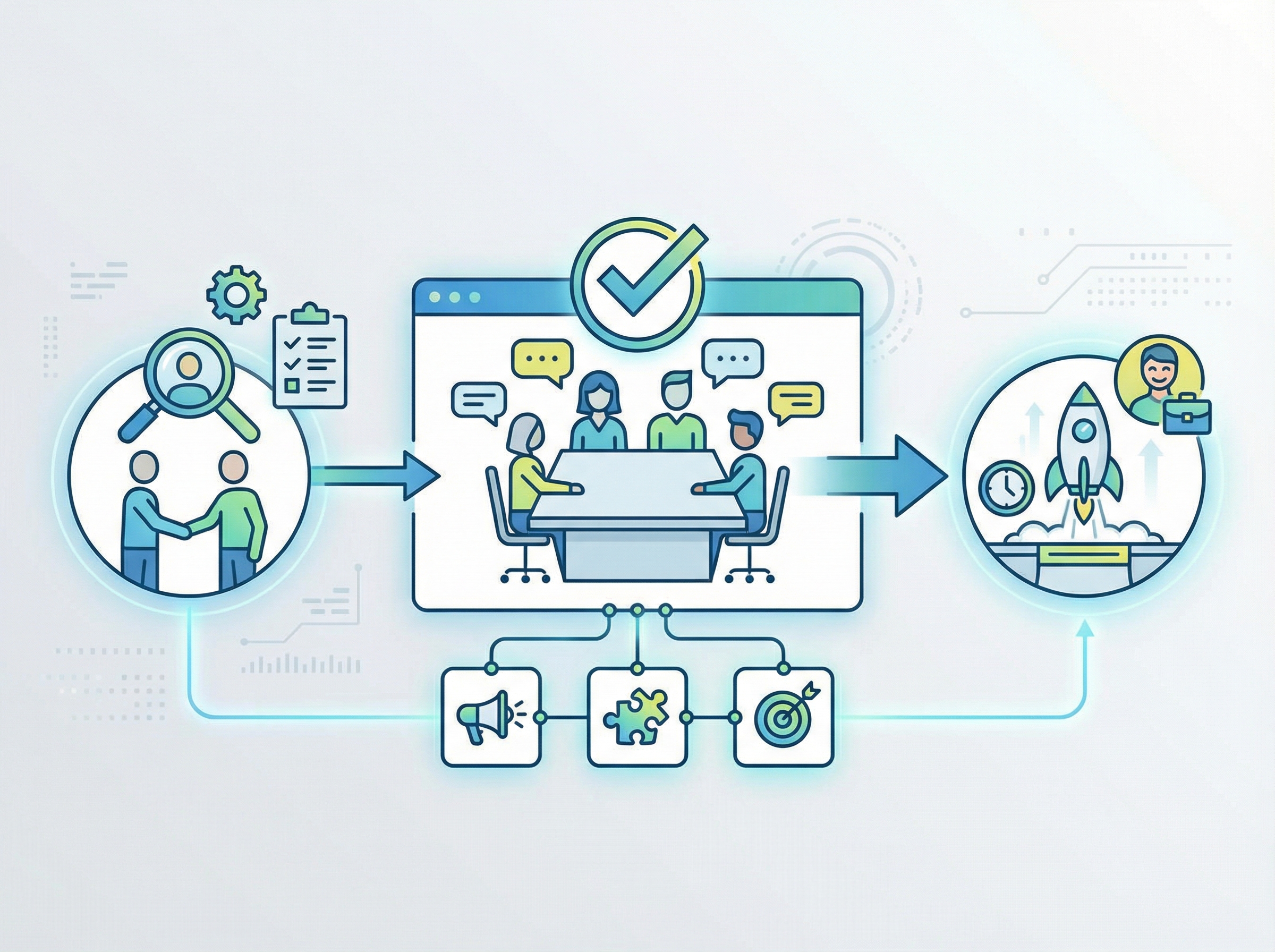
Implementing this checklist creates a "breakthrough moment" where recruitment shifts from reactive to proactive. In organizations that switch to this structured kickoff model, we often see:
- Pass-Through Rates Improve: Candidates submitted to interview ratios jump from 3:1 to 1:1.
- Time-to-Fill Drops: By eliminating the "calibration drift" where criteria change mid-search, cycles reduce by 30-40%.
- Candidate Experience Soars: Candidates aren't ghosted or subjected to redundant interview questions.
When you operationalize the kickoff, you aren't just filling a seat; you are building a predictable revenue engine for the business.
Career Advantage & Strategic Value
For recruiters and talent leaders, mastering the kickoff meeting is a career accelerator. It positions you as a Talent Advisor rather than a resume pusher.
Job Kickoff Pros & Cons
| Benefits (Strategic Alignment) | Tradeoffs (Investment) |
|---|---|
| Higher Quality Hires: Clear criteria lead to better long-term retention and performance. | Upfront Time Investment: Requires 45-60 minutes before the search starts, which can feel slow to impatient managers. |
| Faster Decisions: Pre-agreed scorecards remove hesitation during the offer stage. | Requires Pushback: Recruiters must be comfortable challenging hiring managers on unrealistic expectations. |
| Data-Driven Process: Sets a baseline for measuring funnel metrics and bottlenecks. | Rigidity Risk: If not revisited, a strict checklist can miss "wildcard" talent that doesn't fit the box perfectly. |
Interview Prep: The "Difficult Manager" Question
Q: "Tell me about a time you managed a difficult hiring manager."
A: "I had a manager who rejected every resume but couldn't articulate why. I pressed pause and scheduled a structured kickoff meeting. We reviewed profiles live, and I forced him to rank his 'must-haves.' We discovered his JD didn't match his actual need. By realigning the search criteria and agreeing on a feedback SLA, we hired the next candidate I presented. It reduced our time-to-fill by 40%."
Resume Bullet Examples
- Implemented a standardized job kickoff meeting checklist across Engineering, reducing time-to-hire from 60 to 35 days.
- Achieved 100% hiring manager satisfaction score by establishing pre-search SLAs and calibration workflows.
- Reduced candidate drop-off by 25% by aligning interview stages and selling points during the intake process.
Frequently Asked Questions
What is a job kickoff meeting checklist?
A job kickoff meeting checklist is a document used by recruiters to gather comprehensive details about a job opening. It covers role responsibilities, candidate persona, selling points, interview structure, and timelines to ensure the hiring team is aligned.
Can a job kickoff meeting backfire?
Yes, if it becomes too rigid. If a recruiter refuses to adapt the checklist based on market feedback, or if the meeting turns into an interrogation rather than a partnership, it can damage the relationship with the hiring manager.
Who should attend the intake meeting?
The primary attendees are the Recruiter and the Hiring Manager. Ideally, a Sourcer (if applicable) should join. Occasionally, a peer from the team can join to provide a "day-in-the-life" perspective, but keep the group small to ensure decisions are made.
How long should a kickoff meeting last?
Plan for 45 to 60 minutes. Anything less usually results in surface-level details. If you finish early, use the remaining time to source candidates live together.
Conclusion
The difference between a struggling recruiting team and a high-performing one often comes down to the quality of the kickoff. By investing one hour upfront to execute a job kickoff meeting checklist, you save hundreds of hours of frustration down the line.
Remember, this checklist is a living document. As the market shifts, so should your strategy. But without that initial alignment, you are navigating without a map.
If you want to operationalize this workflow—from sourcing and resume screening to AI interviews and structured scorecards—try tools like Foundire (https://foundire.com). It helps you turn your kickoff strategy into an automated, data-driven hiring engine.