How to Reduce Subjective Bias in Hiring

How to Reduce Subjective Bias in Hiring
Subjective bias in hiring is the unconscious tendency of recruiters and hiring managers to favor candidates who share their personal traits, background, or "vibe," rather than assessing actual skills and potential. It is the invisible force that turns a "culture fit" interview into a mirror image of the interviewer, leading to homogenous teams and missed talent.
For organizations, the stakes of failing to reduce subjective bias are quantifiable and steep. Recent 2025 data suggests that unstructured, bias-prone interviews predict job performance only slightly better than a coin flip, while bad hires can cost companies upwards of $50,000 in replacement costs and lost productivity. By operationalizing objectivity, talent leaders can improve hiring speed, diversity, and long-term retention.
The Narrative Hook: When Intuition Fails
Consider Sarah, a VP of Engineering who prided herself on her "gut instinct" for talent. During a final round interview for a Senior Developer role, she met David. David was quiet, wore a slightly ill-fitting suit, and didn’t laugh at Sarah’s opening joke. Within three minutes, Sarah’s brain had categorized him: low energy, bad culture fit. She spent the next 25 minutes asking easy "softball" questions, unconsciously confirming her bias. She rejected him.
Two weeks later, a competitor hired David. Within six months, he led the development of a patch that saved them millions. Sarah didn't reject David because he lacked skills; she rejected him because her subjective bias mistook "nervousness" for "incompetence." This is the high cost of the gut feeling.
Scenario: Anatomy of a Biased Workflow
To understand how to fix bias, we must first dissect where it lives in a typical recruitment funnel. Let’s look at a standard, unstructured process managed by "Mark," a Hiring Manager at a mid-sized tech firm.
The Unstructured Interview Trap
Mark needs to hire a Project Manager. He receives 50 resumes and creates a shortlist based on proxies: he flags candidates who went to "good schools" (Affinity Bias) and ignores those with employment gaps (Horn Effect). When he begins interviews, he has no script.
- Candidate A (who likes the same sports team as Mark): Mark spends 15 minutes chatting about the playoffs and asks, "What’s your greatest strength?"
- Candidate B (who has a background Mark is unfamiliar with): Mark grills them immediately on technical failures: "Tell me about a time you missed a deadline."
Mark isn't being malicious; he is being human. But the result is that Candidate A is evaluated on likability, while Candidate B is evaluated on competence. The data is incomparable.
Measuring the Damage
By the offer stage, Mark’s funnel is leaking value. His "pass-through rate" for candidates from non-traditional backgrounds is near zero. Even worse, the "Halo Effect"—where one positive trait (like confidence) overshadows major flaws—leads him to hire a candidate who interviews well but struggles to execute. The metric to watch here is Quality of Hire. In Mark's case, his 90-day retention rate drops because his "gut" keeps selecting for charisma rather than capability.
3 Strategies to Reduce Subjective Bias
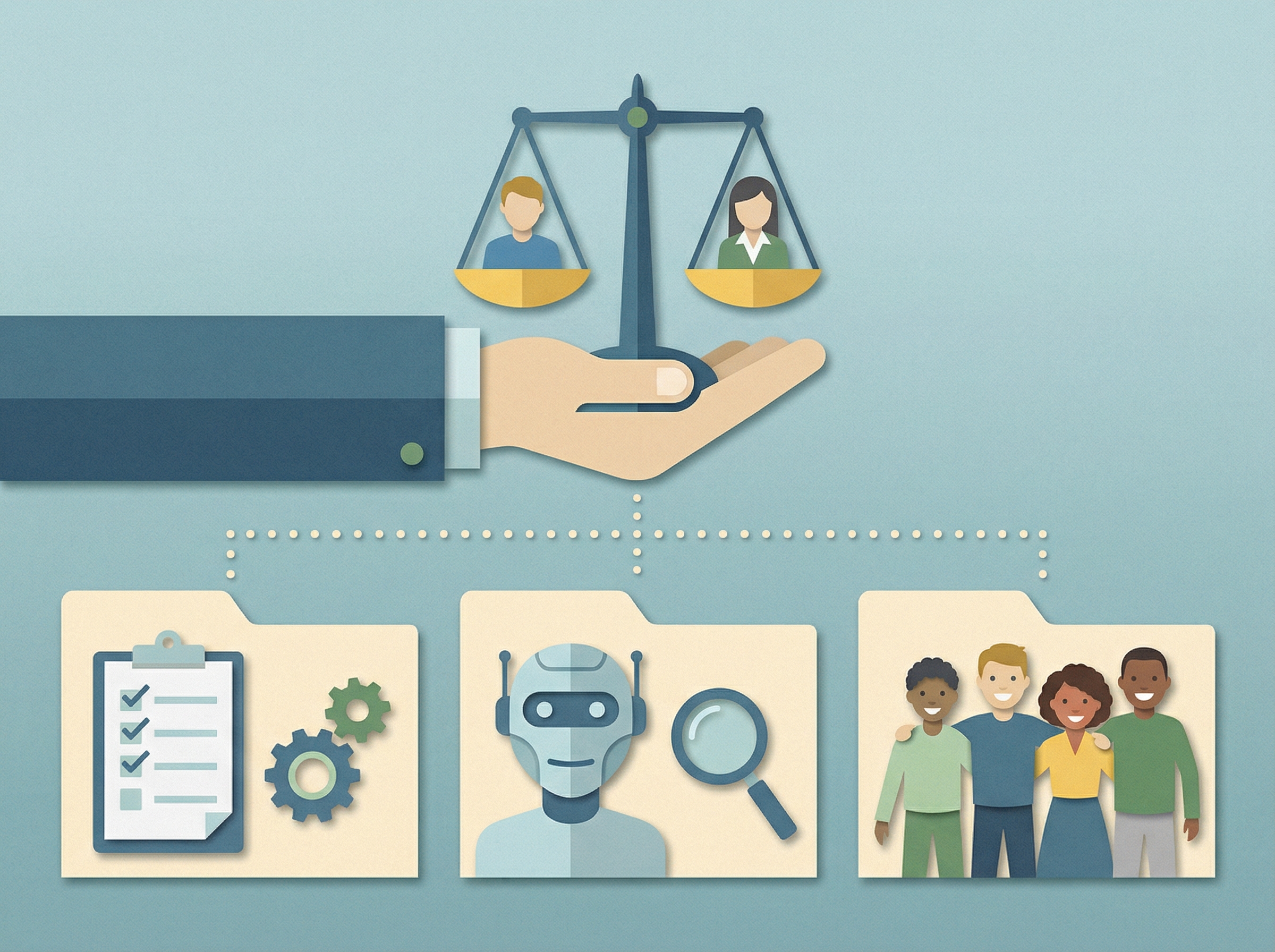
Reducing subjective bias requires moving from "art" to "engineering." You cannot simply "try harder" to be unbiased; you must build systems that prevent bias from entering the room.
1. Implement Structured Interviews
The single most effective intervention is the structured interview. This involves asking every single candidate the exact same questions, in the same order, and scoring them against a pre-defined rubric.
Heuristic: If you didn't ask Candidate A the question, you can't use Candidate B's answer against them.
Research consistently shows that structured interviews are up to twice as predictive of job performance as unstructured ones. By forcing consistency, you strip away the noise of "how much I liked them" and focus on "how well they answered."
2. Anonymize the Screening Layer
Bias often strikes before the first phone call. Blind resume screening involves removing names, photos, graduation years, and university names from applications. Recent studies have shown that "whitening" resumes—removing cues of racial identity—can double callback rates. By removing demographic triggers, you force the screener to focus exclusively on skills and experience.
Modern AI interview platforms can assist here by parsing resumes for skills rather than pedigree, ensuring that a candidate from a state university is weighed equally to one from an Ivy League school if their Python skills are identical.
3. Calibrate Before You Commit
Subjectivity thrives in ambiguity. To combat this, hold a calibration session with your interview panel before meeting candidates. Define what a "5 out of 5" answer looks like versus a "3 out of 5."
For example, if the question is "Tell me about a time you resolved a conflict," a calibrated rubric might look like:

- Poor (1-2): Blames others, takes no personal responsibility.
- Average (3): Describes a standard resolution but lacks specific action.
- Excellent (4-5): Demonstrates empathy, outlines specific steps taken, and cites a measurable positive outcome.
The Breakthrough: Data Over Instinct
The turning point for many organizations comes when they switch from horizontal scoring (one interviewer scores a whole candidate) to vertical scoring.
The Vertical Scoring Method
In a vertical scoring model, you evaluate one specific competency across all candidates before moving to the next. For instance, if you are hiring 10 people, you review the "Coding Challenge" results for all 10 blindly, scoring them purely on code quality. Only then do you look at the "Communication" scores.
This method breaks the Halo Effect. You might find that Candidate C has excellent code (Score: 5) but poor communication (Score: 2). In a traditional "gut feeling" wrap-up, the interviewer might bump the communication score up because "they are such a great coder." Vertical scoring forces you to see the candidate as a collection of data points, not a single narrative.
The Aftermath
Teams that adopt these workflows report startling changes. Pass-through rates for underrepresented groups often rise by 30% or more. But the real victory is speed. Because the criteria are objective, hiring committees stop debating "feelings" and start comparing scores. Consensus is reached faster, and offers go out sooner to the right people. Tools like Foundire are increasingly used to automate these structured assessments, ensuring that every candidate gets a fair, standardized shot regardless of who reviews their file.
Career Advantage: Leading with Objectivity
For recruiters and talent leaders, mastering the ability to reduce subjective bias is a career differentiator. It signals that you are a strategic operator, not just a "people person."
Differentiation for Recruiters
When you are interviewing for a Talent Acquisition role, you will inevitably be asked: "How do you ensure you are hiring the best talent?"
A Subjective Answer: "I really try to connect with candidates and trust my instincts on whether they fit the culture."
A Strategic Answer: "I implement structured interviewing workflows to reduce subjective bias. By standardizing our questions and using calibrated scorecards, I ensure we hire based on competency. In my last role, this reduced our 90-day attrition by 15%."
Resume Builder
Add these bullets to your resume to showcase your expertise:
- Designed and implemented structured interview kits for Engineering roles, reducing subjective bias and increasing offer acceptance rate by 12%.
- Led "License to Hire" training for 50+ managers, teaching calibration and scorecard usage to minimize unconscious bias.
- Operationalized blind resume screening workflows, resulting in a 25% increase in candidate pipeline diversity.
Pros & Cons: The Reality of Structured Hiring
| Benefit | Tradeoff |
|---|---|
| Higher Quality of Hire: Decisions are based on evidence and skills, leading to better performance and retention. | High Upfront Effort: Creating rubrics, question banks, and training managers takes significant time before the first interview. |
| Legal Defensibility: Standardized processes protect the company against discrimination claims. | Perceived "Stiffness": Some candidates (and managers) may feel the process lacks the warmth of a casual chat. |
| Diversity & Inclusion: Naturally removes barriers for non-traditional candidates by focusing on output over pedigree. | Rigidity Risks: If the structured questions are bad, you will consistently get bad data. The system is only as good as the input. |
Frequently Asked Questions
What is subjective bias in recruitment?
Subjective bias is the unconscious tendency to evaluate candidates based on personal feelings, stereotypes, or unrelated traits (like hobbies or appearance) rather than job-related skills. It often manifests as "gut feeling" or "culture fit."
Can structured interviews really reduce bias?
Yes. By asking every candidate the same questions in the same order and using a scoring rubric, you generate comparable data. Research shows structured interviews significantly reduce the impact of gender, race, and affinity bias compared to unstructured chats.
Can attempts to reduce bias backfire?
Yes, if not monitored. For example, "blind hiring" can sometimes reduce diversity if the underlying criteria (like requiring a specific degree) are themselves biased. It is crucial to audit the requirements as well as the process.
What tools help eliminate unconscious bias?
Tools that anonymize resumes, platform-based skills assessments (like coding tests), and structured interview software (like Foundire) help detach the evaluation from the candidate's demographics. Scorecards are the simplest low-tech tool available.
Mastering the art of objectivity isn't just about "fairness"—it is about competitive advantage. The companies that learn to see past the noise of subjective bias are the ones that find the hidden talent their competitors overlook.
If you want to operationalize reduce subjective bias with structured workflows—from sourcing and resume screening to AI interviews and scorecards—try tools like Foundire (https://foundire.com).