How to Match Resumes to Job Descriptions

How to Match Resumes to Job Descriptions
How to match resumes to job descriptions is the strategic process of aligning a candidate’s capabilities—skills, experience, and trajectory—with the specific performance requirements of a role. It is not just about keyword tallying; it is about predicting success.
Why does this matter? Effective matching reduces time-to-fill, lowers the staggering cost of bad hires (estimated at 30% of first-year salary), and ensures that only the highest-potential candidates reach the interview stage. It transforms recruitment from a reactive sorting task into a proactive talent calibration engine.
For most recruiters, the "Recruiter's Dilemma" is a daily reality: you have 250 applicants and only enough hours to thoroughly vet ten. The goal is to identify those ten without accidentally discarding the hidden gem who didn't format their resume perfectly.
The Recruiter’s Nightmare: A Real-World Scenario
Let’s look at a common scenario to illustrate the friction in traditional resume matching.
Meet Sarah, a Talent Acquisition Manager at a mid-sized tech firm. She is hiring for a "Senior Product Manager." On Monday morning, she opens her Applicant Tracking System (ATS) to find 245 new applications.

The "Before" Workflow (Manual & Keyword-Heavy):
- Intake: The hiring manager gave a vague list of requirements: "Agile," "SQL," and "good communication."
- Screening: Sarah scans each resume for roughly 7 seconds (the industry average). She essentially plays "Control+F" with her eyes, looking for "Agile" and "SQL."
- The Result: She shortlists 15 candidates who stuffed their resumes with those exact keywords. She rejects a candidate named Marcus, whose resume listed "Scrum Master certification" and "Data querying expertise" but didn't explicitly say "Agile" or "SQL" in the top summary.
- The Consequence: After 10 hours of phone screens with the "keyword matches," the hiring manager rejects all of them for lacking strategic depth. Sarah has to start over.
This process highlights the core failure of surface-level matching: it prioritizes vocabulary over capability. Sarah burned valuable time and missed Marcus, a high-potential candidate, because her matching heuristics were too rigid.
5 Strategies for Accurate Candidate Alignment
To move beyond simple keyword matching and start truly aligning talent with opportunity, modern recruiters use a mix of advanced heuristics and semantic understanding.
1. Map Semantics, Not Just Keywords
Top-tier recruiters and modern AI tools don't look for exact matches; they look for semantic equivalents. If a job description requires "Project Management," a rigid matcher looks for those words. A semantic matcher accepts "Scrum Master," "Sprint Lead," or "Delivery Manager."
Pro Tip: Create a "synonym cloud" during your intake meeting. Ask the hiring manager, "If a candidate doesn't have 'Salesforce' experience, what other CRM experience would be a valid proxy?"
2. Analyze Career Trajectory
Matching isn't just about what a candidate has done; it's about where they are going. A resume that matches 100% of your requirements might actually be a flight risk—they’ve already done the job and might get bored. Look for a 70% match with an upward trajectory.
- Tenure: Does the candidate stay long enough to see the results of their work (2+ years)?
- Growth: Have their titles or responsibilities expanded within the same company?
3. Identify "Invisible" Soft Skills
You cannot "Control+F" for leadership or adaptability. You have to infer them from the bullet points.
Poor Match: "Responsible for leading the team."
Strong Match: "Mentored 4 junior developers who were subsequently promoted to senior roles." (This matches a requirement for "Team Leadership" and "Talent Development".)
Common Pitfalls to Avoid
Even experienced teams fall into these traps when matching resumes:
- The Pedigree Trap: Over-weighting candidates from prestigious universities or "FAANG" companies. A resume from a big-name company matches the brand, not necessarily the job description.
- Formatting Bias: Rejecting a strong candidate because their resume layout is difficult to parse visually. This is where AI tools often outperform humans—they can extract data regardless of ugly fonts.
- The "Unicorn" Delusion: discarding resumes that miss one minor "nice-to-have" skill. This often eliminates 80% of the viable talent pool.
The Breakthrough: Automating the Match
Let’s return to Sarah. After her failed first round, she shifts her strategy. Instead of manual scanning, she employs a structured hiring workflow assisted by intelligent tools.
The "After" Workflow (Semantic & Structured):
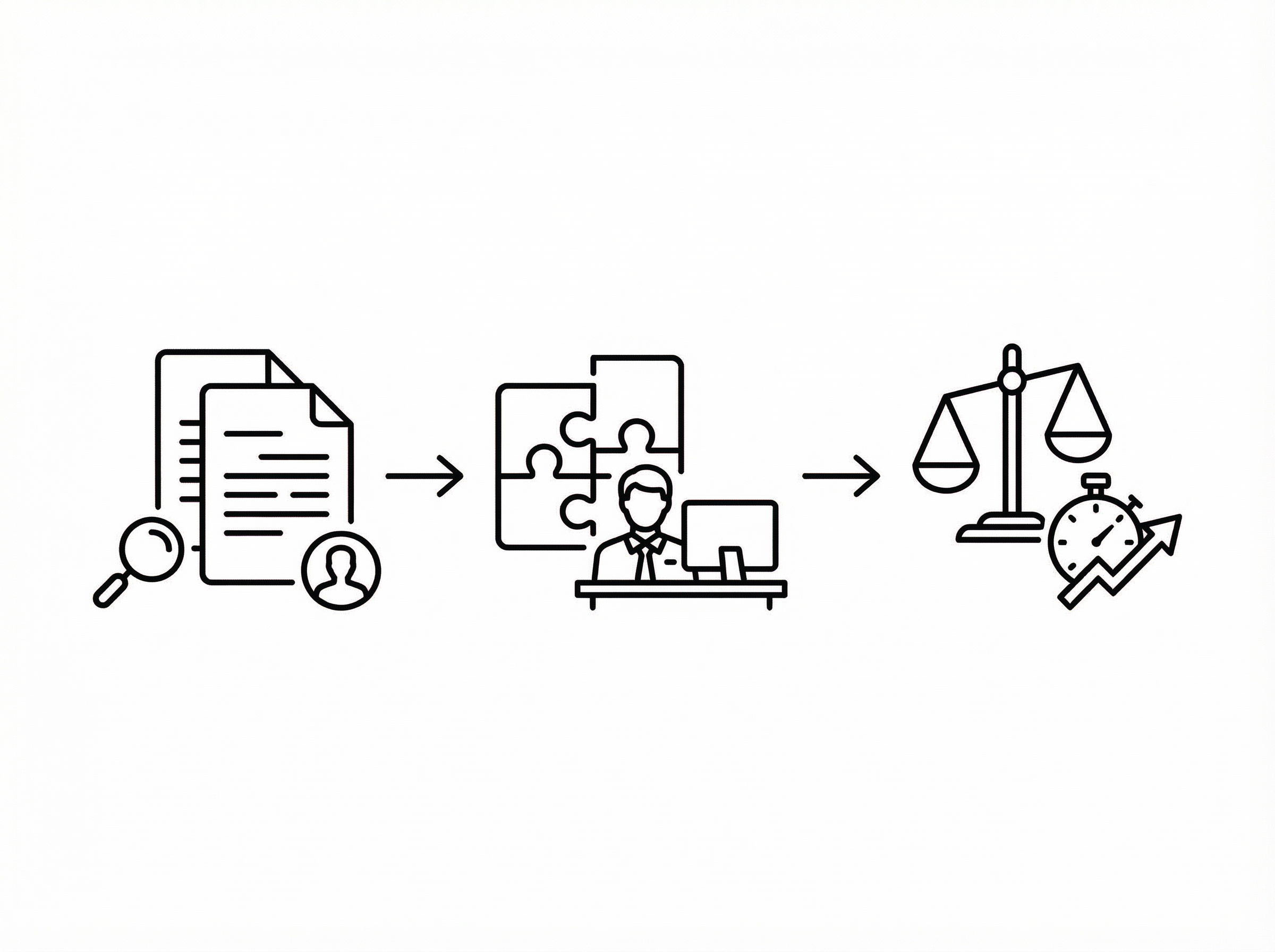
- Calibrated Intake: Sarah defines the outcome of the role ("Launch product X") rather than just a list of skills.
- Automated Screening: She uses a tool (like Foundire or similar AI interview platforms) that parses resumes for competencies rather than keywords. The system highlights Marcus (the previously rejected candidate) because it recognizes "Scrum Master" as a high-value match for the Agile requirement.
- Objective Scoring: Instead of a "gut feeling," Sarah uses an interview scorecard. The candidates are ranked based on how well their resume evidence supports the core competencies.
The Impact:
- Time Saved: Resume screening time dropped from 8 hours to 30 minutes.
- Pass-Through Rate: The interview-to-offer ratio improved. 4 out of 5 candidates sent to the hiring manager were approved for final rounds (up from 0 out of 10).
- Quality of Hire: Marcus was hired and launched the product two weeks ahead of schedule.
Recruiter Toolkit: Career Growth & Executing the Match
Mastering resume matching is a high-value skill. If you are a recruiter interviewing for a new role, you need to articulate how you match candidates to show you are strategic, not just administrative.
Interview Q&A: How to answer "What is your screening process?"
"I don't just keyword match. I use a semantic approach where I calibrate with the hiring manager to define 'must-haves' versus 'coachable' skills. I look for evidence of problem-solving that aligns with the business goals, which typically improves my submittal-to-interview ratio to over 75%."
Resume Bullets for Your Own Portfolio
If you have implemented better matching protocols, add these to your own resume:
- "Implemented semantic resume matching strategy, increasing interview pass-through rates by 22%."
- "Reduced time-to-fill by 15 days by operationalizing automated screening tools for high-volume roles."
- "Partnered with engineering leadership to redefine job descriptions, resulting in a 40% increase in qualified diverse candidates."
Pros & Cons of Automated Matching
| Benefit | Tradeoff |
|---|---|
| Speed & Scale: Can process 1,000+ resumes instantly, identifying top tier candidates based on complex criteria. | False Negatives: Highly creative or non-traditional resumes might be ranked lower if the AI model is too rigid. |
| Reduced Bias: blinded screening can remove age, gender, and university bias from the equation. | Keyword Gaming: Savvy candidates can still "stuff" resumes with invisible text to trick older ATS systems (though newer AI catches this). |
| Consistency: Every resume is evaluated against the exact same criteria, every time. | Context Loss: AI might miss the nuance of a career gap taken for caregiving or a sabbatical that actually added soft skills. |
Frequently Asked Questions
What is semantic resume matching?
Semantic matching is a technology that understands the meaning behind words. It knows that "ReactJS" implies "JavaScript" proficiency, or that a "Chief of Staff" likely has "Strategic Planning" skills, even if those exact words aren't on the page. It matches capabilities, not just text.
Can strict matching backfire?
Yes. If your job description is poorly written (e.g., asking for 10 years of experience in a 5-year-old technology), strict matching will return zero candidates. You must validate the job description's realism before you start matching resumes against it.
How do I handle resume gaps when matching?
Focus on the trajectory before and after the gap. If the candidate held increasing responsibility before the gap and returned to a similar level, the gap is likely irrelevant to their capability. Modern matching focuses on competency currency—do they have the skills now?
Does AI replace manual screening entirely?
No. AI is a ranking tool, not a decision maker. It effectively sorts the "Definitely No" from the "Maybe," allowing humans to spend their time deeply engaging with the top 10-20% of applicants rather than drowning in the bottom 80%.
Conclusion
Learning how to match resumes to job descriptions effectively is the difference between being a "resume pusher" and a "talent advisor." By combining human insight with semantic tools, you can look past formatting and keywords to find the actual potential in a candidate.
If you want to operationalize this with structured workflows—from sourcing and resume screening to AI interviews and background checks—try tools like Foundire to modernize your hiring stack.