How to Master the STAR Method for Hiring Teams

How to Master the STAR Method for Hiring Teams
The STAR method (Situation, Task, Action, Result) is a structured framework used by interviewers to gather concrete evidence of a candidate's skills and by candidates to tell compelling, data-driven stories. By focusing on specific examples of past behavior, it moves hiring decisions from "gut feeling" to predictive validity. For hiring teams, mastering STAR is the difference between hiring a "good talker" and hiring a high performer; for candidates, it is the key to proving potential through past performance.
Imagine this: You just finished an interview with a candidate who was charismatic, confident, and funny. You leave the room thinking, "They're a great culture fit." But three months later, that same hire is missing deadlines and struggling with basic problem-solving. What went wrong? You likely fell for the "halo effect"—hiring based on likability rather than capability. This is the exact problem the STAR method solves, providing a rigor that research shows makes structured interviews twice as predictive of job performance compared to unstructured chats.
Real-World Scenario: From "Vibes" to Verified Skills
Meet Sarah, a Talent Acquisition Director at a mid-sized tech firm. Her team was drowning in a common crisis: high volume, low quality. They were interviewing dozens of candidates per role, yet their 90-day turnover rate was creeping toward 25%. The feedback in their ATS looked like this: "Great energy," "Seemed smart," or "Not sure, maybe too quiet?"
The Broken Workflow
Sarah’s team was relying on conversational interviews. They asked hypothetical questions like, "How would you handle a difficult client?" This allowed candidates to theorize rather than prove. The result was a pipeline clogged with people who knew the right answers but couldn't execute them.
The STAR Intervention
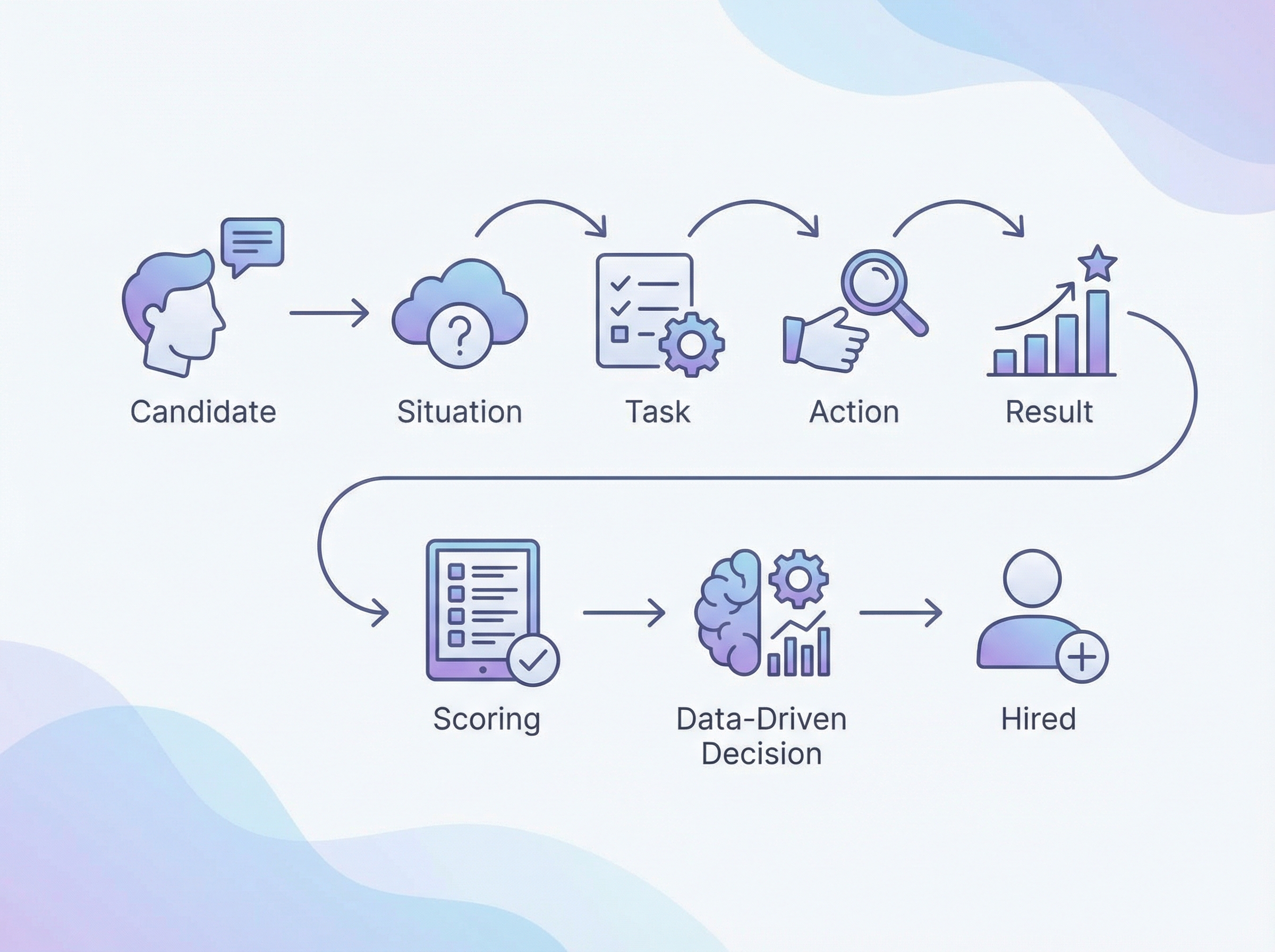
Sarah implemented a structured interviewing protocol using the STAR method across the entire hiring funnel:
- Intake: Hiring managers defined 3 core competencies (e.g., "Conflict Resolution") and mapped them to specific STAR questions.
- Screening: Recruiters looked for STAR structures in resume bullets (e.g., "Led [Action] to achieve [Result]").
- Interview: Panelists were forbidden from asking "How would you...?" and replaced it with "Tell me about a time you..."
- Scoring: Instead of a thumbs up/down, interviewers rated the quality of the Action and the impact of the Result on a scorecard.
The Metric Shift
Within six months, the impact was measurable. By forcing candidates to ground their answers in reality, the team identified "fluff" responses earlier. Their pass-through rate from onsite-to-offer improved by 40% because only qualified candidates made it to the final rounds. More importantly, the 90-day turnover rate dropped to under 10%, saving the company an estimated $150,000 in replacement costs.
Core Insights: Eliciting and Scoring STAR Responses
Implementing STAR isn't just about asking the right questions; it's about listening for the right components. Whether you are a recruiter or a hiring manager, here are the heuristics to master.
1. The "Action" Probe: Separating Passengers from Drivers
The most common pitfall in candidate answers is the "We" trap. A candidate might say, "We launched the project on time." While teamwork is good, you are hiring the individual, not their previous team.
The Heuristic: If a candidate spends 80% of their answer on the Situation and Task, interrupt them. The gold is in the Action. Drill down with:
"I understand the team goal, but what specific step did you take that no one else did?"
2. The "Result" Validation: Quantifiable vs. Qualitative
A weak STAR answer ends with, "...and the client was happy." A strong STAR answer ends with data. According to recent 2025 hiring statistics, candidates who quantify their results are 30% more likely to be hired. As an interviewer, if the Result is missing, you must ask for it.
- Weak: "It saved time."
- Strong: "It reduced processing time by 15 hours per week, saving the department $12k annually."
3. Pitfalls and Misconceptions
Even structured processes have cracks. Watch out for these common errors:
- The Rehearsed Robot: Candidates are now using AI to script STAR answers. If an answer sounds too perfect, ask a "negative constraint" follow-up: "That sounds like a great success, but what was the biggest risk you took during that process that almost failed?"
- The Hypothetical Drift: Candidates often slip from "I did" to "I would." This is a red flag. It usually means they haven't actually done what they are describing. Gently steer them back: "Let's stick to what actually happened in that specific instance."
The Breakthrough: Data-Driven Calibration
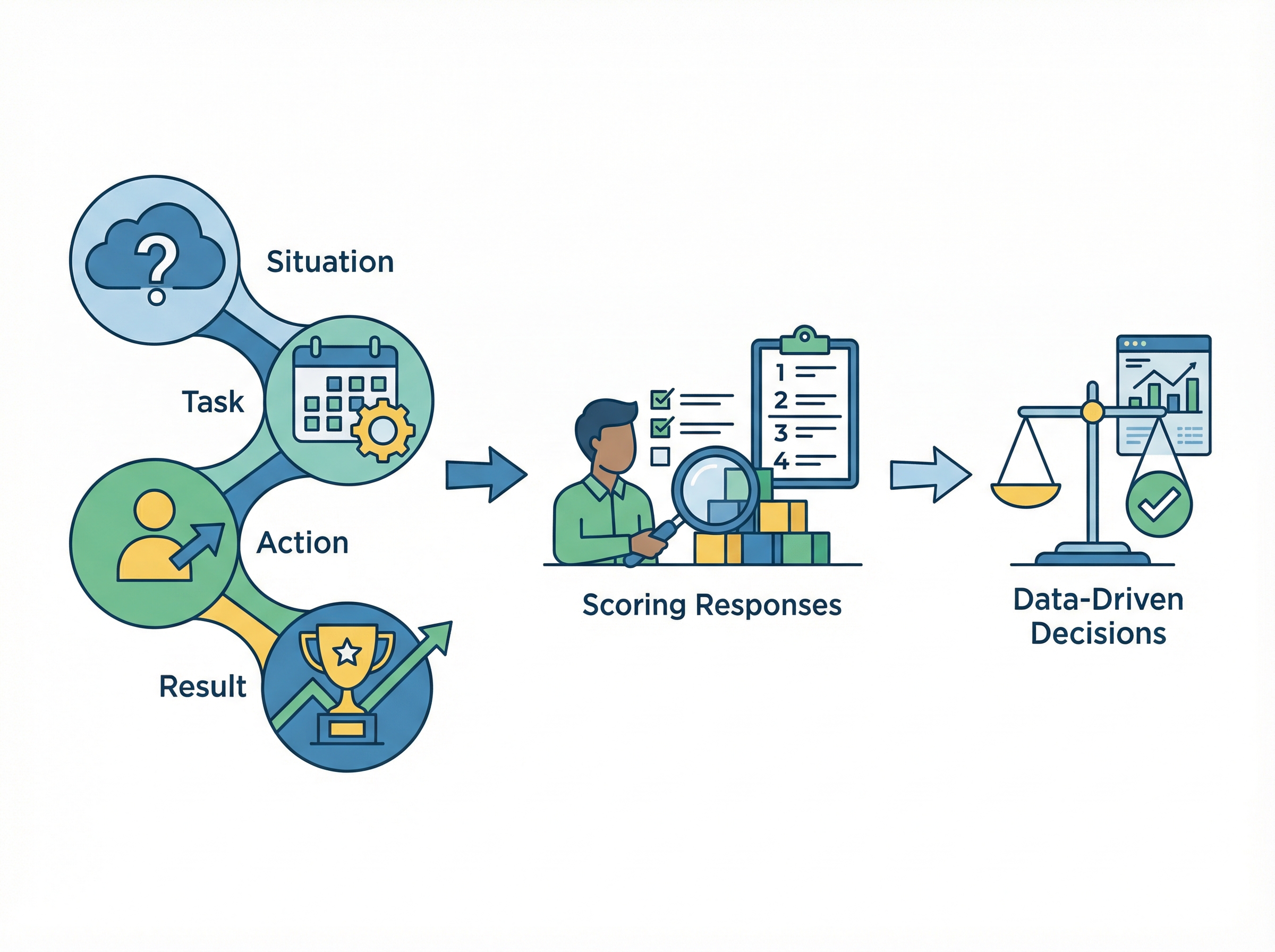
The true power of STAR isn't in the interview room—it's in the debrief (calibration) meeting. Before Sarah's team used STAR, debriefs were debates of opinion. "I liked him" vs. "I didn't feel a spark."
After implementing structured STAR scorecards, the conversation shifted to evidence. One interviewer might say, "I rated her low on Strategic Thinking." Another could counter, "Really? In her answer regarding the supply chain disruption (Situation), she negotiated a new vendor contract (Action) that saved 20% (Result). That demonstrates high strategic thinking."
The Outcome:
- Bias Reduction: Decisions were based on documented behavior, not personality affinity.
- Legal Safety: Structured interviews have survived 100% of legal challenges in recent studies, compared to only 59% for unstructured ones.
- Speed: Decision meetings that used to take 45 minutes were cut to 15 minutes because the data was clear.
Career Relevance for Talent Leaders
For recruiters and HR professionals, mastering the STAR method is a career accelerator. It moves you from an "administrative scheduler" to a "talent advisor."
Q&A: How to Sell STAR to Leadership
Q: "How have you applied STAR to improve outcomes in your previous role?"
A: "I transitioned our hiring process from unstructured chats to competency-based interviews using the STAR framework. I standardized our interview guides to ensure every candidate was evaluated on the same criteria. This reduced our time-to-fill by 20% and improved our quality of hire, as evidenced by a 15% increase in first-year performance ratings."
Resume Bullets for Talent Pros
If you are applying for a role in Talent Acquisition, use these bullets to show your expertise:
- Designed and implemented structured interview guides using the STAR methodology, increasing hiring panel alignment by 90%.
- Trained 50+ hiring managers on behavioral interviewing techniques, reducing candidate drop-off due to poor interviewer conduct.
- Operationalized STAR-based scoring in the ATS to automate data-driven hiring decisions.
Pros & Cons of the STAR Method
| Benefits (Why it works) | Tradeoffs (What to watch) |
|---|---|
|
|
Frequently Asked Questions
What is the STAR method exactly?
The STAR method is a behavioral interview technique used to answer questions about past experiences. It stands for Situation (context), Task (challenge), Action (what you did), and Result (outcome). It provides a structured format to tell linear, evidence-based stories.
Can the STAR method backfire with rehearsed candidates?
Yes. Candidates often memorize STAR stories that sound perfect but lack depth. To counter this, skilled interviewers use "probing questions" to dig into specific details of the "Action" phase, asking for names of stakeholders, specific timelines, or alternative actions considered, which are hard to fake on the spot.
How do I probe if a STAR answer feels fake?
If a story feels generic, ask: "Walk me through the conversation you had when you made that decision," or "What was the specific data point that made you choose path A over path B?" Details verify authenticity; vagueness hides fabrication.
Why is the Result portion often missing?
Candidates often confuse "busyness" with "business impact." They stop the story after describing their hard work. It is the interviewer's job to ask, "So, what was the outcome of all that effort?" to force the candidate to define the value created.
Closing
Mastering the STAR method is not just about better interviews; it is about building a durable hiring advantage. By operationalizing this framework, you transform hiring from a guessing game into a predictable business process. The teams that win the talent war in 2026 won't be the ones with the best chats—they will be the ones with the best evidence.
If you want to operationalize the STAR method with structured workflows—from Sourcing and resume screening to AI interviews, scorecards, offers, and background checks—try tools like Foundire (https://foundire.com) to automate and elevate your hiring precision.