How to Master Structured Interviewing for Better Hires

How to Master Structured Interviewing for Better Hires
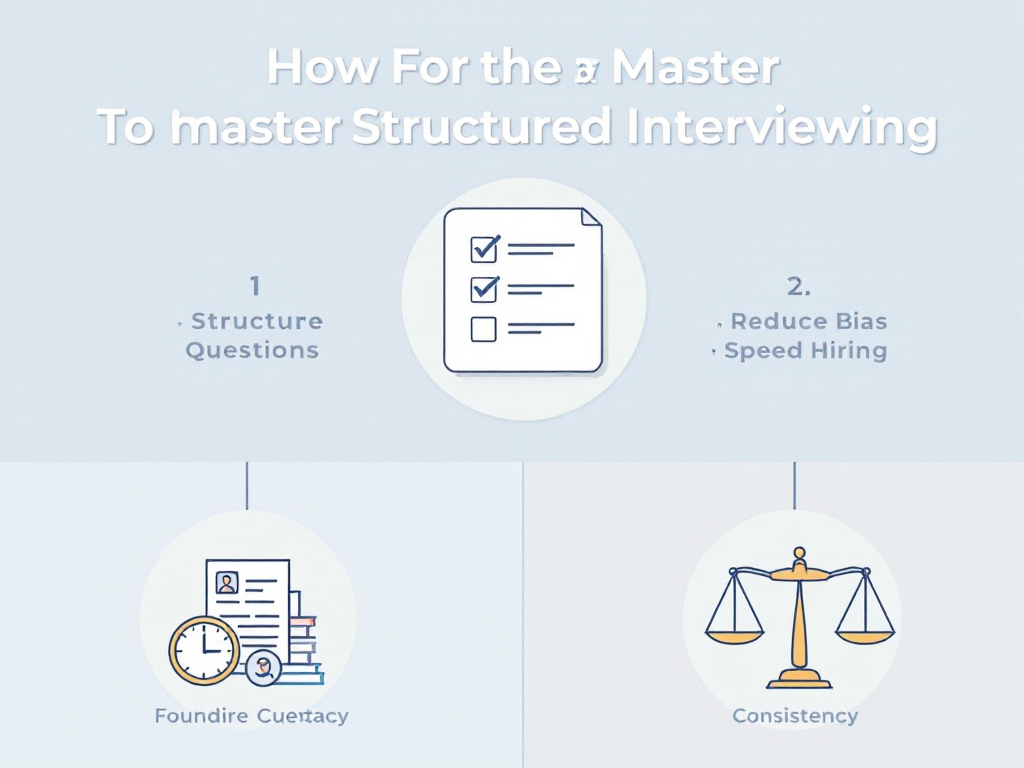
Here is the bottom line: Structured interviewing is the single most effective way to improve hiring speed, reduce bias, and predict actual job performance. In a market where time-to-fill averages over 44 days and high-volume roles attract 180+ applicants, relying on "gut feel" is a luxury no recruiting team can afford. By standardizing your questions and scoring criteria, you don't just protect yourself from bad hires; you create a fair, fast process that respects candidates' time. If you are tired of debriefs where the loudest voice wins, or losing top talent because your process took too long, it is time to move from chaotic conversations to a structured workflow.
The Hidden Cost of Chaotic Interviewing Workflows
The Urgency Trap
Picture this: It is Q4, and you have three critical engineering roles to fill before the budget freeze hits. The hiring manager is panicked, the inbox is overflowing with 500+ resumes, and the pressure is on. In this environment, the default mode is often "just get them on the phone." You scramble to schedule interviews, playing calendar Tetris with a panel of busy engineers.
But because there was no kickoff meeting to define exactly what "senior" means for this role, every interviewer goes rogue. One asks about Python libraries; the other asks about "culture fit" (which turns out to be whether they like the same sci-fi movies). There is no consistency.
The Feedback Black Hole
The real pain hits during the debrief. You are sitting in a room (or a Zoom call) trying to make a decision. One interviewer gives a "Strong Yes" because they "clicked" with the candidate. Another gives a "No" because the candidate "seemed nervous." You realize that nobody asked the same questions, and you have zero comparable data.
This chaos has a tangible cost. According to recent 2024-2025 data, unstructured processes contribute to an average time-to-hire of 44+ days in North America. Worse, 55% of applicants will drop out if they don't get an interview scheduled within a week. While the team debated "vibes," your top candidate accepted an offer from a competitor who moved faster.
3 Pillars of a Reliable Interviewing Strategy
Structured interviewing isn't about turning your team into robots reading from a script. It’s about ensuring every candidate gets the same opportunity to shine. Here are three best practices to implement this week.
1. Standardize the Scorecard First
What it is: Before you even look at a resume, define the 4-6 core competencies required for the job. Not "good communicator," but "can explain technical concepts to non-technical stakeholders."
Example: Instead of a generic 1-5 rating, define what a "5" looks like. "5 = Candidate provided a specific example of resolving a conflict with a client that resulted in a renewed contract."
Action Step: For your next open role, refuse to open the requisition until the hiring manager approves a scorecard with clear definitions for "Must Have" skills.
2. Calibrate the Panel (Assign Zones)
What it is: Stop the "Tell me about yourself" loop. Assign specific competencies to specific interviewers so they don't overlap.
Example: Interviewer A covers "Technical Skills & Architecture." Interviewer B covers "Cross-functional Collaboration." Interviewer C covers "Project Management."

Action Step: Send a prep email 24 hours before the interview loop: "Sarah, you are strictly covering Python proficiency. Mike, you are covering Team Leadership. Please do not stray into each other's lanes."
3. Document, Don't Just Discuss
What it is: Require interviewers to submit their scores and notes before seeing anyone else's feedback. This prevents "groupthink," where the HiPPO (Highest Paid Person's Opinion) sways the room.
Example: An interviewer must write down the candidate's answer to the "conflict resolution" question before rating it.
Action Step: Enforce a "No Score, No Voice" rule in debriefs. If they didn't write it down, they don't get to vote.
Pitfalls to Avoid:
- Over-automation: Using AI to auto-reject without human oversight can lead to compliance risks and missed "hidden gems."
- The "Culture Fit" Trap: "Culture fit" is often code for bias. Shift to "Culture Add"—what perspective is this person bringing that we lack?
- Inconsistent Criteria: Changing the requirements halfway through the process because "we haven't seen anyone good yet."
Breakthrough & Measurable Impact
When a team finally commits to structured interviewing, the tension in the process evaporates. I recently worked with a TA team that was drowning in "maybe" candidates. They implemented a strict rubric where candidates were scored on skills, not personality traits.
The results were immediate and measurable:
- Time Saved: The team saved ~5 hours per role by eliminating vague "sync" meetings.
- Fewer Rounds: They reduced the average interview loop from 6 steps to 4 because they gathered better data in early rounds.
- Better Alignment: Hiring manager satisfaction scores went up because they stopped seeing unqualified candidates in the final round.
The biggest hurdle was a VP who claimed structured questions "killed the chemistry." The breakthrough happened when we showed him the data: his "chemistry" hires had a 40% attrition rate within year one, while the structured hires were consistently top performers. Data wins arguments.
How Hiring Teams Actually Use Structured Interviewing
Theory is great, but execution requires a workflow that keeps everyone on track. In the messy reality of recruiting, you can't rely on sticky notes or disparate spreadsheets.
In practice, modern teams often use a workflow platform (for example, Foundire) to connect resume screening, structured interviews, and score reviews into one consistent system. This ensures that the criteria you defined at the start are actually applied at every step.
A typical structured workflow looks like this:
- Resume Scoring: Instead of keyword matching, candidates are scored against the specific "Must Have" criteria defined in the intake.
- Standardized Screening: Whether using a recruiter screen or an asynchronous tool, every candidate answers the exact same baseline questions.
- Centralized Review: Scores are aggregated into a single dashboard. This gives the hiring manager end-to-end visibility—seeing not just who applied, but why they scored highly on specific skills.
This approach transforms the hiring funnel from a "black box" into a transparent pipeline where decisions are defensible and data-driven.
Elevating the Interview Debrief: Signals vs. Noise
Structured interviewing changes the conversation during the debrief. You stop discussing feelings and start discussing evidence.
Debrief Scenarios
- The Bias Check:
Old Way: "I don't know, he seemed a bit too aggressive."
New Way: "He scored a 2/5 on 'Collaboration' because he interrupted the role-play scenario three times. Here is the transcript." - The Anchor Check:
Old Way: "She went to a great school, she must be smart."
New Way: "Her education is noted, but she scored a 1/5 on the technical coding assessment. We cannot move forward." - The Comparison:
Old Way: "I liked Candidate A better than Candidate B."
New Way: "Candidate A scored higher on Strategy, but Candidate B is significantly stronger on Execution, which is our priority for Q1."
Strong vs. Weak Signals
- Weak Signal (Noise): "They were nervous," "Great energy," "Reminds me of myself," "Good school."
- Strong Signal (Evidence): "Described a specific failure and what they learned," "Completed the coding task with zero errors," "Cited specific metrics for their last project."
Mini Q&A: Defending the Process
"How do I explain consistency without sounding rigid?"
Tell stakeholders: "We are being rigid on the criteria so we can be flexible on the person. This structure ensures we don't accidentally reject a genius just because they're quiet."
Comparison: Traditional vs. Structured Approach
| Feature | Traditional Approach (Gut Feel) | Structured Approach (Workflow-Driven) |
|---|---|---|
| Speed / Time-to-Hire | Fast start, but slow finish (endless debates). | Slower setup, but rapid decisions. Reduces days-to-offer. |
| Consistency & Fairness | Low. High risk of unconscious bias. | High. Every candidate gets the same shot. EEOC friendly. |
| Interviewer Alignment | Chaotic. Overlapping questions. | Aligned. Everyone knows their assigned role. |
| Candidate Experience | Frustrating. "Why did they ask me that 3 times?" | Professional. Candidates feel heard and respected. |
| Predictive Validity | ~0.24 (Low correlation to job success). | ~0.50 - 0.70 (High correlation to job success). |
Frequently Asked Questions About Structured Interviewing
How does structured interviewing actually reduce bias?
It forces the brain to evaluate "System 2" thinking (slow, logical) rather than "System 1" (fast, intuitive). By asking every candidate the same questions and scoring them immediately, you minimize the "halo effect" where a single positive trait (like attending the same college) overshadows actual competency gaps. Research shows this can reduce gender and racial bias by over 30%.
Can we still assess culture in a structured process?
Absolutely, but you must define it. Instead of "Culture Fit," use structured questions to assess "Values Alignment." For example, if your company values "Ownership," ask: "Tell me about a time you saw a problem that wasn't your job to fix, but you fixed it anyway."
Can Foundire help operationalize structured interviewing?
Yes. Tools like Foundire are designed to take the manual work out of structure. They help teams standardize resume scoring, administer consistent screening questions, and aggregate review data so that the "structure" happens automatically as part of the workflow, rather than requiring constant policing by HR.
Does this make the interview feel robotic?
No. Structure applies to the questions and the evaluation, not the conversation. You can still build rapport. In fact, because the interviewer knows exactly what to ask, they can be more present and attentive to the candidate's answers rather than worrying about what to say next.
Final Thoughts: Building a Process That Scales
Moving to a structured interviewing model is one of the highest-ROI changes a talent acquisition team can make. It protects you from legal risk, improves diversity, and most importantly, it results in colleagues who are actually good at their jobs. It shifts the recruiting function from "finding people who look like us" to "finding people who can take us where we need to go."
If you want to operationalize structured interviewing with structured screening, interview simulations, and consistent score reviews, tools like Foundire can help your team move faster without losing quality. Foundire helps you build the reliable, data-driven hiring engine your organization deserves.