How to Master Qualifications-to-Role Mapping

How to Master Qualifications-to-Role Mapping
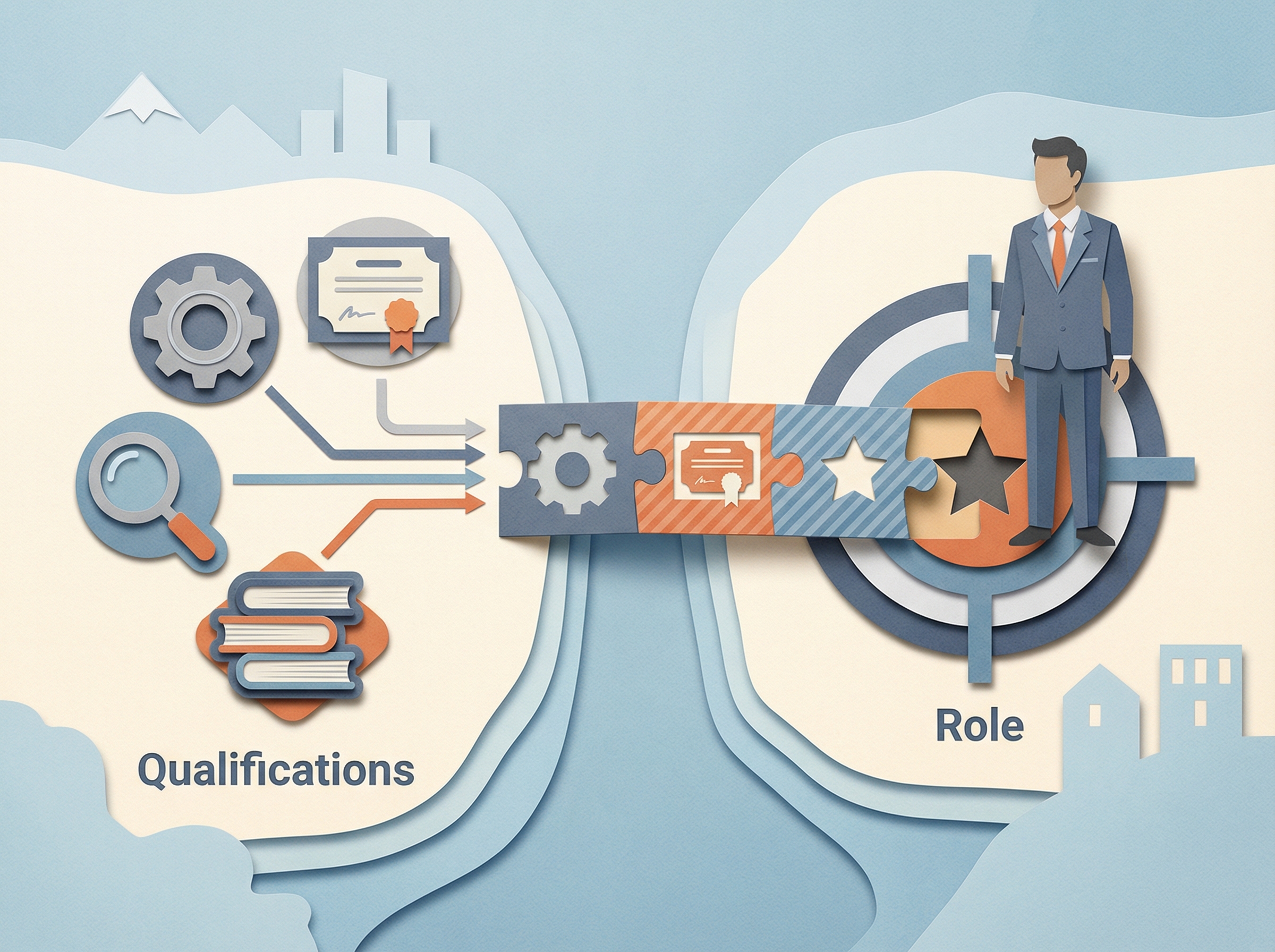
Qualifications-to-role mapping is the strategic process of translating a job’s theoretical requirements into measurable, evidence-based assessment criteria. It is the "translation layer" between a vague job description and a successful hire. By linking specific Knowledge, Skills, Abilities, and Other characteristics (KSAOs) to concrete performance outcomes, this method shifts hiring from "gut feeling" to data-driven precision.
For recruiters and talent leaders, mastering this framework is no longer optional. It is the primary lever for reducing time-to-fill, legally defending hiring decisions, and solving the "false positive" problem where candidates look good on paper but fail in the role.
Key Takeaway: In 2026, the most successful talent teams don't just "gather requirements." They map qualifications to specific stages of the funnel—deciding exactly where and how each skill will be verified before a single candidate is screened.
The Scenario: The "Frankenstein" Job Description
To understand why mapping is critical, let’s look at a common failure mode. Meet Marcus, a Senior Recruiter, and Sarah, a VP of Engineering.
Sarah needs a "Staff Software Engineer." She is anxious about making a bad hire, so she dumps every possible requirement into the job description (JD). She asks for:
- 10+ years of Python experience
- Master’s degree in Computer Science (preferred)
- "World-class" communication skills
- Experience with three different niche cloud platforms
- Project management certification
This is a "Frankenstein JD"—a monster stitched together from anxieties rather than reality. The result? Marcus opens the role and gets 300 applicants. The Applicant Tracking System (ATS) auto-rejects 280 of them for missing the "10 years" keyword. The remaining 20 are expensive "unicorns" who aren't interested.
Three weeks later, the funnel is broken. Sarah is frustrated ("Why can't we find anyone?"), and Marcus is burnt out from screening unqualified candidates who managed to game the system.
The Turning Point: Strategic Mapping
Marcus calls a "Reset Meeting." Instead of taking orders, he uses qualifications-to-role mapping to deconstruct the role. He asks Sarah three specific questions for every requirement on her list:
- "Is this a Day 1 skill, or can it be learned in 90 days?" (Separating Selection Criteria from Training Needs).
- "What is the evidence for this skill?" (If she says "communication," Marcus asks, "Do you need them to write technical specs or present to the Board?").
- "Where do we test this?" (Resume screen, technical test, or final interview?).
They discover that "10 years of experience" was actually code for "ability to debug complex legacy systems." They map this specific competency to a technical screening question rather than a resume filter. They drop the Master's degree entirely, widening the talent pool by 19x (according to 2025 skills-based hiring data). Suddenly, the role is fillable.
Core Insights: Heuristics for Better Mapping
To replicate Marcus's success, use these three heuristics to operationalize your mapping process.
1. The "Evidence Matrix" Heuristic
Never accept a qualification without assigning it a verification method. Create a simple matrix for every role:
- Qualification: Strong Stakeholder Management.
- Definition: Can de-escalate conflict with product managers.
- Mapping: Structured Interview Round 2 (Behavioral Question: "Tell me about a time you said 'no' to a feature request").
If you cannot define how you will test a qualification, it does not belong on the job description.

2. The "Calibration Early" Rule
A map is only a hypothesis until it meets reality. Commit to reviewing the first 5 screen results synchronously with the hiring manager. If Marcus sends 5 candidates and Sarah rejects 4, the map is wrong. Adjust the qualifications immediately rather than waiting for the interview stage to fail. This "feedback loop" prevents weeks of wasted interviews.
3. Automate the Link with Tools
Manual mapping is slow. Modern talent teams use platforms to automate this workflow. Tools like Foundire allow you to operationalize this map by linking resume screening directly to structured interview guides. When a candidate passes a "qualification" gate, the system can automatically suggest the relevant deep-dive questions for the next interviewer, ensuring no skill is checked twice while others are ignored.
Common Pitfalls to Avoid
- Confusing Experience with Competency: "5 years of experience" is a proxy, not a qualification. A candidate can repeat one year of bad experience five times. Map to outcomes (e.g., "Has scaled a database to 1M users") instead of time.
- The "Halo Effect" Override: This happens when an interviewer likes a candidate's personality and ignores the scorecard. Strict mapping requires that if a "Must-Have" qualification is missing (e.g., legal compliance knowledge), the candidate cannot pass, regardless of charm.
- Over-Indexing on Credentials: In 2026, degree requirements are disappearing. Mapping a role to a "Bachelor's Degree" often introduces bias without predicting performance.
The Breakthrough: Measuring Impact
When organizations move from "wishlists" to mapped qualifications, the metrics change drastically. In our scenario, once Marcus and Sarah implemented the map:
- Pass-Through Rate Increased: The candidate-to-interview ratio jumped from 5% to 25% because the criteria were realistic.
- Reduced Bias: By focusing on "evidence of debugging" rather than "degree from top school," they hired a self-taught developer who became a top performer.
- Speed: Time-to-fill dropped by 40% because interviewers stopped asking redundant questions.
According to recent industry reports, companies that use structured scorecards and skills mapping reduce mis-hires by up to 88%. This isn't just an HR process; it is a profit protection strategy.
Career Advantage: Positioning This Skill
For recruiters and talent acquisition leaders, "qualifications-to-role mapping" is a differentiator. It signals that you are a Talent Advisor, not just a resume shuffler.
Interview Q&A Snippet
Interviewer: "How do you ensure quality of hire?"
You: "I use qualifications-to-role mapping. I don't just take a job description at face value. I work with hiring managers to decompose the role into measurable competencies, then map each one to a specific stage of the funnel—screening, assessment, or interview. For example, in my last role, this reduced our drop-off rate by 15% because candidates clearly understood what they were being tested on."
Resume Bullet Examples
- Implemented qualifications-to-role mapping for Engineering roles, reducing time-to-fill by 30% while increasing interview pass-through rates.
- Designed structured interview scorecards that linked core competencies to specific assessment methods, resulting in a 95% retention rate for new hires.
- Partnered with leadership to transition from credential-based to skills-based hiring, widening the qualified talent pool by 2x.
Pros & Cons of Structured Mapping
| Benefit (The Strategic Gain) | Tradeoff (The Operational Cost) |
|---|---|
| Higher Accuracy: Drastically reduces false positives (bad hires) and unconscious bias. | Upfront Time: Requires a 60-minute "intake strategy" meeting, which impatient managers may resist. |
| Legal Defensibility: Provides a clear, documented audit trail for why Candidate A was hired over Candidate B. | Rigidity: Can feel bureaucratic if not managed well; requires discipline to update the map if market conditions change. |
| Scalability: Once mapped, the process can be delegated to junior recruiters or AI tools without losing quality. | Complexity: Requires training interviewers on how to use scorecards, not just what to ask. |
Frequently Asked Questions
What is qualifications-to-role mapping in simple terms?
It is the process of breaking down a job role into specific skills (competencies) and deciding exactly how and when each skill will be tested during the hiring process. It replaces vague job descriptions with a clear plan for assessment.
Can qualifications-to-role mapping backfire?
Yes, if the map is too rigid or realistic. If you map "Must-Have" qualifications that don't exist in the current labor market (a "purple squirrel"), you will end up with zero candidates. The map must be calibrated against market supply.
How does AI support qualifications-to-role mapping?
AI tools can analyze thousands of resumes to suggest which skills correlate with success in a specific role. They can also auto-generate interview questions that map directly to the skills identified in the job description, saving recruiters hours of preparation time.
What is the difference between job analysis and role mapping?
Job analysis is the broad study of what a job entails (duties, environment). Role mapping is the execution step—taking that analysis and creating the specific workflow, scorecards, and assessment gates needed to hire for it.
Conclusion
Mastering qualifications-to-role mapping is the difference between hoping for a good hire and engineering one. It creates a durable hiring advantage by aligning your entire team around what "good" looks like before the first interview begins. By moving from vague wishlists to structured evidence, you respect the candidate's time, protect the company's budget, and elevate the role of Talent Acquisition.
If you want to operationalize qualifications-to-role mapping with structured workflows (Sourcing → resume screening → AI interviews → scorecards → offers → background checks), try tools like Foundire (https://foundire.com).