How to Master Interview Scoring

How to Master Interview Scoring
Interview scoring is a systematic framework used by hiring teams to evaluate candidates against pre-defined job criteria using numerical scales (typically 1–5) or descriptive rubrics. By replacing subjective "gut feelings" with standardized data, interview scoring directly improves quality of hire, reduces legal liability, and accelerates decision-making. According to recent 2024–2025 industry benchmarks, organizations using structured scoring are twice as effective at predicting job performance compared to those relying on unstructured interviews.
Consider Sarah, a hiring manager at a growing fintech company. She loved "chatting" with candidates. Her feedback was often, "Great energy!" or "Not a culture fit." But three months later, her "great energy" hire was struggling technically, and her team was burnt out from covering the gaps. Sarah didn't have a talent problem; she had a measurement problem. She needed a way to translate her intuition into calibration.
Defining Interview Scoring for Modern Hiring
What is Interview Scoring?
At its core, interview scoring turns the qualitative conversation of an interview into quantitative data. Instead of a general "thumbs up," interviewers rate specific competencies—such as "Strategic Thinking" or "Java Proficiency"—on a standardized scale. This method, often supported by Behaviorally Anchored Rating Scales (BARS), ensures that a "4" means the exact same thing to a recruiter in New York as it does to a hiring manager in London.
Why It Matters: Moving Beyond Gut Feeling
Subjective hiring is risky. It invites unconscious bias, such as the "Like Me" effect, where interviewers prefer candidates who share their hobbies or background rather than those best suited for the role. Structured scoring forces the brain to slow down and evaluate evidence.
Key Stat: Research consistently shows that structured interviews with scoring rubrics have a 26% predictive success rate for job performance, compared to just 14% for unstructured interviews.
Real-World Scenario: From Chaos to Calibration
Let’s look at how interview scoring transforms a chaotic hiring process into a predictable engine. We’ll follow Sarah (Hiring Manager) and Mike (Talent Acquisition Lead) as they hire a Senior Product Manager.
The Traditional "Gut Feeling" Workflow
The "Before" State: Mike screens 50 resumes and sends 10 to Sarah. Sarah interviews four candidates. Her feedback in the Applicant Tracking System (ATS) looks like this:
- Candidate A: "Super smart, maybe too academic?"
- Candidate B: "Loved her! We went to the same university."
- Candidate C: "Solid, but seemed nervous."
The Result: Sarah wants to hire Candidate B because of the personal connection. However, during the final round with the VP, Candidate B fails the technical case study. The team has wasted 15 hours of interview time, and they have to restart the search. The time-to-hire balloons to 65 days.
Implementing the Scorecard
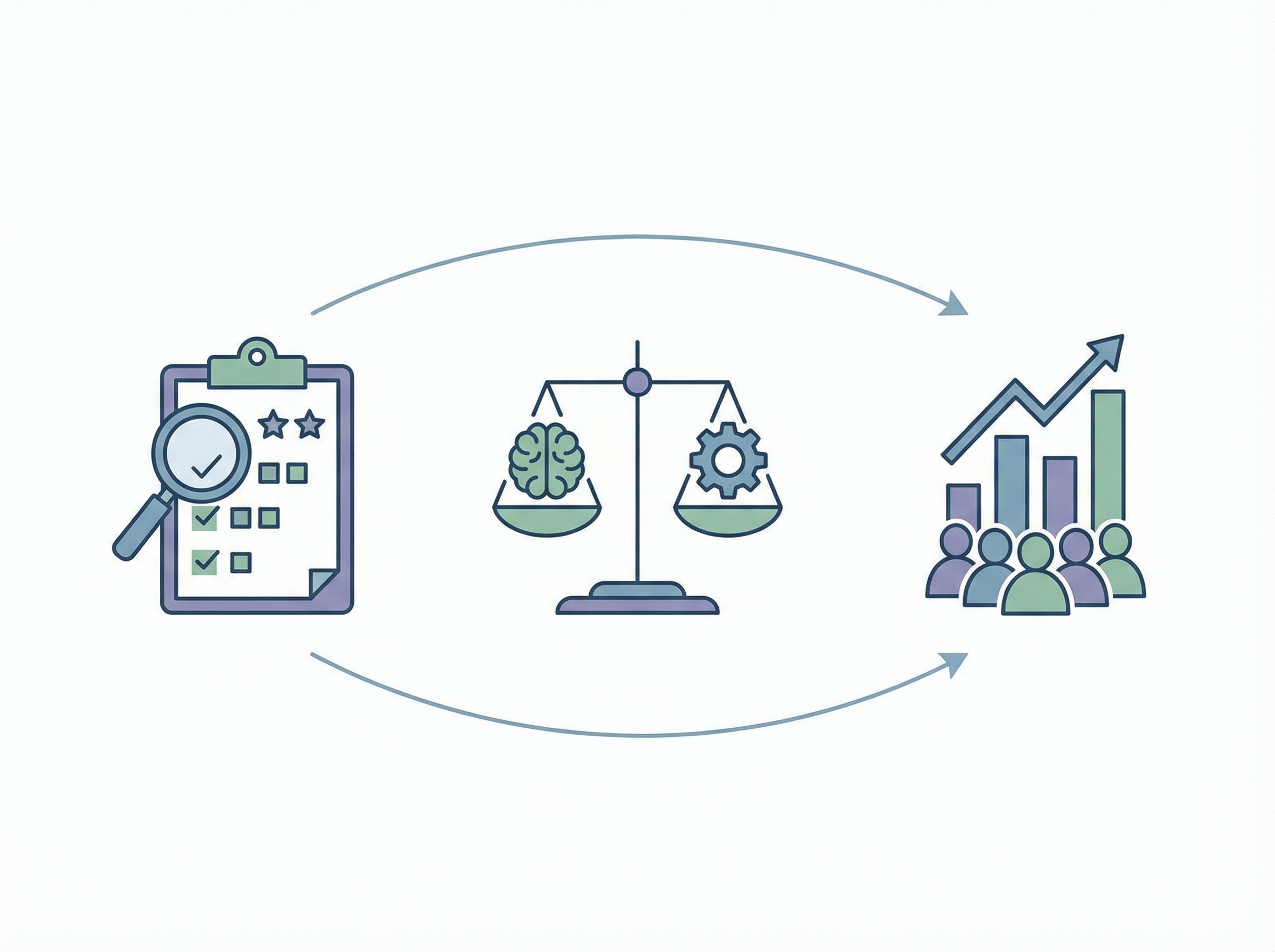
The "After" State: Mike intervenes. He works with Sarah to build a structured interview scorecard. They define five core competencies, including "Data Analysis" and "Stakeholder Management." They assign a 1–5 rating scale to each.
The New Workflow:
- Intake & Calibration: Mike and Sarah agree that a "5" in Data Analysis requires the candidate to demonstrate SQL proficiency and experience with A/B testing tools.
- Structured Interview: Sarah asks every candidate the same core questions.
- Immediate Scoring: Sarah scores Candidate C a "4" on Data Analysis and a "5" on Stakeholder Management immediately after the call, citing specific examples the candidate gave.
- Data-Driven Decision: The team realizes Candidate C (the "nervous" one) actually had the highest cumulative score across all competencies.
The Outcome: They hire Candidate C. Six months later, she is a top performer. The team’s pass-through rate from interview to offer stabilizes, and time-to-hire drops to 42 days.

Core Insights: Heuristics for Effective Scoring
Designing the Perfect Rubric
To make scoring effective, you must remove ambiguity. A common best practice is using BARS (Behaviorally Anchored Rating Scales).
- 1 (Poor): Candidate cannot provide an example of managing a difficult stakeholder.
- 3 (Average): Candidate provides a generic example of conflict resolution but lacks specific outcome data.
- 5 (Excellent): Candidate details a specific complex scenario, the strategy used to align stakeholders, and the measurable business outcome.
Common Pitfalls to Avoid
Even with a scorecard, human brains are buggy. Watch out for these traps:
- The Halo Effect: Letting one strong trait (e.g., "they went to Harvard") positively influence scores on unrelated traits (e.g., "coding ability").
- Central Tendency Bias: The fear of extremes. Lazy interviewers score everyone a "3" to avoid justifying a high or low rating, rendering the data useless.
- Recency Bias: Giving higher scores to the candidate you interviewed last because their answers are freshest in your memory.
The Breakthrough: Data-Driven Decision Making
The Turning Point
The true power of interview scoring is revealed during the debrief or calibration session. Without scores, debriefs are arguments about opinions. With scores, they are discussions about data.
Imagine a scenario where the hiring committee reviews the data. The "Charismatic Talker" has high scores in communication but low scores in technical execution. The "Quiet Strategist" has consistent 4s and 5s across the board. The scorecard acts as a truth serum, revealing that the quiet candidate is the better long-term bet.
Measuring the Impact
Companies that operationalize this shift see drastic improvements. Recent data suggests that moving to structured scoring can reduce unnecessary interviews by up to 80% and improve 90-day retention rates by 15%. By standardizing the input, you stabilize the output.
Career Relevance for Talent Leaders
Differentiating Yourself in the Market
For recruiters and HR leaders, mastering interview scoring transforms you from a "process administrator" into a "strategic talent advisor." You aren't just scheduling calls; you are architecting a system that predicts human performance.
Q&A: How to Talk About Scoring in Interviews
Q: "How have you applied interview scoring to improve outcomes?"
A: "I transitioned our hiring process from unstructured chats to a structured scoring model. We implemented 1–5 calibration rubrics for all roles. This reduced our debrief time by 30% and increased our offer acceptance rate because candidates appreciated the professional, objective process."
Resume Builder: Bullet Points for Success
Add these to your resume to show your expertise:
- Designed and implemented structured interview scorecards for Engineering and Product roles, reducing bias and increasing diversity of hires by 20%.
- Led interviewer training on 'Behaviorally Anchored Rating Scales' (BARS), resulting in a 15% increase in 1-year employee retention.
- Optimized ATS workflows to capture granular interview data, enabling predictive analytics on quality of hire.
Pros & Cons of Structured Scoring
| Benefit | Tradeoff |
|---|---|
| Objectivity & Fairness: Reduces unconscious bias and gives every candidate a fair shot based on merit. | Setup Time: Requires significant upfront effort to define competencies and write rubrics for every role. |
| Legal Defense: Provides clear documentation on why a candidate was selected or rejected, protecting against liability. | Perceived Rigidity: Some hiring managers may feel the process is too "robotic" or lacks the personal touch. |
| Scalability: Allows different interviewers to assess candidates consistently, enabling faster growth. | Training Overhead: Interviewers must be trained on how to use the scale, or the data will be noisy. |
Frequently Asked Questions
What is interview scoring and why is it necessary?
Interview scoring is the practice of assigning numerical values to candidate responses based on pre-set criteria. It is necessary because it reduces hiring bias, improves the predictive validity of the interview, and ensures all candidates are evaluated on the same standards.
Can interview scoring backfire if rubrics are too rigid?
Yes. If a rubric is too specific, it might penalize a candidate who solves a problem in a creative, unexpected way. Best practice is to score on outcomes and competencies rather than requiring a specific script.
How does AI impact modern interview scoring processes?
AI can now auto-generate scorecards, transcribe interviews, and even provide preliminary scoring based on transcripts. This augments human decision-making by ensuring no detail is missed, though the final hiring decision should always remain human-led.
Conclusion: The Durable Hiring Advantage
Mastering interview scoring is the bridge between chaotic interviewing and predictable business growth. It protects your company from bias, protects your time from wasted interviews, and protects your culture from misalignment. In a competitive talent market, the team with the best data wins.
If you want to operationalize interview scoring with structured workflows—covering everything from Sourcing and resume screening to AI interviews and background checks—try tools like Foundire (https://foundire.com). Their all-in-one platform connects every step, ensuring your scoring logic flows seamlessly from the first hello to the final offer.