How to Master Inbound Applications Sorting

How to Master Inbound Applications Sorting: Strategies for Speed and Quality
Inbound applications sorting is the strategic process of filtering, prioritizing, and qualifying incoming resumes to convert a raw applicant volume into a high-potential interview pipeline. It is not just about organizing files; it is the operational engine that determines your Time-to-Hire and Quality of Hire.
For modern recruiters, effective sorting bridges the gap between the chaos of open requisitions and the clarity of a shortlist. It leverages criteria-based filtering—often powered by Applicant Tracking Systems (ATS) or AI tools—to identify best-fit candidates immediately while responsibly archiving those who aren't a match. The result? A faster hiring workflow, reduced recruiter burnout, and a candidate experience that doesn't leave people in limbo for weeks.
The Reality Check: You open your laptop on Monday morning. Your inbox flags 500+ new applications for that remote Senior Product Manager role you posted on Friday. You have three hours before your hiring manager sync. Do you read every single resume? If you do, you lose. If you don't, you might miss the perfect hire. This is the inbound sorting dilemma.
The Scenario: The 48-Hour Screening Sprint
Let’s look at this through the eyes of "Sarah," a Lead Talent Partner at a mid-sized tech company. Sarah is responsible for filling five roles this quarter, including a high-volume Customer Success Manager position.
The Bottleneck
In her old workflow, Sarah’s process was linear and manual. Candidates entered the ATS in chronological order—First-In, First-Reviewed. This created a massive inefficiency. By the time Sarah reviewed the 150th application, the "perfect" candidate who applied 400th was already interviewing with a competitor.
Sarah was spending an average of 6 to 10 seconds per resume, a pace that invites cognitive bias and fatigue. Her pass-through rate (candidates moved from Review to Screen) hovered around 2%, meaning for every 100 resumes she read, 98 were rejections she had to manually process. The mental load was unsustainable, and her "Time-to-Screen" metric was slipping to 7+ days.
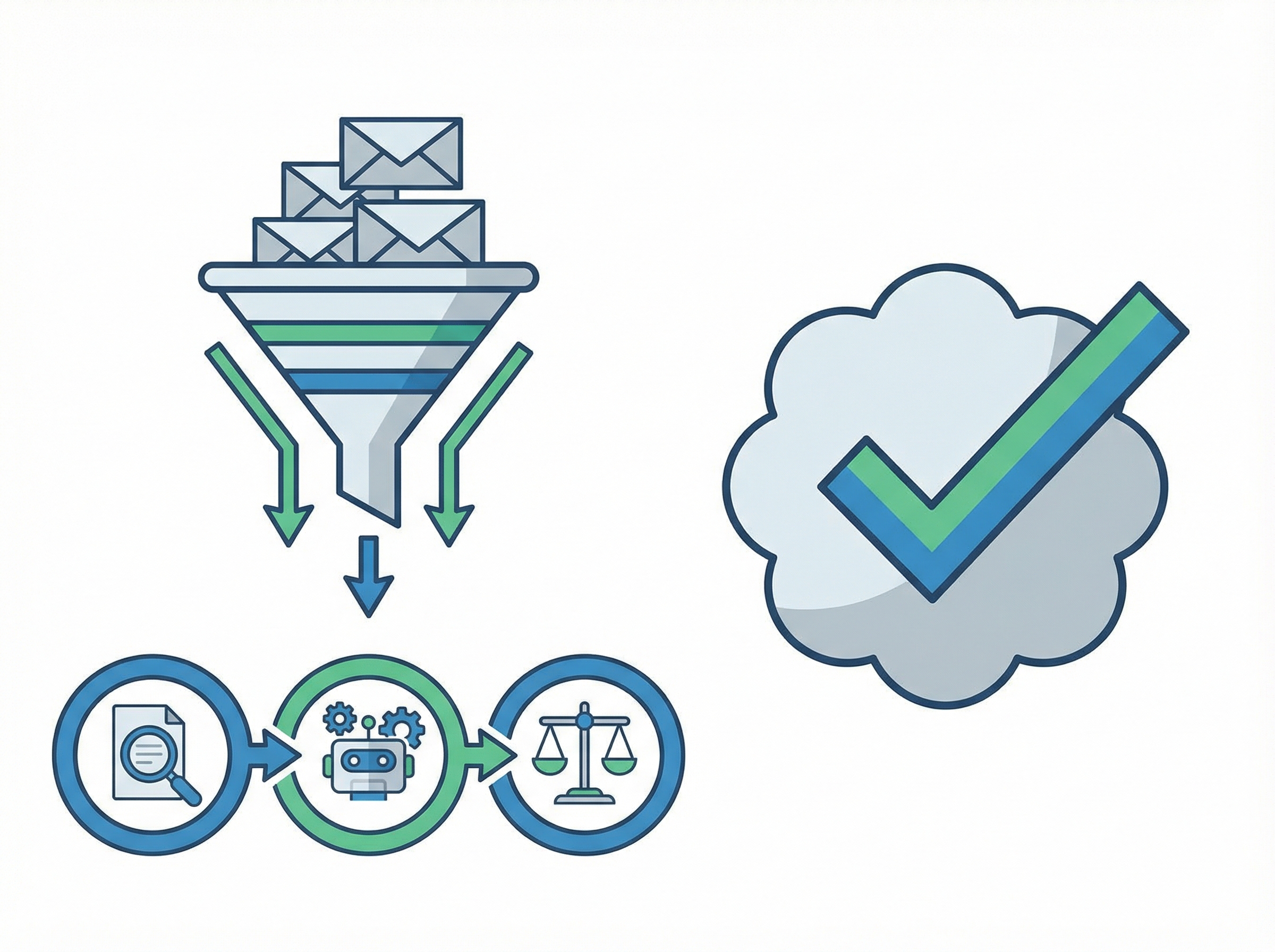
The Old Method vs. The New Method
Sarah decided to overhaul her approach by shifting from reading to sorting.
- Old Way (Manual): Open ATS → Read Resume → Check LinkedIn → Make Decision → Tag Candidate → Repeat 500 times.
- New Way (Structured Sorting): Define constraints → Automate "Knockouts" → AI-Sort by Skill Match → Review only top 20% → Interview.
By implementing a structured sorting mechanism, Sarah didn't just work faster; she changed the math. Instead of finding a needle in a haystack, she used a magnet. She moved from a chronological queue to a relevance-based queue, ensuring the strongest profiles were reviewed first, regardless of when they applied.
Core Insights: 5 Heuristics for Better Sorting
To replicate Sarah's success, you need to move beyond "gut feeling" and implement operational heuristics. Here are five actionable strategies to master inbound applications sorting.
1. Deploy Ruthless "Knockout" Questions
Never review a resume that is legally or logistically impossible to hire. Configure your application form to ask binary questions that automatically filter candidates into a "Reject" folder (with a polite, automated email delay). Common knockouts include:
- Visa Sponsorship: "Will you now or in the future require sponsorship?"
- Location: "Are you located in [Country/Timezone]?"
- License/Certification: "Do you hold a valid CPA license?"
2. Use Tiering Logic, Not Binary Decisions
Amateur sorters think in "Yes/No." Pros think in tiers. Create buckets in your ATS:
- Tier 1 (Immediate): Meets all requirements + "Nice to haves." Contact within 24 hours.
- Tier 2 (Maybe/Hold): Meets requirements but lacks a specific preferred skill. Keep warm if Tier 1 falls through.
- Tier 3 (Reject): clearly unqualified.
3. Leverage "Explainable AI" for Skills Matching
Modern tools like Foundire and advanced ATS platforms use AI to score resumes against the job description. However, trust but verify. Look for "Explainable AI" features that highlight why a candidate was scored high (e.g., "Found matching terms: Python, SQL, Tableau"). This allows you to validate the sort instantly without reading the entire document.
4. Pitfall: The Keyword Trap
A common misconception is that you should filter exclusively by exact keywords. This leads to "False Negatives." A candidate might list "Client Relations" instead of "Account Management." If your sorting logic is too rigid, you reject qualified talent. Best Practice: Use semantic search tools that understand synonyms and context, rather than simple Ctrl+F logic.
5. Pitfall: Ignoring the "Freshness" Factor
While relevance is key, speed is the tie-breaker. Data suggests that candidates are most responsive within 48 hours of applying. Your sorting workflow must prioritize high-scoring candidates who applied recently. A 100% match who applied three weeks ago is likely already off the market.
The Breakthrough: Automating the Funnel
The turning point for Sarah came when she integrated hiring workflow automation. She set up a trigger: If a candidate scores >85% match AND passes all knockout questions, automatically send a request for a structured async interview or a screening scorecard.
Measuring the Impact
This single change decoupled her time from the volume of applications.
- Time Savings: Sarah’s screening time dropped from 20 hours/week to 4 hours/week.
- Pass-Through Rate: Because she was only interviewing pre-qualified candidates, her screen-to-offer ratio improved significantly.
- Candidate Experience: Candidates received faster feedback. Rejections happened in days, not months, and top talent received interview requests within hours of applying.
Sarah moved from being a "Resume Reader" to an "Exception Handler." She only had to manually intervene for borderline cases or to conduct the final behavioral interviews.

Career Advantage: Selling Your Sorting Skills
For recruiters and talent leaders, mastering inbound applications sorting is a career differentiator. It proves you understand ROI and Operational Excellence.
Interview Q&A Strategy
Q: "How do you handle high-volume requisitions?"
A: "I don't just 'review' resumes; I build a calibrated sorting workflow. By setting clear knockout criteria and utilizing AI-driven skill matching, I prioritize the top 20% of the funnel immediately. This allows me to reduce time-to-fill while ensuring we don't miss quality candidates due to fatigue. In my last role, this approach reduced our screening hours by 70%."
Resume Boosters
- "Implemented an automated inbound sorting workflow that reduced Time-to-Screen from 7 days to 24 hours."
- "Increased interview pass-through rates by 15% by utilizing structured scoring rubrics and semantic search filters."
- "Managed a high-volume funnel of 2,000+ applicants/month with a 98% response rate via ATS automation."
Pros & Cons of Automated Sorting
| Benefit | Tradeoff |
|---|---|
| Speed & Scalability: Can process thousands of applications instantly, allowing recruiters to focus on human interactions. | False Negatives: Rigid algorithms may reject "non-traditional" candidates who have the skills but lack the specific keywords or formatting. |
| Consistency: Every applicant is judged against the same set of objective criteria, reducing unconscious bias related to names or schools. | Algorithmic Bias: If the AI is trained on historical data that was biased, it may replicate those biases (e.g., favoring certain demographics). |
| Data-Driven Decisions: Provides clear metrics on pipeline health, source quality, and pass-through rates. | Setup Time: Requires initial investment to calibrate the system, define scorecards, and integrate tools like Foundire or an ATS. |
Frequently Asked Questions
What is inbound applications sorting in modern recruiting?
It is the automated or semi-automated process of filtering and prioritizing incoming job applications based on pre-set criteria (skills, location, experience). The goal is to separate unqualified applicants from potential hires instantly to speed up the recruitment timeline.
Can automated sorting backfire and reject good candidates?
Yes. If the criteria are too strict or rely solely on exact keyword matches, the system can produce "false negatives." To prevent this, use semantic matching tools and regularly audit your "Reject" pile to ensure calibration is accurate.
What are the best metrics to track sorting efficiency?
Track Time-to-Screen (how long from application to first review), Pass-Through Rate (percentage of applicants moved to interview), and False Negative Rate (qualified candidates mistakenly rejected).
How does AI impact resume screening compliance?
AI can help reduce bias by ignoring protected characteristics (age, gender, race). However, you must use "Explainable AI" tools to ensure the algorithm isn't making decisions based on proxy variables (like zip codes) to remain compliant with equal opportunity laws.
Conclusion: Building a Durable Workflow
Mastering inbound applications sorting is not about finding shortcuts; it is about building a durable, scalable hiring engine. When you replace manual chaos with structured workflows, you gain the freedom to focus on what actually closes candidates: relationships, culture, and negotiation.
The recruiters who win in 2026 and beyond will be the ones who treat sorting as a strategic advantage, not an administrative burden.
If you want to operationalize inbound applications sorting with structured workflows—from resume screening and AI interviews to scorecards and offers—try tools like Foundire (https://foundire.com) to automate and elevate your entire hiring funnel.