How to Master Evidence-Based Evaluation

How to Master Evidence-Based Evaluation
Evidence-based evaluation is the systematic process of assessing candidates using objective data, standardized criteria, and observable behaviors rather than intuition or "gut feeling." By decoupling observation from interpretation, this methodology significantly reduces unconscious bias, improves legal defensibility, and increases the predictive validity of hiring decisions. For recruiters and talent leaders, mastering this approach is the difference between guessing who might succeed and knowing who has the skills to thrive.
We’ve all been there: A hiring manager finishes an interview and says, "I don't know, something just felt off," or conversely, "I loved them! We hit it off immediately." While these reactions are human, they are catastrophic for hiring quality. Reliance on intuition often leads to affinity bias—hiring people who remind us of ourselves—rather than those best suited for the job. Evidence-based evaluation replaces this volatility with a structured workflow that drives consistency, speed, and better retention.
The High Cost of Subjectivity: A Real-World Scenario
To understand the power of evidence-based evaluation, let’s look at a common scenario involving "Sarah," a VP of Engineering at a mid-sized tech firm. Sarah was struggling to fill a Senior Product Manager role. Her team was drowning in resumes, yet every "perfect" candidate they hired seemed to churn within six months.
The Chaos of Unstructured Interviews
Sarah’s process was typical. She would glance at a resume for 30 seconds, pick out a few keywords (like "Agile" or a prestigious university), and then conduct a free-flowing chat. Her feedback to the talent acquisition team was vague: "Not a culture fit," or "Too academic."
Because there was no standardized scoring system:
- Interviewer A asked about technical roadmapping.
- Interviewer B spent 45 minutes talking about hobbies.
- Interviewer C grilled the candidate on a coding language irrelevant to the role.
The result? A fragmented view of the candidate, a 60-day time-to-fill average, and a costly mis-hire who lacked critical stakeholder management skills—a competency no one had actually tested.
The Turning Point: Implementing Structure
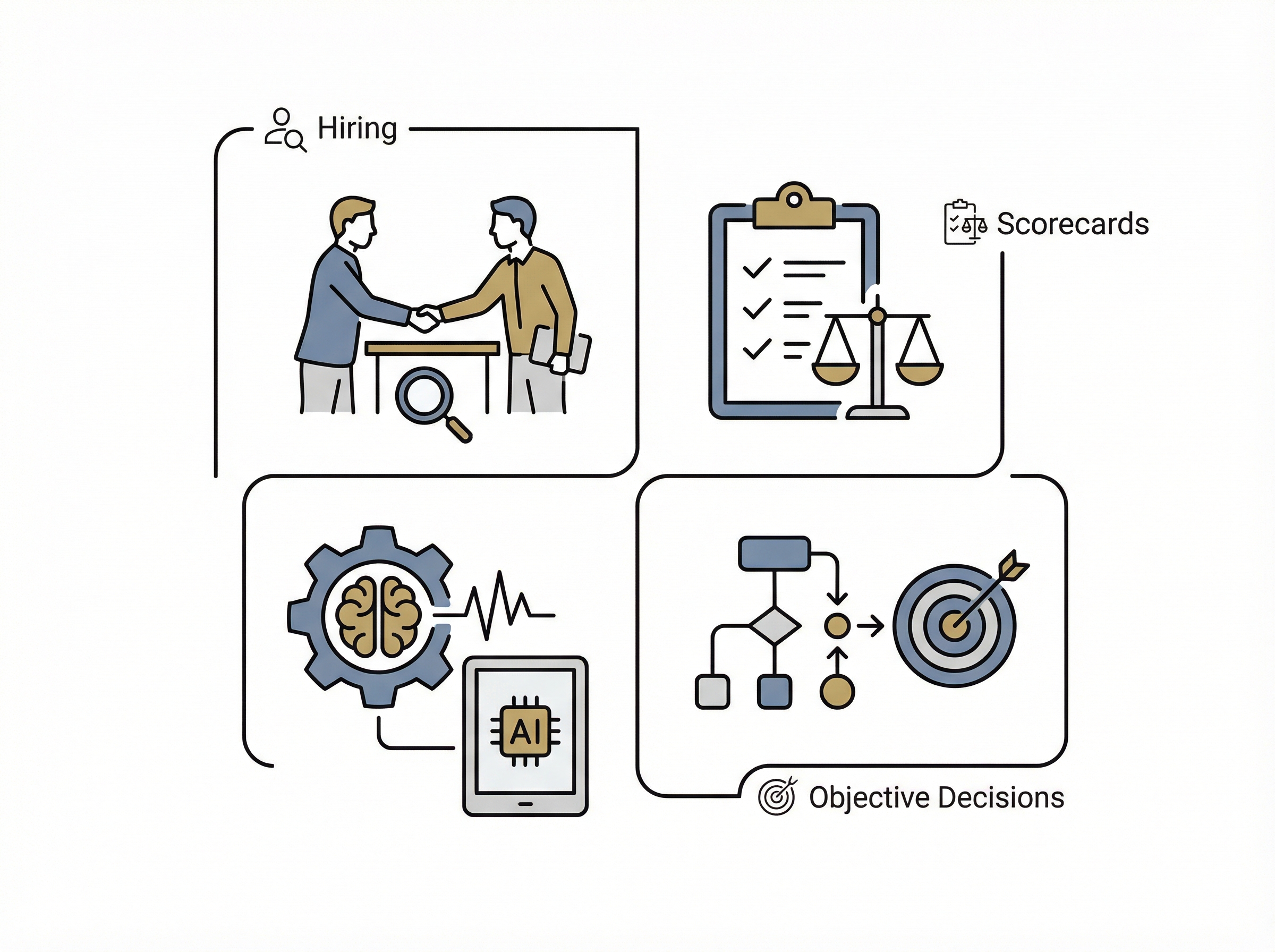
Frustrated, Sarah worked with a Talent Ops leader to pivot to an evidence-based model. They replaced the "chat" with a structured interview kit. Now, every candidate faced the same core questions, mapped to specific competencies like "Strategic Planning" and "Conflict Resolution."
They implemented a digital scorecard system where interviewers had to rate specific behaviors on a 1-5 scale before discussing the candidate as a group. The impact was immediate.
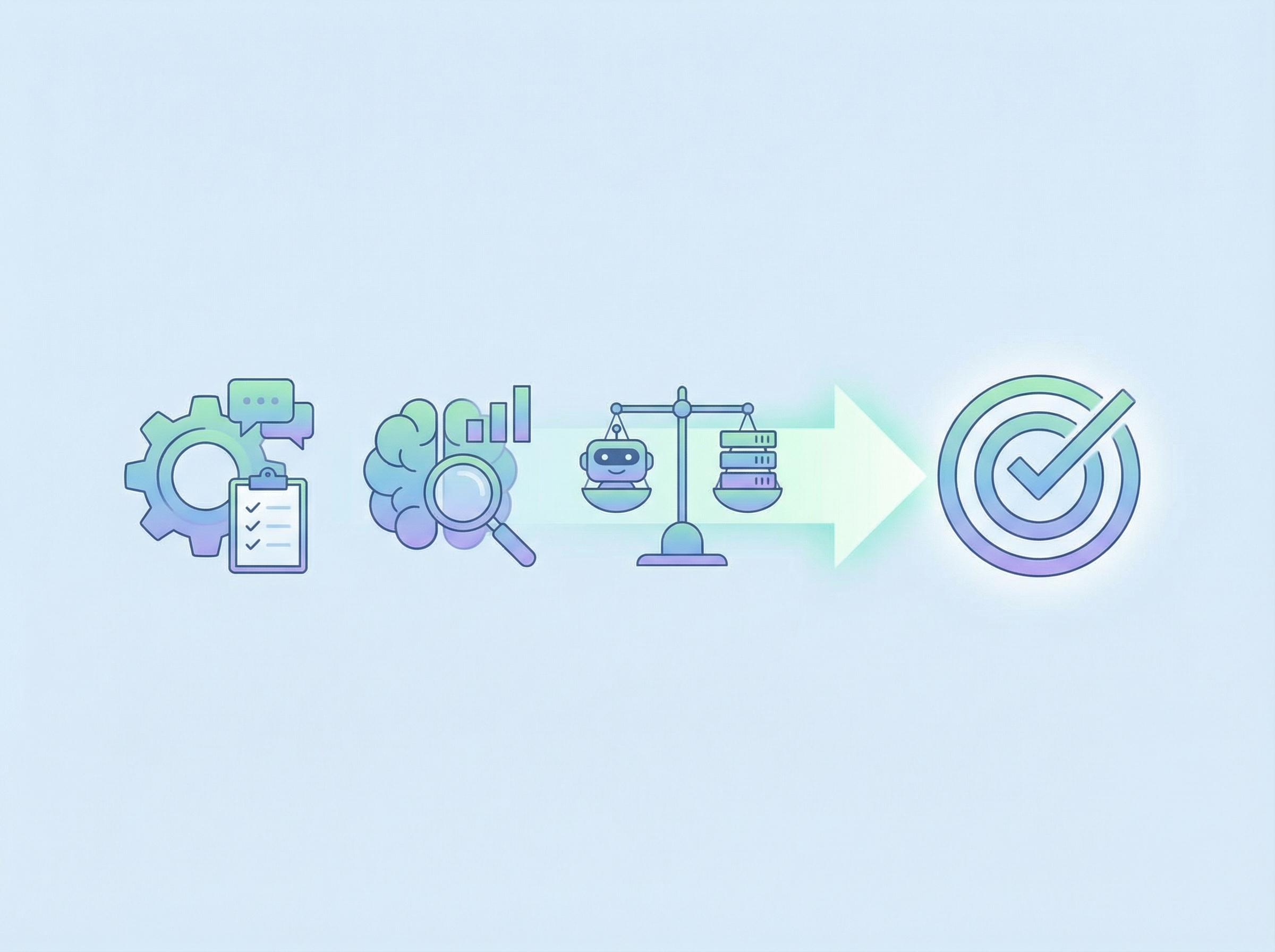
"By forcing the team to write down 'evidence'—what the candidate actually said or did—rather than their 'feeling,' we realized our top choice wasn't the charismatic extrovert, but the quiet strategist who had specific examples of turning around failing products."
Within two quarters, Sarah’s department saw a 20% increase in retention and a significant drop in time-to-fill, as the team spent less time debating feelings and more time comparing data points.
3 Pillars of an Evidence-Based Hiring Workflow
To replicate Sarah’s success, you need to operationalize these three core heuristics.
1. Structured Interview Kits & Competency Mapping
Evidence-based evaluation starts before the candidate is even sourced. You must define exactly what "good" looks like. Create an interview kit where every question targets a specific skill.
- Don't ask: "Tell me about yourself." (Too broad, invites bias).
- Do ask: "Describe a time you had to negotiate a deadline with a difficult stakeholder. What was your approach and what was the outcome?" (Targeted, behavioral).
Heuristic: If a question doesn't map to a row on your scorecard, cut it. Every minute of an interview is expensive real estate; use it to gather signal, not noise.
2. Separate Observation from Interpretation
This is the golden rule of evidence-based assessment. An observation is a fact; an interpretation is a guess.
- Observation: "The candidate paused for ten seconds before answering and asked clarifying questions."
- Interpretation: "The candidate isn't confident." (Wrong)
- Evidence-Based Interpretation: "The candidate demonstrates a thoughtful communication style and ensures alignment before proceeding." (Right)
Train your hiring managers to log the observation first. This simple pause allows you to calibrate whether a behavior is actually a red flag or just a different working style.
3. AI-Assisted Screening & Automation
In 2026, evidence-based evaluation scales through technology. Tools like Foundire are essential for removing the initial layer of human fatigue and bias. By using AI to screen resumes and conduct initial structured interviews, you ensure every candidate is judged against the exact same criteria.
For example, Foundire’s AI-assisted voice interviews can ask adaptive questions based on the candidate's responses, capturing a depth of data that a static form cannot. This ensures that a candidate’s score is based on their demonstrated knowledge and communication skills, not on the recruiter’s mood at 4:00 PM on a Friday.
Common Pitfalls to Avoid
- The Halo Effect: Letting one strong attribute (like attending a top school) overshadow major gaps in actual skills.
- Confirmation Bias: asking leading questions to confirm your initial impression (e.g., "You're good at multitasking, right?").
- Over-reliance on Keywords: Assuming a resume mentioning "Python" equals proficiency. Evidence requires validation through assessments or technical screenings.
Career Impact: Using Data to Advance Your HR Role
Mastering evidence-based evaluation doesn't just help your company; it positions you as a strategic partner rather than a service provider. When you can present data explaining why a candidate is a hire/no-hire, you gain the trust of executive leadership.
Resume Boosters
If you are a recruiter or talent leader, add these evidence-based wins to your own resume:
- "Designed and implemented structured interview scorecards for Engineering roles, improving quality of hire metrics by 25% year-over-year."
- "Reduced unconscious bias in the screening process by operationalizing AI-driven assessment tools, resulting in a 15% increase in diverse candidate pass-through rates."
- "Standardized the evaluation workflow, cutting time-to-fill from 45 to 32 days while increasing new hire performance ratings."
The Interview Advantage
When you are interviewing for a new role, use this script to demonstrate your expertise:
Interviewer: "How do you handle difficult hiring managers who just want to hire their friends?"
You: "I shift the conversation from opinions to evidence. I implement calibration sessions where we review scorecards side-by-side. I ask managers to point to the specific data point or observed behavior that supports their decision. By focusing on the structured criteria we agreed on upfront, I help them see past their gut feeling to the candidate's actual competency. In my last role, this approach reduced our 90-day churn rate by nearly 20%."
Pros & Cons of Evidence-Based Evaluation
While powerful, this methodology requires commitment. Here is the trade-off analysis:
| Benefit | Tradeoff |
|---|---|
| Reduced Bias: Standardized criteria and AI tools like Foundire minimize the impact of unconscious bias (gender, race, affinity). | Upfront Effort: Requires time to build rubrics, question banks, and train managers before a single interview happens. |
| Legal Defensibility: Documentation of objective reasons for hiring/rejecting protects against discrimination claims. | Perceived Rigidity: Some hiring managers may feel "constrained" by not being allowed to ask random, off-the-cuff questions. |
| Predictive Validity: Significantly higher correlation between interview performance and on-the-job success. | Tooling Cost: May require investment in modern platforms for scorecards, recording, and AI analysis. |
Frequently Asked Questions
What is evidence-based evaluation in recruitment?
Evidence-based evaluation is a hiring methodology that relies on objective data, structured interviews, and validated assessments to measure a candidate's skills. It prioritizes observable facts over intuition to predict job performance accurately.
Can evidence-based evaluation backfire?
Yes, if the metrics are wrong. If you measure the wrong competencies (e.g., testing for speed when accuracy is required), you will systematically hire the wrong people. Regular calibration of your scorecards is essential.
How does AI support evidence-based hiring?
AI tools like Foundire automate the collection of objective data. They can screen resumes, conduct initial structured interviews, and score responses against a standardized rubric, ensuring consistency that human reviewers often lack due to fatigue.
Is this method slower than "gut feeling" hiring?
Initially, it takes more time to set up. However, it is faster in the long run because it reduces the need for repeat interviews, endless internal debates, and replacing bad hires who churn quickly.
Closing Thoughts
The days of hiring based on a firm handshake or a shared alma mater are ending. Evidence-based evaluation is not just a trend; it is the operating system for high-performing talent acquisition teams. By grounding your decisions in data, you create a fairer, faster, and more effective hiring machine that creates a durable competitive advantage.
If you want to operationalize evidence-based evaluation with structured workflows—from Sourcing and resume screening to AI interviews, scorecards, offers, and background checks—try tools like Foundire (https://foundire.com).