How to Master Application Eligibility Screening

How to Master Application Eligibility Screening: The Gatekeeper of High-Quality Hiring
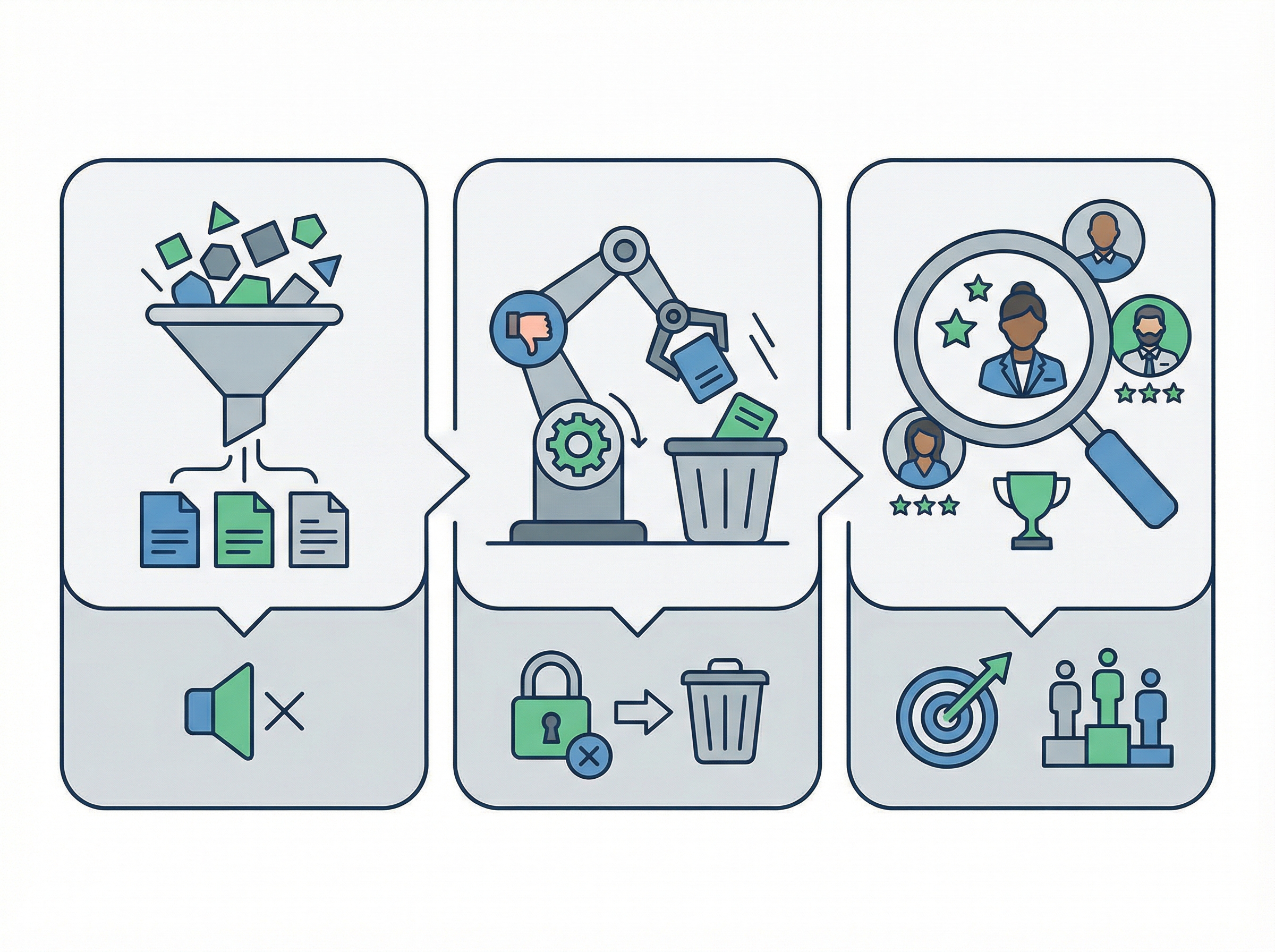
Application eligibility screening is the systematic process of filtering job candidates based on non-negotiable criteria—such as visa status, location, licenses, or core technical certifications—before a human recruiter ever reviews a resume. It is the first and most critical line of defense in a healthy recruiting funnel, directly impacting Time to Fill, Quality of Hire, and recruiter sanity.
For modern talent acquisition teams, this isn't just about saying "no" faster; it's about clearing the noise so you can say "yes" with confidence. In an era where a single "Easy Apply" job posting can trigger 500+ applications in 48 hours, failing to operationalize eligibility screening is a strategic error that leads to burnout and missed talent.
The High Cost of Noise: A Recruiter’s Nightmare
Meet Sarah. Sarah is a Senior Technical Recruiter at a mid-sized fintech company. She’s talented, empathetic, and excellent at closing candidates.
Last Tuesday, Sarah opened a requisition for a "Senior Backend Engineer." By Thursday morning, her Applicant Tracking System (ATS) showed 542 applications. Excited, she grabbed her coffee and started reviewing.
Two hours later, the excitement was gone.
Candidate #1 lived in a timezone the team couldn't support. Candidate #4 required visa sponsorship the company couldn't offer. Candidate #12 was a fresh graduate applying for a senior role. By lunch, Sarah had reviewed 80 resumes and found only three potentially viable candidates. She had 460 to go.

This is the "noise" problem. Without application eligibility screening, Sarah isn't recruiting; she's data entry. She is spending 90% of her cognitive energy rejecting unqualified applicants rather than engaging with top talent. Worse, while she’s buried in the pile, the best engineer in the stack—who applied at 9:00 AM—has already been contacted by a competitor who uses automated screening.
Real-World Scenario: From Resume Flood to Precision Funnel
Let’s look at how transforming this specific workflow changes the outcome.
The Manual Bottleneck (Before)
- Volume: 542 Applicants
- Screening Method: Manual resume review (approx. 2 minutes per resume).
- Total Time Spent: ~18 hours of recruiter time.
- Outcome: Sarah is exhausted. Candidates wait 2–3 weeks for a generic rejection email. Top talent drops off due to silence.
- Metric: Time to First Interview is 14 days.
Implementing the Screen (After)
Sarah decides to stop the bleeding. She configures her ATS (or a dedicated tool like Foundire) to enforce application eligibility screening using "Knockout Questions" (KO questions). She defines three binary constraints with her hiring manager:
- "Are you legally authorized to work in the US without current or future sponsorship?" (Yes/No)
- "Do you have 5+ years of production experience with Python or Go?" (Yes/No)
- "Are you willing to work onsite in Chicago 3 days a week?" (Yes/No)
The results are immediate and drastic.
- Volume: 542 Applicants.
- Auto-Disqualified: 390 applicants (72%) failed one or more constraints.
- Remaining Pool: 152 qualified candidates.
- Screening Method: AI-assisted ranking of the remaining 152.
- Total Time Spent: 2 hours.
- Outcome: The 390 unqualified applicants received an instant, polite rejection email (better candidate experience than the "black hole"). Sarah spends her day sourcing and calling the top 20 candidates from the qualified pool.
- Metric: Time to First Interview drops to 3 days.
Core Insights: Best Practices & Pitfalls
To replicate Sarah's success, you cannot simply add random questions to your application form. You must approach application eligibility screening with engineering precision.
3 Actionable Heuristics for Success
1. Differentiate "Must-Haves" from "Nice-to-Haves"
Eligibility screening is for eligibility, not desirability. A Master’s degree is rarely a hard eligibility requirement; it’s a preference. A medical license for a nursing job, however, is eligibility. Only screen for criteria that would legally or functionally prevent the person from doing the job on Day 1.
2. Use Binary Logic (Yes/No)
Avoid open-text fields for screening. "Tell us about your experience with Java" requires a human to read it. "Do you have 3+ years of commercial experience with Java?" is data. Binary questions allow your software to act as a reliable gatekeeper, automating the sorting process without error.
3. The "Intake Calibration" Rule
Never set screening criteria in a vacuum. During the intake meeting, ask the hiring manager: "If a candidate is perfect but lacks this specific thing, would you interview them?" If they say yes, that criteria cannot be a knockout question. Calibration prevents false negatives.
Common Pitfalls to Avoid
Warning: The goal is to filter out the unqualified, not the imperfect.
- Over-Screening: Asking 20+ questions upfront causes high drop-off rates among top candidates who value their time. Keep it to 3–5 critical questions.
- Keyword Reliance: relying solely on resume parsing ("Does the resume contain 'Python'?") is dangerous. Candidates can keyword-stuff white text, or conversely, a brilliant developer might list "built backend systems" without explicitly writing "Python" five times. Direct questions ("Do you know Python?") are more reliable than keyword matching.
- The "Experience" Trap: Asking for "5 years of experience" is often a proxy for "Senior Level." A brilliant engineer might have 3 years of intense, high-scale experience that outweighs 7 years of mediocrity. Be careful with rigid tenure numbers.
The Breakthrough: Operational Impact
The turning point for Sarah came when she found "Alex." In the manual workflow, Alex’s application was #402—buried deep in the pile. By the time Sarah would have reached it manually, Alex would have accepted another offer.
With application eligibility screening, Alex was in the "Qualified" bucket instantly. Sarah saw the application 30 minutes after it was submitted, conducted a phone screen that afternoon, and moved to a technical interview the next day. The breakthrough wasn't just speed; it was opportunity cost.
Career Relevance for Recruiters
Mastering this workflow does more than save time; it positions you as a Talent Operations Leader rather than a resume shuffler. In interviews, when asked how you handle volume, you don't say "I work late." You say, "I build automated eligibility funnels."
Q: "How have you applied application eligibility screening to improve outcomes?"
A: "I audited our high-volume roles and implemented standardized knockout questions for non-negotiables like licensure and visa status. This reduced our manual screening load by 60% and improved our pass-through rate from phone screen to onsite by 25%, as I was only speaking to truly viable candidates."
Resume Bullet Examples:
- Designed and implemented automated application eligibility screening workflows, reducing Time-to-Fill by 18% across engineering roles.
- Standardized knockout criteria for 50+ requisitions, eliminating 20 weekly hours of administrative screening time.
- Increased candidate satisfaction scores (NPS) by ensuring 100% of unqualified applicants received immediate, transparent status updates.
Pros & Cons: The Balance of Automation
| Benefit (The Upside) | Tradeoff (The Risk) |
|---|---|
| Drastic Time Savings: Reduces administrative load by up to 70%, allowing recruiters to focus on closing and relationship building. | False Negatives: Rigid criteria may reject "non-traditional" candidates who could do the job but lack a specific credential (e.g., self-taught coders without a degree). |
| Bias Reduction: Binary questions (Yes/No) are objective. They don't care about a candidate's name, school, or gender—only their eligibility. | Impersonal Feel: If rejection emails are poorly written or too instant (e.g., 10 seconds after applying), it can feel robotic and damage the employer brand. |
| Funnel Hygiene: Keeps your ATS clean. You know exactly how many real candidates you have, making forecasting and metrics far more accurate. | System Gaming: Savvy candidates may learn to "lie" on knockout questions to get past the bot, requiring a secondary layer of verification. |
Frequently Asked Questions
What is application eligibility screening?
Application eligibility screening is the recruitment phase where candidates are automatically or manually filtered based on mandatory "knockout" criteria. These criteria typically include legal right to work, location availability, necessary licenses, or specific hard skills. It ensures that only candidates who can do the job are reviewed for whether they should get the job.
Can application eligibility screening backfire?
Yes. If the criteria are too rigid (e.g., requiring a specific degree when experience would suffice), you will reject qualified talent. Additionally, if the process is too long or complex, top candidates may abandon the application entirely. It requires constant calibration.
What is the difference between screening and selection?
Screening is a negative process: it subtracts candidates who are unqualified (filtering out). Selection is a positive process: it identifies the best candidate among the qualified pool (filtering in). Eligibility screening handles the former so humans can focus on the latter.
How do I automate eligibility screening without losing the human touch?
Use automation for the "No" and humans for the "Yes." Automate the rejection of candidates who are legally or functionally ineligible with kind, transparent messaging. Use the time saved to provide a high-touch, personalized experience for the qualified candidates you actually interview.
Conclusion: Building a Durable Hiring Advantage
Application eligibility screening is not about building a wall; it is about building a filter. When done correctly, it respects the candidate’s time by giving them a quick answer, and it respects the recruiter’s time by allowing them to practice their craft rather than process paperwork.
In a market defined by speed and volume, the ability to operationalize this screen is a durable competitive advantage. It transforms the recruiting function from a reactive cost center into a proactive talent engine.
If you want to operationalize application eligibility screening with structured workflows—from Sourcing to resume screening, AI interviews, scorecards, and offers—try tools like Foundire to modernize your entire hiring stack.