How to Master Applicant Qualification Review

How to Master Applicant Qualification Review: A Strategic Guide for Modern Hiring
Applicant qualification review is the systematic process of evaluating a candidate’s education, experience, skills, and competencies against established job requirements to determine their suitability for a role. Unlike a simple resume glance, this structured assessment verifies that an applicant meets the minimum standards before moving them into the interview phase. By operationalizing this step, hiring teams significantly improve speed to hire, reduce unconscious bias, and increase the quality of candidates passing through the funnel. It is the critical bridge between candidate sourcing and the structured interview process.
Imagine this scenario: You have just opened a requisition for a Senior Project Manager. Within 48 hours, your Applicant Tracking System (ATS) is flooded with 350 applications. Without a solid applicant qualification review strategy, you are essentially looking for a needle in a haystack while wearing a blindfold. This lack of process leads to the "black hole" candidate experience, exhausted recruiters, and hiring managers frustrated by interviewing unqualified talent.
The Chaos of Unstructured Screening: A Real-World Nightmare
To understand the value of a formalized applicant qualification review, we need to look at what happens when it is missing. Let’s look at the case of "Sarah," a Talent Acquisition Manager at a rapidly scaling fintech company.
Sarah was tasked with hiring five Account Executives (AEs) in Q1. The stakes were high; revenue targets depended on these seats being filled.
The Workflow Bottleneck
Sarah’s process was traditional and manual. She held a brief, unstructured intake meeting with the VP of Sales, who gave vague instructions: "I need someone aggressive, with SaaS experience, who just gets it."
Sarah posted the job. The deluge began. She spent four hours a day manually scanning resumes. Because the qualification criteria were subjective ("aggressive," "gets it"), she relied on gut feeling and proxy metrics, such as whether the candidate worked at a competitor or went to a top-tier university.
The Metrics of Failure
Three weeks later, the data was alarming:
- Screening Volume: 800 resumes reviewed manually.
- Pass-Through Rate: Only 5% of candidates were sent to the Hiring Manager (HM).
- Rejection Rate at HM Review: The VP rejected 80% of Sarah’s picks, claiming they lacked specific technical certifications that were never mentioned in the intake.
- Time-to-Fill Projection: Pushed out to 90 days.
The problem wasn't the talent market; it was the lack of a standardized applicant qualification review framework. Sarah was screening for pedigree, while the HM was qualifying for technical certification. The misalignment was costing the company thousands of dollars in wasted hours and delayed revenue.
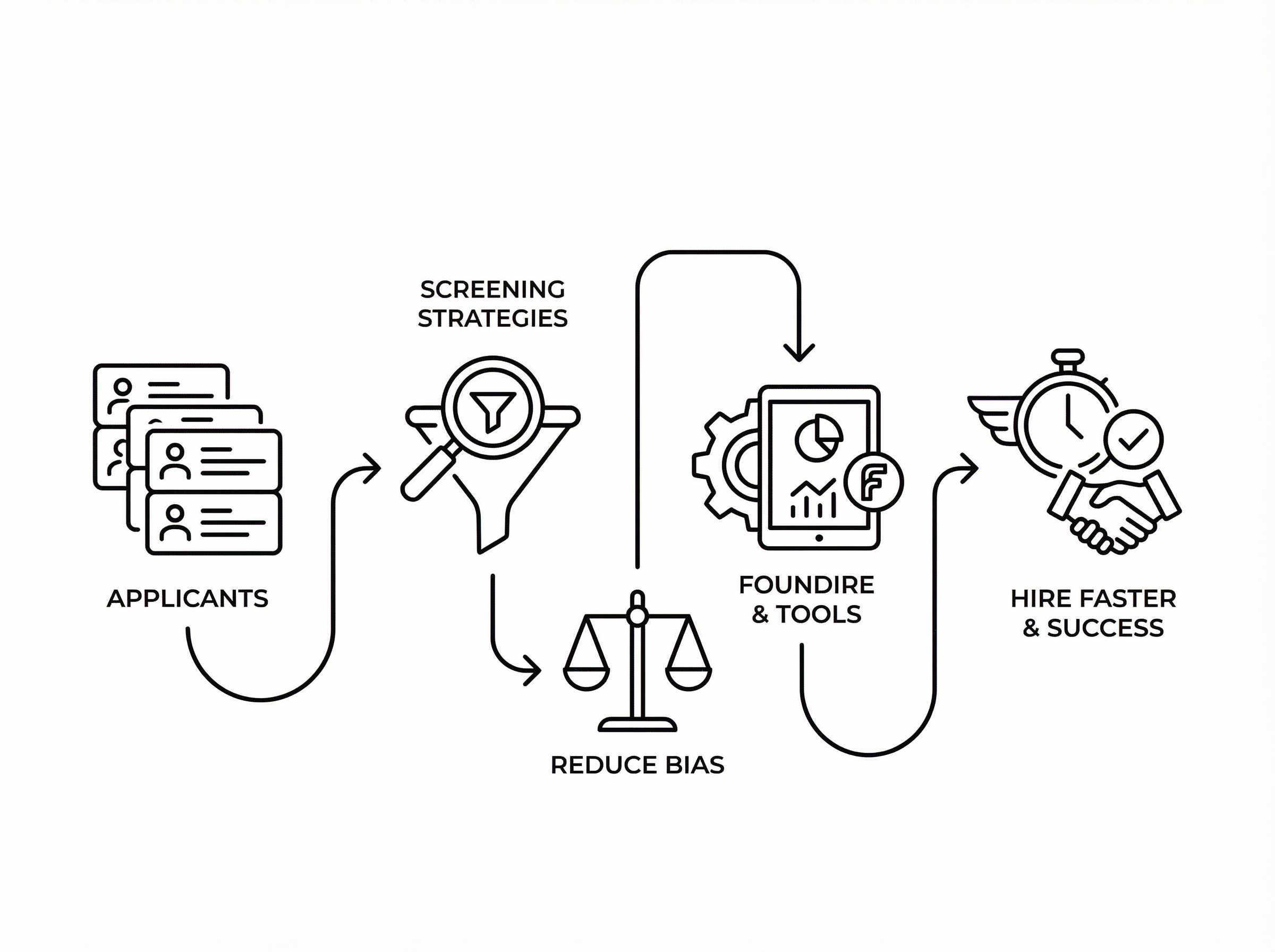
5 Best Practices for Qualification Review
Transforming this chaos into a streamlined engine requires moving from "gut feeling" to data-driven qualification. Here are five heuristics to master the process.
1. Establish "Knockout" Criteria During Intake
The review process fails before the job is even posted if the criteria are ambiguous. You must distinguish between Minimum Qualifications (MQs) and Preferred Qualifications (PQs).
MQs are binary: Does the candidate have a valid nursing license? Do they have work authorization? Do they have 3+ years of Python experience? If the answer is "no," they are disqualified immediately. PQs are weighted: specific industry experience or leadership skills.
Key Takeaway: Never start reviewing applicants until the Hiring Manager has signed off on a written list of binary MQs.
2. Implement Structured Scorecards
A scorecard is not just for interviews; it is vital for the resume screening phase. Create a simple grid that maps the resume against the job description.
- Criteria: Enterprise Sales Experience (5+ years).
- Evidence: Look for specific titles, deal sizes mentioned in bullets, or tenure.
- Score: 1 (Does not meet), 2 (Unclear/needs probing), 3 (Meets), 4 (Exceeds).
This ensures that every recruiter on the team reviews applicants through the same lens, reducing the variance in candidate quality.
3. Leverage AI and Automation Tools
Modern hiring demands modern tools. Manually reading 800 resumes is poor resource allocation. Platforms like Foundire use advanced AI to automate the initial layer of applicant qualification review. By parsing resumes against the MQs and PQs you defined, these tools can surface the top 10% of candidates instantly.
Furthermore, an AI interview platform can handle the initial phone screen. Instead of Sarah spending 30 minutes on a call to find out a candidate lacks communication skills, an AI agent can conduct a text or video-based screen to verify qualifications, saving human interaction for high-potential candidates.
4. Avoid Common Pitfalls
Even with tools, recruiters fall into traps:
- Keyword Stuffing Bias: Rejecting a candidate because they used "Client Success" instead of "Account Management." Good qualification review looks for semantic meaning, not just exact keyword matches.
- The "Halo Effect": Passing a qualified candidate solely because they worked at Google, ignoring that their actual skills don't match the current role's needs.
- Ignoring Transferable Skills: Over-filtering for exact title matches rather than competency matches, which hurts diversity and innovation.
5. Integrate Background Checks Early
While usually left for the end, some qualification reviews (like certifications for medical or government roles) should be verified early in the workflow automation to prevent late-stage drop-offs.
The Breakthrough: Turning Data into Decisions
Let’s return to Sarah. After realizing her process was broken, she pressed pause. She sat down with the VP of Sales and built a qualification matrix. They agreed that "aggressive" actually meant "track record of exceeding quota by 20%+" and "technical certs" meant "AWS Cloud Practitioner."
From Bottleneck to Strategic Advantage
Sarah implemented a new workflow:
- Automated Screening: She used an AI tool to filter applicants based on the new binary MQs (Quota attainment + AWS Cert). This reduced the pile from 800 to 120.
- Asynchronous Assessment: The remaining 120 received a short assessment asking them to explain a complex technical concept to a non-technical audience (testing the "sales" skill).
- Human Review: Sarah only reviewed the 40 candidates who passed the assessment.
Measuring the Change
The results of this optimized applicant qualification review were drastic:
- Time Spent Screening: Reduced by 70%.
- HM Acceptance Rate: Jumped from 20% to 90% because every candidate presented met the agreed-upon criteria.
- Time-to-Fill: The roles were filled in 35 days (down from the projected 90).
- Candidate Experience: Applicants who didn't qualify received instant, polite rejection notices rather than silence.
Elevating Your Recruiter Profile
For talent leaders and recruiters, mastering applicant qualification review is a career accelerator. It shifts your perception from "administrative support" to "talent advisor."
Interviewing for Your Next Role
When you are interviewing for a Senior Recruiter or Talent Operations role, you will be asked how you manage volume and quality. Here is how to answer.
Q: "How have you applied qualification review to improve outcomes?"

A: "In my previous role, I noticed a 60% rejection rate at the hiring manager review stage, which indicated a misalignment on criteria. I operationalized a structured applicant qualification review process. I collaborated with leadership to define binary knockout criteria and implemented an automated scoring system. This standardized our screening, reduced false positives by 40%, and streamlined the time-to-interview by two weeks. Ultimately, we improved our quality of hire while reducing recruiter burnout."
Resume Bullets That Prove Impact
If you want your resume to trigger the qualification algorithms of other companies, use bullets like these:
- Designed and executed a standardized applicant qualification review matrix, increasing candidate pass-through rates by 35%.
- Calibrated hiring teams on objective screening criteria, reducing unconscious bias and improving diversity metrics by 18% YoY.
- Implemented workflow automation for resume screening, saving 15 hours per week per recruiter while maintaining 100% compliance with hiring standards.
Pros and Cons of Structured Review
| Benefit | Tradeoff |
|---|---|
| Legal Defensibility: Using standardized criteria protects the organization against claims of discrimination by proving decisions were based on job-related qualifications. | Initial Setup Time: It requires significant upfront investment to align with hiring managers and build scorecards before viewing a single resume. |
| Scalability: Structured reviews allow for the use of AI and automation (like Foundire), enabling teams to handle thousands of applicants without adding headcount. | Potential Rigidity: If criteria are too strict, you may generate "false negatives" and reject non-traditional candidates who could have been high performers. |
| Reduced Bias: Focusing on competencies rather than pedigree or "culture fit" creates a more diverse talent pool. | Requires Training: Hiring teams must be trained on how to use scorecards effectively, or they will revert to gut-feeling decisions. |
Frequently Asked Questions
What is applicant qualification review?
Applicant qualification review is the phase in the recruitment lifecycle where a candidate’s application is assessed against specific, pre-defined job criteria. It serves as a filter to ensure only candidates who possess the necessary skills, education, and experience advance to the interview stage, optimizing time and resources.
Can automated qualification review backfire?
Yes, if the criteria are poorly defined. If you set "Must have 10 years of experience" when 5 years is sufficient, automation will reject excellent candidates (false negatives). It is crucial to audit your automated workflows regularly to ensure they are screening in talent, not just screening it out.
What is the difference between screening and qualification?
Screening is often a broader term that includes checking for basic requirements (location, visa status). Qualification is a deeper assessment of competency and fit against the job description. In modern workflows, screening is often automated, while qualification may involve a human review of a portfolio or an AI-based skills assessment.
How does AI improve the qualification process?
AI improves qualification by removing human fatigue and inconsistency. An AI tool can review 1,000 resumes at 2 AM with the same precision as at 9 AM. It identifies patterns and semantic matches that humans might miss, allowing recruiters to focus on high-value interactions rather than data entry.
Conclusion: The Future of Hiring
Mastering applicant qualification review is no longer optional; it is the differentiator between a chaotic hiring function and a strategic talent engine. By moving away from gut feelings and implementing structured workflows—from Sourcing to Resume Screening to AI Interviews and Scorecards—you create a durable hiring advantage.
When you standardize how you qualify talent, you don't just fill roles faster; you build a more fair, diverse, and high-performing organization.
If you want to operationalize applicant qualification review with structured workflows (Sourcing → resume screening → AI interviews → scorecards → offers → background checks), try tools like Foundire (https://foundire.com).