How to Fix Your Screening to Interview Workflow

How to Fix Your Screening to Interview Workflow
If you’re reviewing this, you likely have a "leaky bucket" problem. You have applicants, and you have open roles, but the bridge between them—the screening to interview workflow—is broken.
What is a screening to interview workflow?
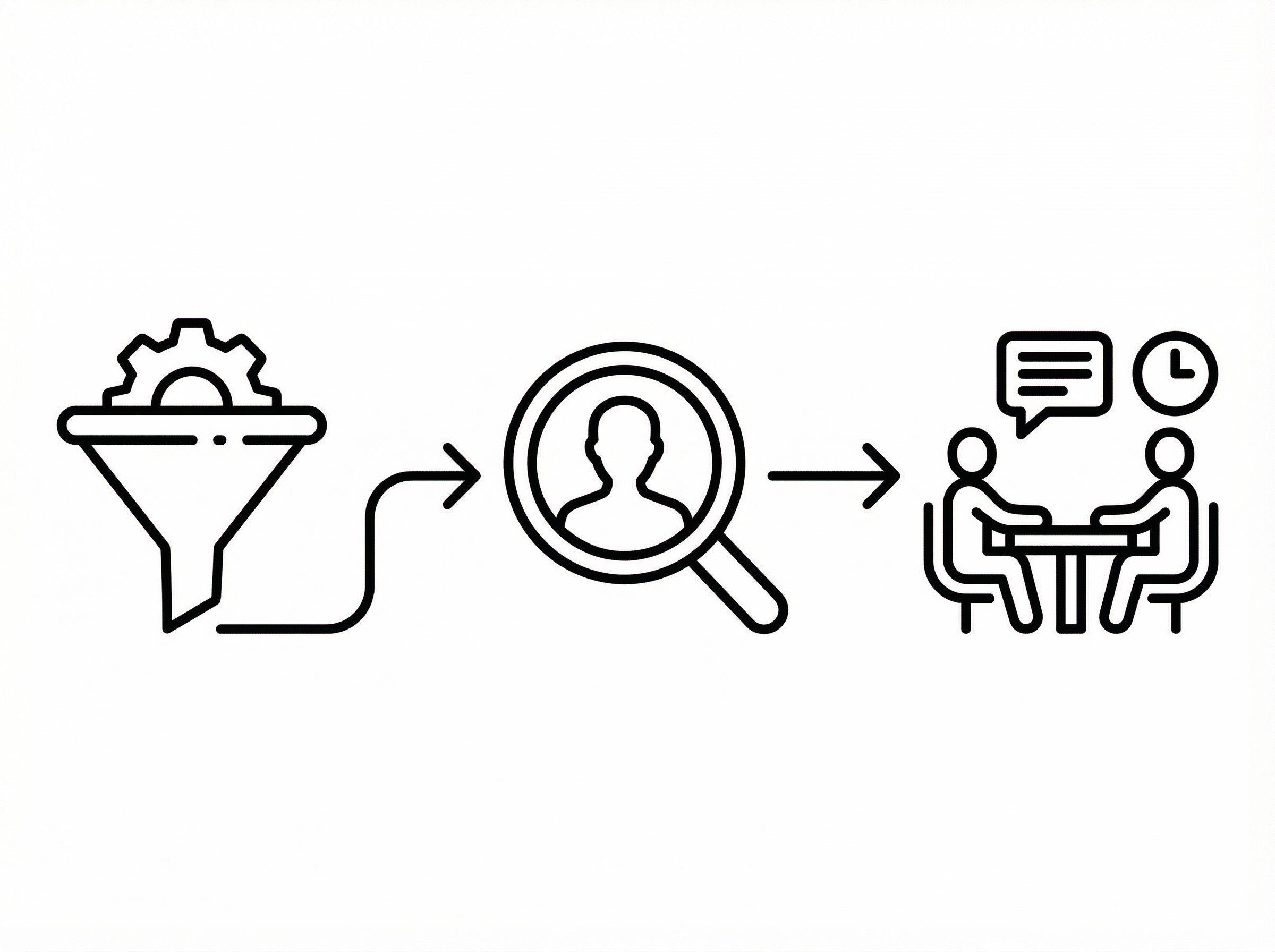
It is the operational process of moving a candidate from their initial application review (screening) to their first direct interaction with a hiring team member (interview). This workflow includes resume parsing, qualification calls, skills assessments, and scheduling.
Why does this specific slice of the funnel matter more than sourcing or closing? Because it is where speed and quality collide. According to 2025 hiring benchmarks, top candidates are often off the market in just 10 days, yet the average time-to-fill for professional roles hovers between 35 and 45 days. If your workflow drags, you aren't just losing speed; you are systematically filtering out the best talent who won't wait around for manual email tag.
The Reality Check: A slow screening workflow doesn't just annoy candidates; it actively selects for the desperate rather than the qualified.
Real-World Scenario: Fixing a Broken Pipeline
Let’s look at a realistic scenario that plays out in recruitment teams every day. We’ll look at "CloudCorp," a mid-sized tech firm struggling to scale their engineering team.
The Before: Chaos at CloudCorp
Sarah (Hiring Manager) and Alex (Recruiter) were drowning. They had opened a Senior Developer role and received 400 applications in week one.
- The Process: Alex manually reviewed every PDF. He flagged 50 candidates and sent individual emails asking for availability.
- The Bottleneck: It took Alex 5 days to screen resumes. By the time he emailed the top 5 candidates, 2 had already accepted other offers.
- The Metric: Their "Screen to Interview" time was 14 days. Their candidate drop-off rate was nearly 60% because candidates found the process "boring and opaque."
- The Result: Sarah spent her interview time speaking with "available" candidates, not the "best" candidates. The team was conducting an average of 20 interviews per hire—a massive drain on engineering productivity.
The After: Structured Success
CloudCorp decided to overhaul their workflow by implementing automation and structured criteria (using a platform similar to Foundire). Here is what changed:
- Automated Intake: Instead of a manual review, an AI-driven screening tool instantly scored resumes against Sarah’s calibrated scorecard.
- Asynchronous Screening: The top 10% of candidates received an immediate invite to a short, asynchronous video interview. This replaced the 30-minute "phone screen" that clogged Alex's calendar.
- Instant Scheduling: Candidates who passed the async screen were instantly served a calendar link for the hiring manager interview.
The Outcome:
- Time to Interview: Reduced from 14 days to 3 days.
- Retention: The drop-off rate fell to 10%.
- Quality: Sarah interviewed fewer people (5 instead of 20) but made an offer to one of the first candidates because the pre-screening was rigorous and accurate.
Core Insights & Operational Best Practices
Optimizing your screening to interview workflow requires moving away from "gut feeling" and toward "process engineering." Here are three actionable heuristics to apply immediately.
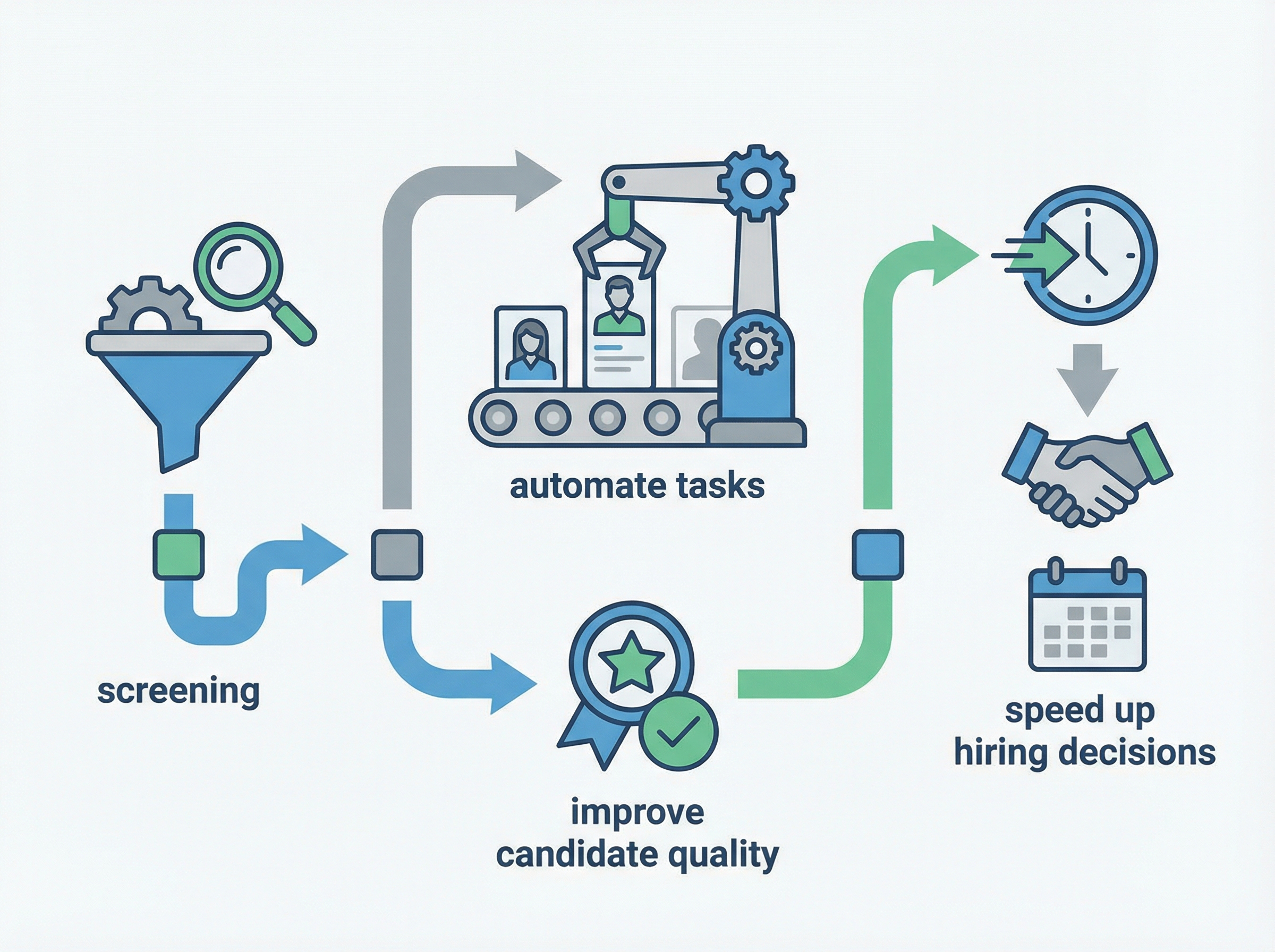
1. Automate Low-Value Friction
The biggest killer of workflow velocity is manual coordination. If a human recruiter is manually scheduling the first conversation, you are already behind. Modern Applicant Tracking Systems (ATS) and AI interview platforms allow you to automate the "qualification" phase.
Heuristic: If a task is repetitive and data-based (e.g., checking if a candidate has 5+ years of Python experience), automate it. Reserve human time for tasks that require empathy and negotiation.
2. Calibrate Scorecards Before the Search
Inefficiency often stems from misalignment. If the recruiter screens for "enthusiasm" but the manager screens for "technical depth," the workflow breaks.
Best Practice: create a Structured Interview Scorecard. This document defines exactly what "good" looks like for every stage. When the screening criteria matches the interview criteria, you eliminate the "false positives" that waste hiring manager time.
3. Implement a "Fast-Track" Lane
Not all candidates are equal. 2025 data suggests that the top 5% of talent receives 90% of the recruiter attention.
Action: Set up triggers in your workflow. If a candidate scores above 90% on the initial screen, they should bypass the standard queue and go directly to a hiring manager interview. Speed is your primary differentiator for elite talent.
Common Pitfalls to Avoid
- The "More Steps = More Quality" Fallacy: Adding extra screening hoops (like lengthy personality tests before a first call) typically increases drop-off without improving quality of hire.
- Ignoring the "No" Pile: Failing to automate rejection emails damages your employer brand. A swift "no" is better than ghosting.
- Over-Reliance on Keywords: Old-school ATS parsers reject great candidates who don't keyword-stuff their resumes. Modern AI screening looks for semantic matches (skills/context) rather than exact keyword matches.
The Breakthrough Moment
For most talent leaders, the breakthrough happens when they look at their Pass-Through Rate (PTR) data.
In a manual workflow, you might see a Screening-to-Interview PTR of 50%, but an Interview-to-Offer PTR of only 5%. This means you are screening too loosely and interviewing too many unqualified people.
The Shift: When you tighten the screening workflow (using tools like Foundire for rigorous upfront assessment), your Screening-to-Interview PTR might drop to 15%, but your Interview-to-Offer rate skyrockets to 60%. You are doing less work for better results. That is the moment the workflow transforms from a cost center to a strategic asset.
Career Impact: Mastering the Workflow
For recruiters and talent acquisition leaders, mastering this workflow is a career accelerator. It moves you from being a "scheduler" to a "talent operations expert."
The Interview Advantage
When you are interviewing for a new role, you can differentiate yourself by discussing workflow architecture.
Q: "How have you improved hiring velocity in previous roles?"
Weak Answer: "I worked really hard and called candidates on weekends."
Strong Answer: "I audited our screening to interview workflow and identified a 4-day lag in scheduling. I implemented an automated scheduling tool and standardized our intake scorecards, which reduced time-to-hire by 40% while improving our interview pass-through rate."
Resume Bullet Examples
- "Redesigned the screening to interview workflow, reducing average time-to-fill from 45 days to 28 days."
- "Implemented structured interview scorecards and AI-driven screening, cutting hiring manager interview hours by 30% per hire."
- "Increased candidate pipeline conversion by 25% through the integration of automated engagement tools."
Pros, Cons, and FAQs
| Benefit (Optimized Workflow) | Tradeoff (Considerations) |
|---|---|
| Speed & Competitive Edge: Reduces time-in-process, securing candidates before competitors can make an offer. | Setup Time: Requires upfront investment to build scorecards, configure automation tools, and train managers. |
| Bias Reduction: Structured screening criteria reduce unconscious bias compared to "gut feel" resume reviews. | Loss of "Human Touch": If over-automated, candidates may feel treated like numbers. (Mitigate this with personalized automated messaging). |
| Data Visibility: clear metrics allow you to spot exactly where the pipeline is clogged. | Tool Cost: Implementing premium screening and interviewing platforms requires budget approval. |
Frequently Asked Questions
What is a good benchmark for screening pass-through rates?
In 2025, a healthy benchmark for Applicant-to-Screen is roughly 5-10%, and Screen-to-Interview is around 20-30%. If your Screen-to-Interview rate is higher than 50%, your screening process may be too lenient.
Can automation in screening backfire?
Yes, if calibrated poorly. If your automated filters are too strict, you will reject qualified candidates ("false negatives"). It is crucial to regularly audit rejected candidates to ensure the system is working correctly.
How does AI impact the screening workflow?
AI is shifting screening from "keyword matching" to "competency evaluation." Tools can now conduct initial code reviews, analyze spoken responses for soft skills, and predict role fit with much higher accuracy than manual review.
Closing Thoughts
Mastering your screening to interview workflow is not just about administrative hygiene; it is a durable hiring advantage. In a market where speed is the new currency, the ability to move a candidate from "Interested" to "Interviewing" in hours—not weeks—is what separates high-performing talent teams from the rest.
If you want to operationalize this with structured workflows that handle everything from sourcing and resume screening to AI interviews and background checks, consider exploring platforms like Foundire (https://foundire.com). Building a predictable pipeline starts with fixing the flow.