How to Fast-Track Critical Roles

The High Cost of the Empty Seat
If you’re a talent acquisition leader, you know the feeling: the silence of a critical role sitting open is deafening. It’s not just an empty chair; it’s a missed quarterly target, a stalled product launch, or a strategic initiative collecting dust. In recruitment, critical roles are the linchpins of organizational success. When they go unfilled, the cost isn’t just measured in agency fees—it’s measured in lost momentum.
According to 2024–2025 market data, the cost of a bad hire for a leadership position can skyrocket to over 200% of the employee’s annual salary. But the cost of no hire can be equally devastating. In North America’s competitive landscape, where specialized skills are scarce, speed and quality often feel like opposing forces. You need to move fast to secure top talent, but moving too fast risks a mismatch that sends you back to square one.
This article isn’t about "hiring harder." It’s about operationalizing your workflow so you can identify, vet, and close candidates for critical roles without burning out your team or compromising on quality.
When Everything Is a Priority, Nothing Is
The Reality of the "Hair on Fire" Request
Picture this: It’s Monday morning. Your inbox is flooded with “URGENT” subject lines. A VP just stopped by your desk (or pinged you on Slack) to say that the Director of Engineering role needs to be filled yesterday because the product roadmap is at risk. Meanwhile, your recruiters are juggling 25 other requisitions, reviewing hundreds of resumes that don’t quite hit the mark, and chasing down hiring managers for feedback on interviews that happened three days ago.
Where the Process Breaks Down
In this chaotic environment, the definition of a "critical role" becomes blurred. When every opening is treated as a five-alarm fire, your team lacks the focus required to headhunt high-impact talent. The breakdown usually happens in the middle of the funnel:
- Inconsistent Feedback: One interviewer loves the candidate’s energy; another thinks they lack technical depth. Without a structured scorecard, you’re comparing apples to oranges.
- The "Gut Feel" Trap: A hiring manager rejects a finalist because they "didn't feel like a culture fit," effectively discarding weeks of work based on an undefined bias.
- Ghosting Risks: Top candidates in the US and Canada are on the market for as little as 10 days. If your approval process drags on for weeks, they’ve already accepted an offer from a competitor who moved faster.
The result? A 60+ day time-to-fill average for specialized roles, frustrated stakeholders, and a recruiting team running on fumes. We have to stop treating critical hiring as a fire drill and start treating it like a specialized workflow.
3 Best Practices for High-Stakes Hiring
To fix the broken process, you need to introduce structure where it matters most. Here are three best practices to stabilize your critical role hiring.
1. Define "Critical" Before You Post
Not every backfill is critical. A critical role is one where vacancy directly impacts revenue, compliance, or strategic innovation. Create a tiered service-level agreement (SLA) with your business leaders. If a role is deemed "Tier 1 Critical," it gets prioritized sourcing resources and a guaranteed 24-hour feedback turnaround from hiring managers. If everything is Tier 1, nothing is.
2. Calibrate Early to Avoid Rework
The "Intake Meeting" is the most important step in the process. Don’t just take the job description and run. Sit down with the hiring manager and ask:
- "If you had to choose between specific industry experience and leadership potential, which wins?"
- "What is the one deal-breaker skill that is non-negotiable?"
Actionable Step: Use this meeting to build a Scorecard. This document defines the 4-5 core competencies you are testing for, so interviewers know exactly what "Good" looks like before they meet the first candidate.

3. Structure the Feedback Loop
Stop accepting "I liked them" as feedback. In North America, where fair hiring compliance (EEOC) is paramount, you need defensible data. Assign specific competency questions to specific interviewers. For example, Interviewer A covers "Technical Strategy," while Interviewer B covers "Team Management."
Pitfall to Avoid: Don't let interviewers see each other's feedback before they submit their own. "Groupthink" kills objectivity. Keep scores hidden until the debrief to ensure you get raw, unbiased signals.
Breakthrough: From Chaos to Clarity
Implementing these changes can feel like turning a cruise ship, but the impact is measurable. When teams shift from reactive scrambling to proactive, structured evaluation, the metrics change drastically.
Consider a team that adopted structured scorecards for their VP-level searches. Initially, hiring managers complained that the process felt "too rigid." But after the first two hires, the tone changed. Why? Because they stopped wasting time in aimless debriefs arguing over opinions. They looked at the data: Candidate X scored a 4/5 on Strategy but a 2/5 on Execution. Candidate Y was a 4/5 on both. Decision made.
Measurable Impact:
- Time Savings: Reduces debrief meetings from 60 minutes to 15 minutes.
- Speed: Cuts time-to-fill by 10–15 days by eliminating "maybe" candidates earlier.
- Quality: Increases new hire retention by ensuring expectations match reality.
How Hiring Teams Actually Manage Critical Roles
Theory is great, but execution requires the right infrastructure. Managing structured interviews, scorecards, and blind feedback reviews in spreadsheets is a recipe for administrative disaster. This is where modern workflow tools bridge the gap.
In practice, high-performing teams use a workflow platform (for example, Foundire) to connect resume screening, structured interviews, and score reviews into one consistent system. Instead of chasing email threads, the recruiter has a dashboard that shows exactly where every candidate stands against the scorecard criteria.
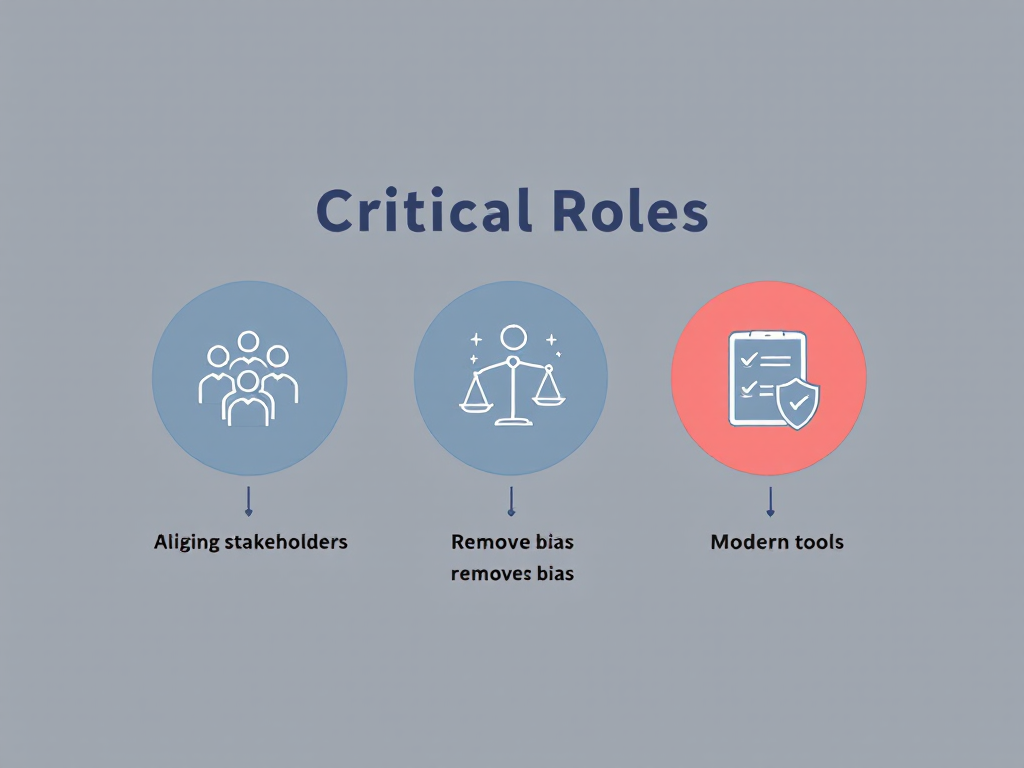
A modern workflow supports critical roles by:
- Standardizing Criteria: ensuring every resume is screened against the same required skills, reducing unconscious bias.
- Guiding Interviewers: providing interviewers with specific question sets directly in their interface, so they don’t have to "wing it."
- Centralizing Scores: aggregating feedback into a clear view that highlights the strongest signals, allowing for faster, data-backed decisions.
Interviewing for Impact: A Field Guide
For critical roles, the interview isn't just a chat; it's an investigation. Here is how to sharpen your evaluation:
Scenarios for Debriefs
- Scenario A (The Vague Feedback): "I just didn't click with them."
Fix: Ask, "Which specific competency on the scorecard did they fail to demonstrate? Can you give an example?" - Scenario B (The Halo Effect): "They went to the same university I did; they're great!"
Fix: Redirect to the skills assessment. "That's great, but how did they rate on the Crisis Management scenario?"
Questions That Reveal Competence
Avoid hypothetical "What would you do?" questions. Use behavioral questions that demand proof:
- "Tell me about a time you had to make a critical decision with only 50% of the data. What was the outcome?"
- "Describe a strategic initiative you led that failed. Why did it fail, and what did you change in your process afterward?"
Strong vs. Weak Signals
- Weak Signal: Candidate speaks in generalities ("We usually did X...").
- Strong Signal: Candidate uses "I" statements and provides specific metrics ("I led the migration, which cut costs by 15%...").
Traditional vs. Structured Hiring
The difference between "how we've always done it" and "how it should be done" is stark when you look at the outcomes.
| Feature | Traditional "Gut Feel" Approach | Structured Workflow (Foundire-style) |
|---|---|---|
| Speed / Time-to-Hire | Slow (delayed by indecision and scheduling chaos) | Fast (decisions made on data, not debate) |
| Consistency & Fairness | Low (highly susceptible to bias) | High (standardized criteria for all) |
| Interviewer Alignment | Poor (interviewers overlap questions) | High (clear roles and question sets) |
| Candidate Experience | Frustrating (repetitive questions, long waits) | Professional (focused, efficient process) |
| Risks | Compliance risks, bad hires, ghosting | Process requires initial setup time |
Frequently Asked Questions
What exactly defines a "critical role"?
A critical role is a position that has a disproportionate impact on the organization's ability to meet its strategic goals, revenue targets, or compliance requirements. It is not always a senior leadership role; it could be a specialized technical expert or a key operational manager.
How can we reduce bias when hiring for critical roles?
The most effective way to reduce bias is to use structured interviews and scorecards. By asking every candidate the same set of relevant questions and rating them on a pre-defined scale, you minimize the influence of unconscious bias and focus on competency.
Can Foundire help operationalize the process for critical roles?
Yes. Foundire helps teams operationalize critical hiring by providing a platform for consistent resume screening, structured interview guides, and centralized score reviews. This ensures that the process is efficient, fair, and documented.
What is the average time-to-fill for critical roles in North America?
According to recent 2024-2025 benchmarks, the average time-to-fill for specialized or leadership roles in North America ranges from 40 to 70 days. However, teams using structured workflows can often reduce this by 20-30%.
Building a Resilient Workforce
Hiring for critical roles is the ultimate stress test for a recruiting team. It exposes the cracks in your process, but it also offers the greatest opportunity to prove the value of Talent Acquisition as a strategic partner. By moving away from "gut feel" and embracing a structured, data-driven workflow, you protect your company from the high cost of bad hires and burnout.
Structure doesn’t kill speed—it enables it. If you want to operationalize critical roles with structured screening, interview simulations, and consistent score reviews, tools like Foundire can help your team move faster without losing quality.