How to Ensure Consistent Scoring

How to Ensure Consistent Scoring Across Candidates
Defining Consistent Scoring Across Candidates
The Core Definition for Modern Hiring
Consistent scoring across candidates is the systematic application of identical evaluation criteria to every applicant throughout the hiring process. Instead of relying on subjective impressions, this approach uses standardized rubrics to measure skills, competencies, and behavioral traits against a pre-defined baseline. This method minimizes unconscious bias, ensures fairness, and creates a legally defensible audit trail for every hiring decision.
Why does this matter now? In an era where efficiency and equity are paramount, data proves that structured interviews are nearly twice as effective at predicting job performance compared to unstructured "chats." By locking in the criteria before the candidate enters the room, you transform hiring from a guessing game into a repeatable science.
The "Gut Feeling" Trap
We have all been there. You finish an interview and think, "I just got a great vibe from them." They went to your university, laughed at your jokes, and the conversation flowed effortlessly. Meanwhile, another candidate—perhaps nervous but highly qualified—stumbled through an unstructured chat and was written off.
This is the "gut feeling" trap. Without consistent scoring, you aren't actually measuring competence; you are measuring how much a candidate resembles you. This affinity bias doesn't just hurt diversity; it leads to costly mis-hires. Recent industry data suggests a bad hire can cost a company up to 30% of that employee's first-year earnings. Consistent scoring acts as the guardrail that prevents your gut from steering the company off a cliff.
The Chaos of Unstructured Evaluation
A Real-World Recruiting Nightmare
Meet Alex, a Talent Lead at a high-growth tech startup. Alex was drowning in resumes and facing pressure to hire ten account executives in a month. The process was completely unstructured. Hiring managers would "wing it," asking different questions to different candidates based on the flow of conversation.
One manager asked about sales tactics; another spent 30 minutes discussing golf. Feedback in the Applicant Tracking System (ATS) was a mess of vague notes like "Good culture fit" or "Seemed low energy." There were no scorecards, no defined competencies, and absolutely no way to compare Candidate A to Candidate B objectively.
The Hidden Costs of Inconsistency
The result was chaotic. Alex's funnel showed a massive leak: a 40% drop-off rate at the offer stage because candidates felt the process was disorganized and unfair. Worse, the team hired two candidates who had "great vibes" but lacked core closing skills, leading to their termination within six months.
The friction was palpable. Debrief meetings turned into arguments about opinions rather than evidence. "I liked him" became a valid argument. Without consistent scoring, Alex couldn't prove why a quiet, methodical candidate was actually the superior choice over a charismatic but unqualified one. The lack of data paralyzed the decision-making process, extending the time-to-hire by weeks.
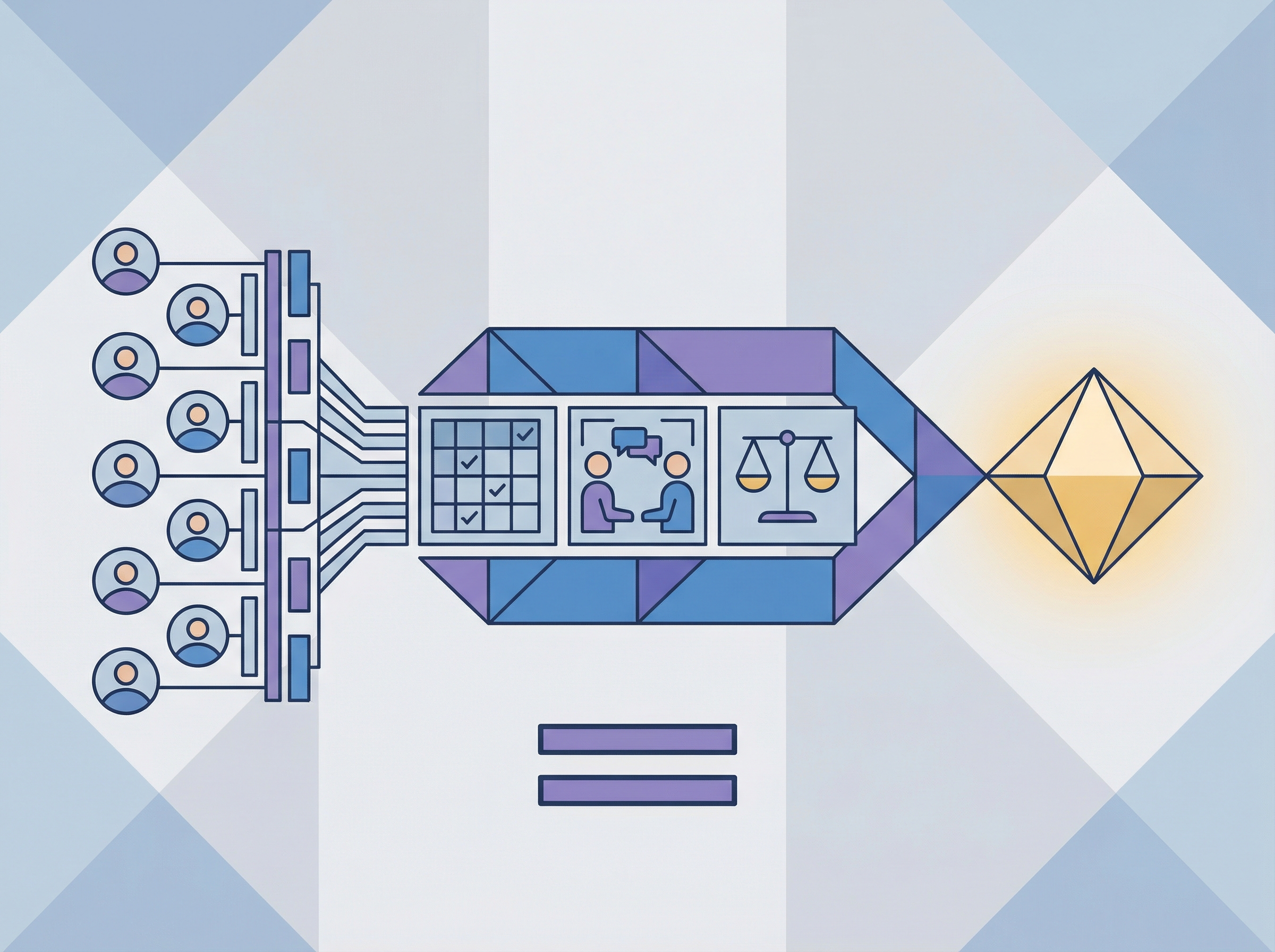
Implementing a Structured Scoring Framework
Building the Scorecard
The turning point for Alex came with the implementation of a structured scorecard. This isn't just a form; it's a strategic tool. The team defined five core competencies for the role (e.g., "Objection Handling," "Prospecting," "Coachability").
For each competency, they created a 1-5 rating scale with specific "anchor" descriptions:
- 1 (Poor): Candidate cannot provide a relevant example or gives a theoretical answer only.
- 3 (Average): Candidate provides a generic example with limited detail on the outcome.
- 5 (Excellent): Candidate shares a specific, complex example with clear action steps and measurable results (STAR method).
This simple shift changed everything. Interviewers stopped asking, "Do I like them?" and started asking, "Did they demonstrate the behavior described in level 5?"
Calibration and Technology
To ensure consistency, Alex integrated these scorecards directly into their ATS. They also adopted Foundire, an AI interview platform, to handle the initial screening. Foundire ensured that every single candidate answered the exact same screening questions and was scored by AI against the same criteria before reaching a human recruiter.
This hybrid approach—AI consistency at the top of the funnel and human structured scoring at the bottom—reduced bias significantly. The team held "calibration sessions" where they reviewed scored interviews together to align on what a "4" looks like versus a "5."

Common Pitfalls to Avoid
Even with a system in place, human psychology is tricky. Alex trained the team to watch out for three specific rating errors:
- The Halo Effect: Letting one strong trait (like a prestigious degree) unintentionally boost the scores of all other traits.
- Central Tendency Bias: The fear of committing to a strong opinion, leading evaluators to rate everyone a "3" or "safe hire."
- Contrast Effect: Judging a candidate based on the previous person interviewed rather than the objective standard (e.g., an average candidate looks amazing after a terrible one).
The Outcome: After three months of consistent scoring, Alex's team reduced time-to-hire by 18 days. More importantly, the pass-through rate from interview to offer stabilized, and the "new hire retention rate" improved by 25%.
The Career Advantage of Data-Driven Hiring
Why Recruiters Need This Skill
For recruiters and talent leaders, mastering consistent scoring is a career accelerant. It moves you from being an administrator to a strategic advisor. When you can present data showing why a candidate scored highly, you gain authority in the boardroom. You are no longer reporting feelings; you are reporting metrics.
Career Tip: In your own job interviews, positioning yourself as an expert in "structured interviewing" and "calibration" distinguishes you from generalist recruiters.
Q&A: Answering the "Process" Question
Interviewer: "How do you improve quality of hire?"
You: "I implement consistent scoring frameworks to reduce bias. In my last role, I standardized our interview rubrics and calibrated our hiring managers. This moved us from subjective 'gut' decisions to evidence-based hiring, which reduced our early turnover by 20% and ensured every candidate was evaluated fairly on the same criteria."
Resume Bullet Examples
- Designed and implemented a structured interview scorecard system, improving inter-rater reliability by 40%.
- Led interview calibration training for 50+ hiring managers to eliminate "Halo Effect" bias.
- Partnered with leadership to define competency anchors, reducing time-to-decision by 2 weeks.
- Integrated Foundire AI screening to ensure 100% scoring consistency across high-volume candidate pools.
Pros & Cons of Consistent Scoring
| Benefit (Why it wins) | Tradeoff (What to watch for) |
|---|---|
| Fairness & Inclusion: dramatically reduces bias by focusing on evidence over affinity. | Rigidity: Can feel mechanical if interviewers aren't trained to maintain a conversational flow. |
| Predictive Power: Structured data correlates much higher with actual job performance. | Upfront Effort: Requires significant time to build rubrics and train managers before interviewing starts. |
| Speed & Alignment: Debriefs are faster because the team argues over data points, not opinions. | Missed "Wildcards": Highly non-traditional candidates might score low on specific rigid criteria despite high potential. |
Frequently Asked Questions
What is consistent scoring across candidates?
It is a hiring methodology where every applicant is evaluated using the exact same set of questions, criteria, and rating scales. This ensures that hiring decisions are based on comparable data rather than subjective impressions or "vibes."
Can consistent scoring backfire?
Yes, if the criteria are wrong. If your scorecard prioritizes the wrong skills, you will consistently hire the wrong people. It can also backfire if the process becomes so robotic that it alienates candidates. The key is to be structured in evaluation but authentic in conversation.
How do you calibrate interview scores?
Calibration involves a meeting where interviewers review their scores for the same candidate (or a sample candidate). If one person rates a "5" and another a "2" for the same answer, they discuss the evidence until they align on what constitutes each score. This harmonizes the team's standards.
Conclusion
Mastering consistent scoring across candidates is the difference between hoping for a good hire and engineering one. It protects your company from bias, protects your candidates from unfairness, and protects your reputation as a talent professional. By moving away from "gut feelings" and toward structured, data-backed decisions, you create a hiring process that is not only faster but fundamentally better.
If you want to operationalize consistent scoring with structured workflows—from sourcing and resume screening to AI interviews and automated scorecards—try tools like Foundire (https://foundire.com) to build a defensible, high-quality hiring machine.