How to Create a Role Requirements Checklist

How to Create a Role Requirements Checklist
A role requirements checklist is a strategic document that translates vague job descriptions into measurable competencies, ensuring every hiring stage—from resume screening to final offer—is aligned with specific performance outcomes. It acts as the "source of truth" for recruiters and hiring managers, preventing misalignment, reducing bias, and significantly increasing the speed and quality of hire.
According to 2025 recruitment data, the average cost of a bad hire now ranges from 30% to 50% of an employee's first-year salary, often exceeding six figures for senior roles. Yet, many teams still rely on "gut feeling" rather than structured criteria. This lack of clarity is the primary driver of ghosting, long time-to-fill metrics, and painful mis-hires.
Story Hook: Imagine rejecting the perfect candidate because a hiring manager said, "I just didn't get the right vibe," only to find out three months later that the "vibe" they wanted was a skill they never listed. That’s the expensive chaos a role requirements checklist prevents.
The Scenario: From Chaos to Clarity
Let’s look at a real-world scenario involving "Alex," a Senior Recruiter at a mid-sized tech firm. Alex was tasked with filling a critical "Senior Backend Developer" role. The job description was standard: 5+ years of experience, Python expertise, and "good communication skills."
The Intake Meeting Disconnect
For the first four weeks, Alex sourced aggressively. The metrics were discouraging:
- Applicant Volume: 150+ candidates.
- Screening Pass-Through Rate: 10% (most were rejected by the hiring manager for "not being senior enough").
- Interview Pass-Through Rate: 0%. Three candidates reached the final round, but the hiring manager rejected all of them, citing a lack of "system design intuition"—a requirement that was never mentioned in the intake meeting or the job description.
- Time-to-Fill: 45 days and counting.
The Turnaround
Frustrated by the wasted effort, Alex paused the search. He scheduled a "calibration reboot" with the hiring manager. Instead of asking "What do you want?", Alex asked, "What does this person need to do in their first 90 days to be considered successful?"
Together, they built a Role Requirements Checklist. They moved away from generic traits and defined specific evidence for each stage. "Good communication" became "Can explain a complex API architecture to a non-technical product manager." "Seniority" became "Has led a migration of a legacy monolith to microservices."
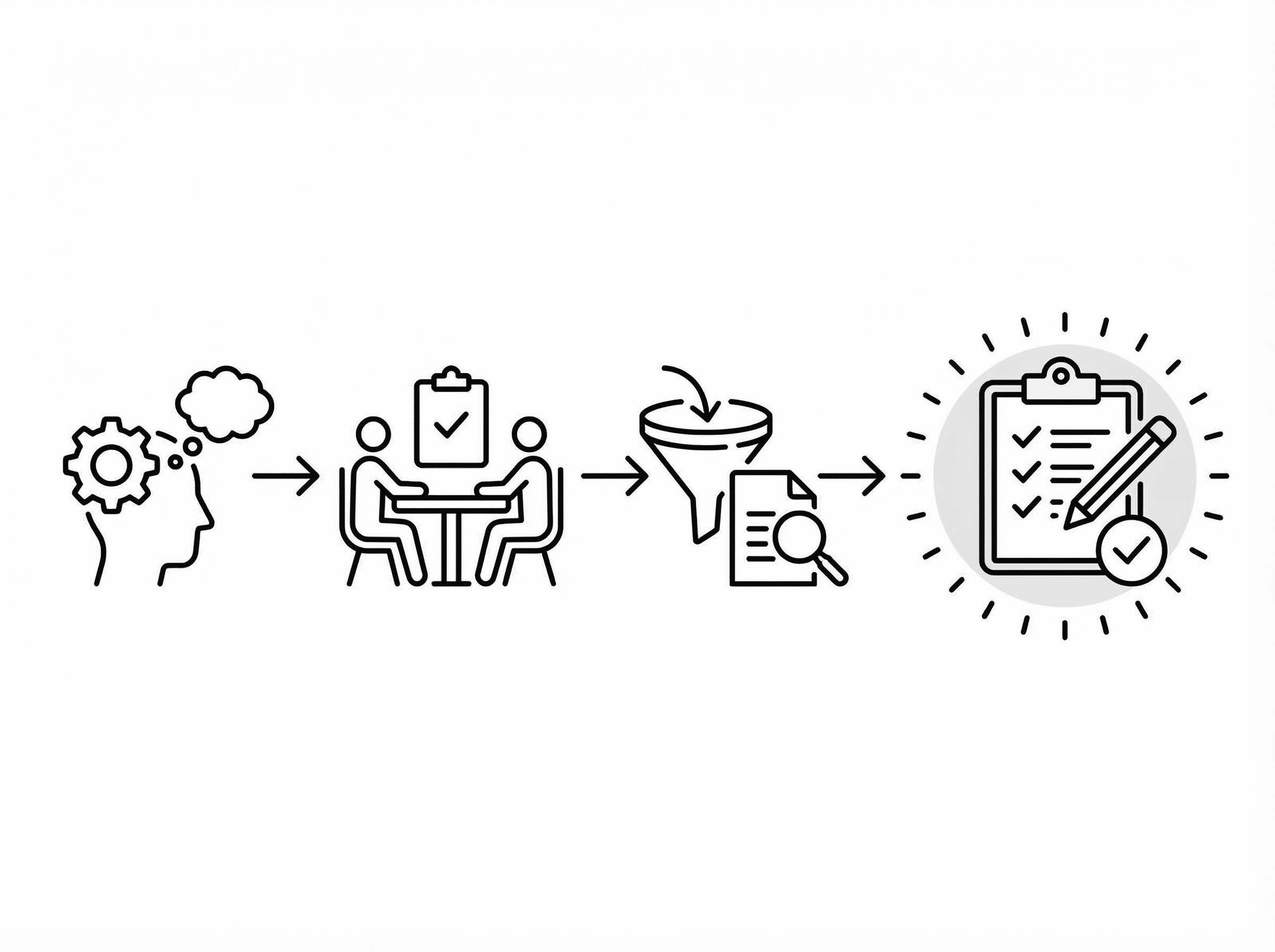
Core Heuristics for Building Your Checklist
To replicate Alex’s turnaround, you need more than a list of bullet points. You need a structured approach to filter signal from noise. Here are three heuristics to build a checklist that actually works.
1. The "If You Can't Test It, Don't List It" Rule
Vague requirements are the enemy of structured interviews. If you list "ambitious" as a requirement, you must define how you will measure it. If you can’t measure it effectively, remove it.
Bad Requirement: "Must be a self-starter."
Operationalized Requirement: "Can demonstrate a history of identifying a process gap and proposing a solution without being asked. Tested via behavioral question in the culture screen."
2. The "3 Essential Competencies" Rule
Avoid "unicorn hunting" by limiting your absolute non-negotiables to the three things the person must have to survive day one. Everything else is coachable or secondary.
- Competency A (Technical): E.g., Advanced SQL scripting for data analysis.
- Competency B (Behavioral): E.g., Ability to deliver bad news to stakeholders (Conflict Resolution).
- Competency C (Contextual): E.g., Experience working in a high-compliance industry (FinTech/HealthTech).
3. Map Requirements to Workflow Stages
A great checklist doesn't just list skills; it assigns them to a specific verification stage. This prevents interview redundancy, where every interviewer asks "Tell me about yourself" and nobody checks for technical depth.
- Resume Screening: Check for certifications, years of specific tool usage, and industry background.
- AI Interview / Phone Screen: Use tools like Foundire to automate the validation of core hard skills and initial behavioral fit before a human recruiter spends time on the phone.
- Hiring Manager Interview: Deep dive into case studies and real-world problem solving.
- Reference/Background Checks: Validate dates, titles, and verify the "soft skills" claimed during the interview.
The Breakthrough and Results
Once Alex implemented the checklist, the dynamic changed immediately. The "system design" requirement was moved to the forefront of the process.
The "Aha" Moment
The very next candidate, "Jordan," didn't have the "5+ years" of experience listed on the original JD. However, Jordan’s resume highlighted a successful system migration project. Because the checklist focused on outcomes (migration experience) rather than proxies (years of experience), Alex passed Jordan through.
The hiring manager interviewed Jordan and immediately scored them a 4/4 on the interview scorecard. Jordan was hired two weeks later.
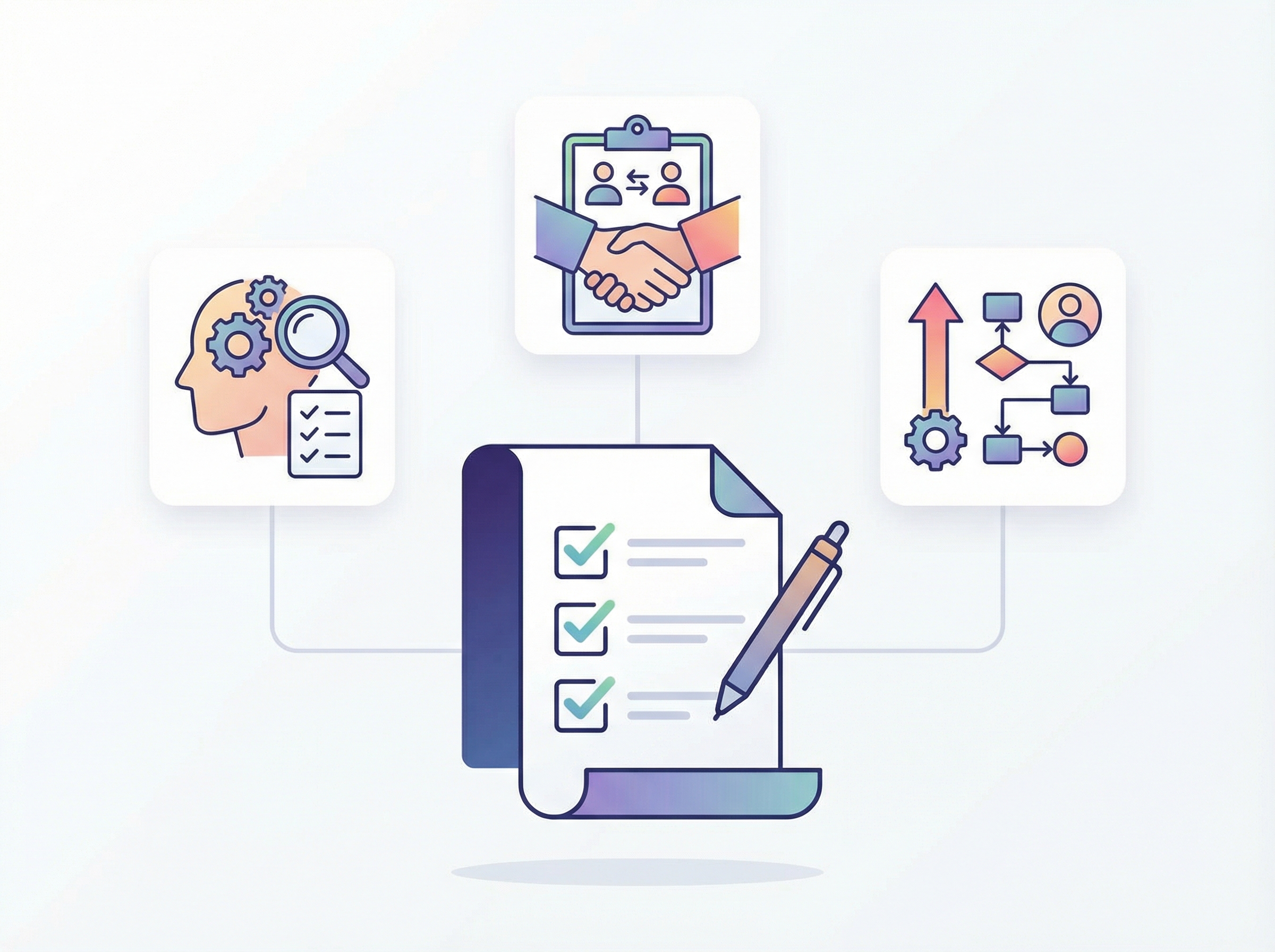
Measuring the Impact
Post-checklist implementation, Alex’s metrics improved drastically:
- Time-to-Fill: Reduced from a projected 90 days to 60 days.
- Conversion Rate: Interview-to-offer ratio improved by 40%.
- Candidate Experience: Candidates reported appreciating the clarity of the process, as they knew exactly what they were being evaluated on.
Common Pitfalls to Avoid
- Copy-Pasting Old JDs: The market changes fast. A requirement for a specific software version from 2022 might be obsolete in 2026.
- Confusing Personality with Competency: "Introverted" is a personality trait; "struggles to present to groups" is a competency gap. Don't bias against personality traits that don't affect performance.
- Failing to Calibrate: If the first three candidates fail the same checklist item, the requirement might be unrealistic for the salary band.
Career Relevance for Talent Leaders
Mastering the role requirements checklist is a career accelerator for recruiters and talent acquisition leaders. It shifts your perception from "administrative support" to "strategic talent advisor."
Interview Q&A Strategy
When you are interviewing for a Head of Talent or Senior Recruiter role, use this concept to demonstrate your strategic value.
Interviewer: "How do you handle difficult hiring managers who don't know what they want?"
You: "I use a structured role requirements checklist to drive alignment before we ever look at a resume. For example, in my last role, I reduced time-to-fill by 30% by forcing a distinction between 'nice-to-have' traits and measurable competencies. This allowed us to implement hiring workflow automation steps that filtered unqualified candidates early, saving the hiring manager roughly 10 hours of interview time per requisition."
Resume Boosters
Add these bullet points to your own resume to show your mastery of structured hiring:
- Designed and implemented role requirements checklists for 20+ technical roles, reducing mis-hires to near zero.
- Partnered with leadership to introduce interview scorecards, resulting in a 25% increase in diverse hires due to reduced unconscious bias.
- Operationalized talent acquisition workflows using AI tools to validate checklist criteria at the top of the funnel.
Pros & Cons of a Role Requirements Checklist
| Benefit | Tradeoff |
|---|---|
| Speed & Efficiency: drastically reduces time spent interviewing unqualified candidates by filtering them out early based on clear criteria. | Upfront Investment: Requires a 60-90 minute intake meeting and documentation time before sourcing can begin. |
| Legal & Fairness: Creates a defensible, objective paper trail that minimizes bias and supports diversity hiring goals. | Rigidity: If overly strict, it can accidentally filter out "wildcard" candidates with non-traditional backgrounds who could be high performers. |
| Automation Ready: Structured criteria can be easily fed into platforms like Foundire or ATS filters to automate screening. | Maintenance: Must be updated constantly. A checklist from 6 months ago may no longer reflect the team's current needs. |
Frequently Asked Questions
What is a role requirements checklist?
A role requirements checklist is an internal document that details the specific skills, behaviors, and outcomes required for a job. Unlike a public-facing job description, it includes how each requirement will be measured, who will measure it, and what score is required to pass.
Can a role requirements checklist backfire?
Yes, if it becomes a "wish list" of impossible criteria. If a checklist includes too many requirements (e.g., more than 15), it creates a "purple squirrel" profile that no candidate can match, leading to zero hires and frustrated stakeholders.
How often should the checklist be updated?
Ideally, for every new requisition. Even if you are hiring for the "same" role, the team context may have changed (e.g., the team now has plenty of juniors and needs a mentor). Review the checklist during the intake meeting for every single search.
Is this different from a job description?
Yes. A job description is a marketing document designed to attract candidates. A role requirements checklist is an operational document designed to evaluate candidates. One sells the role; the other governs the hiring decision.
Conclusion
The difference between a struggling recruiting function and a high-performing talent engine often comes down to clarity. A role requirements checklist is not just administrative paperwork; it is the blueprint for a fair, fast, and effective hiring process. By defining what "good" looks like before you start, you save time, reduce bias, and build trust with your hiring managers.
If you want to operationalize your checklist with structured workflows—from Sourcing and resume screening to AI interviews and scorecards—try using modern hiring platforms like Foundire (https://foundire.com) to automate the validation of your requirements and secure the right talent faster.