How to Compare Candidates Side-by-Side

How to Compare Candidates Side-by-Side: The Horizontal Hiring Method
Definition & Business Context
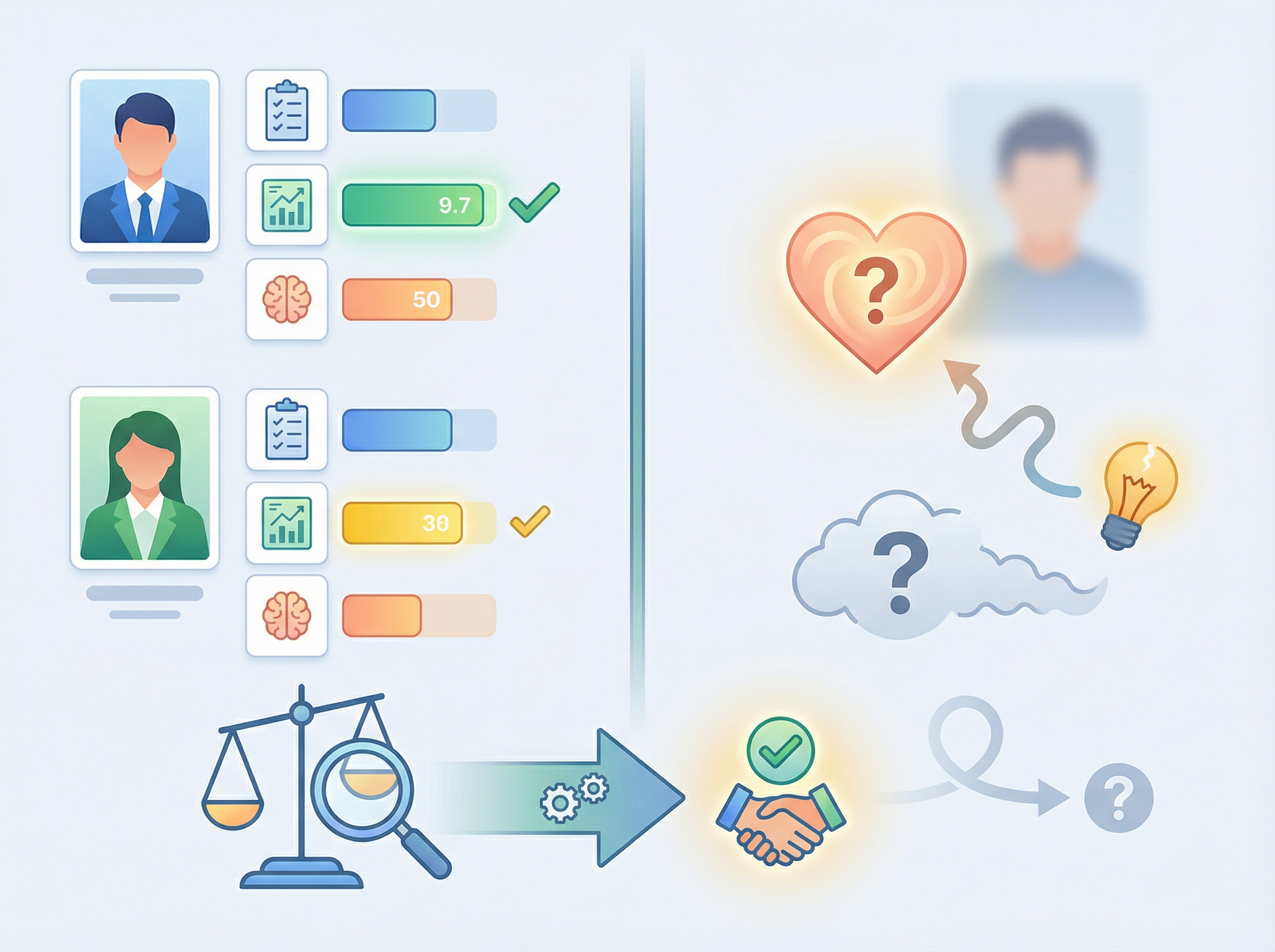
Compare candidates side-by-side is a structured evaluation technique where hiring teams assess applicants against specific competencies (horizontal comparison) rather than evaluating each candidate as a holistic narrative (vertical comparison). In a vertical review, a recruiter reads one resume from top to bottom, forms an impression, and then moves to the next. In a side-by-side horizontal review, the team isolates a single criterion—such as "strategic planning" or "Python proficiency"—and evaluates that specific data point across the entire candidate pool simultaneously.
This distinction is critical for reducing bias. When hiring professionals search for how to compare candidates, they are often trying to solve a consistency problem: avoiding the "Halo Effect," where a candidate’s likability or a single impressive credential disproportionately influences the final decision. By stripping away the narrative and focusing on side-by-side data points, organizations improve quality of hire, speed up consensus meetings, and create a legally defensible audit trail for their decisions.
The Core Hiring Problem: Imagine a hiring manager, Sarah, who interviews three candidates. Candidate A is charismatic but lacks technical depth. Candidate B is nervous but highly skilled. Candidate C is average but attended Sarah’s alma mater. Without a side-by-side comparison framework, Sarah’s brain defaults to the "likability" heuristic, likely favoring Candidate A or C. A structured comparison matrix forces the decision back to the skills that actually drive performance.
Real-World Hiring Scenario
The Chaos of "Gut-Based" Decisions
Let’s look at a common scenario in a mid-sized B2B SaaS company. The VP of Sales, Marcus, is hiring a new Account Executive. He interviews five people in one week. By Friday afternoon, his memory is a blur. He remembers that "Candidate 2 had great energy" and "Candidate 4 worked at Salesforce."
When the Recruiter, Elena, asks for his decision, Marcus relies on the Contrast Principle. He ranks Candidate 4 highest, not because they met the specific competency requirements, but because they interviewed immediately after a disastrous candidate, making them look brilliant by comparison. This is a "vertical" failure—Marcus is judging the candidates against each other based on "vibes" rather than against the job requirements.

Implementing the Comparison Matrix
Elena intervenes to switch the process to a side-by-side comparison. She introduces a Weighted Decision Matrix. Instead of asking "Who did you like?", she breaks the role into four weighted competencies:
- Prospecting (30%)
- Contract Negotiation (30%)
- Technical CRM Aptitude (20%)
- Cultural "Add" (20%)
They review the interview notes again, but this time, they score only "Prospecting" for all five candidates. Then they move to "Negotiation."
The Result: The "Salesforce" candidate actually scored a 2/5 on Prospecting—they had relied on inbound leads in their previous role. Meanwhile, Candidate 2, who Marcus thought was just "energetic," scored a 5/5 on Prospecting because they demonstrated a proven cold-outreach framework. The side-by-side data revealed the better hire, increasing the team's confidence and removing the recency bias. The final debrief meeting, which usually took 60 minutes of debate, finished in 15 minutes with a unanimous decision.

Core Insights, Best Practices & Pitfalls
1. Use Horizontal Segmentation to Kill Bias
The most effective way to compare candidates is to evaluate "horizontally." If you are reviewing resumes or interview transcripts, do not read one candidate start-to-finish. Instead, review the "Work Experience" section for all candidates at once. Then review the "Skills" section for all candidates. This mechanical separation prevents your brain from forming a premature narrative (bias) about a person.
2. Define "Behavioral Anchors" for Ratings
A rating of "4 out of 5" means nothing if two interviewers define "4" differently. To make side-by-side comparison valid, you must use Behavioral Anchored Rating Scales (BARS).
- 1 (Low): Cannot describe a time they handled a crisis.
- 3 (Mid): Describes a crisis but relied on manager for the solution.
- 5 (High): Proactively identified a crisis before it happened and implemented a fix independent of supervision.
When you have clear definitions, you can lay candidate scores side-by-side and know they are mathematically comparable.
3. Leverage AI for Data Extraction
Manually creating these matrices can be administratively heavy. This is where modern AI tools bridge the gap. Platforms like Foundire can act as an intelligence layer, automatically parsing candidate profiles and interview data into structured formats. By standardizing the input data, these tools allow recruiters to visualize candidates side-by-side on specific attributes without spending hours manually copying and pasting from resumes to spreadsheets.
Common Pitfalls to Avoid
The False Equivalency Trap: Be careful when comparing candidates with vastly different experience levels side-by-side. If you compare a Senior Engineer with 10 years of experience against a Junior with 2 years, the Senior will win every category. To fix this, you must weight the scores relative to the role's requirements, not just raw volume of experience.
The "Likability" Leak: Even with a matrix, interviewers often inflate the scores of people they found charming. To counter this, many teams add a specific row for "Communication Style" or "Rapport." If a candidate is charming, they get points there—but it prevents that charm from artificially inflating their score in "Technical Coding."
Career Impact, Pros & Cons & FAQs
For Talent Acquisition leaders, mastering side-by-side comparison transforms you from a logistical coordinator into a strategic business partner. You are no longer just sending resumes; you are presenting data. When you can show a hiring manager a visualization of why Candidate A is statistically a safer bet than Candidate B, you gain immense credibility. This method also protects the organization legally by basing hiring decisions on documented, objective criteria rather than subjective notes.
Interview with a Talent Leader
Q: How has side-by-side comparison changed your debrief meetings?
"It used to be a battle of opinions. Now, we put the scorecard data on the screen. If someone argues for a candidate who scored low, they have to explain why the data is wrong, rather than just saying 'I liked them.' It has reduced our time-to-hire by 20% because we stop second-guessing ourselves."
Pros & Cons of Structured Comparison
| Benefit (Strategic) | Tradeoff (Operational) |
|---|---|
| Reduces Unconscious Bias: Forces evaluation based on evidence and competencies, not gut feeling or "halo" effects. | High Setup Time: Requires creating detailed rubrics and weighting criteria before a single interview happens. |
| Faster Consensus: Data-driven debriefs eliminate circular arguments and vague feedback loops. | Perceived Rigidity: Hiring managers may feel "boxed in" if they emotionally prefer a candidate the data rejects. |
| Defensible Decisions: Creates a clear audit trail showing exactly why one candidate was selected over another. | Risk of Over-Engineering: Too many criteria can dilute the focus. A matrix with 20 rows is often less effective than one with 5. |
Frequently Asked Questions (FAQ)
What is side-by-side candidate comparison?
It is a structured hiring method where candidates are evaluated on isolated competencies (e.g., technical skill, communication) against a standardized scale, rather than being compared broadly against one another. This "horizontal" approach minimizes bias.
Can strict comparison matrices backfire?
Yes, if the criteria are wrong. If you optimize your matrix for "Years of Experience" rather than "Adaptability," you might hire a highly experienced candidate who cannot adjust to your startup's pace. The matrix is only as good as the inputs.
How does AI assist in side-by-side resume screening?
AI tools can extract unstructured text from resumes (like project descriptions) and map them to your scorecard criteria. This allows you to instantly see a side-by-side view of how five different candidates tackled similar challenges, without reading five full documents.
Takeaway
Mastering the art to compare candidates side-by-side is the difference between guessing and knowing. By moving from vertical storytelling to horizontal data evaluation, you remove the noise of bias and focus on the signal of competency. This creates a durable hiring advantage that scales with your company.
If you want to operationalize side-by-side comparison with structured workflows (Sourcing → resume screening → AI interviews → scorecards → offers → background checks), try tools like Foundire (https://foundire.com) to automate the data gathering and visualization.