How to Build Effective Career Paths

How to Build Effective Career Paths
Career pathing is the strategic process of aligning employee goals with business needs to create structured roadmaps for advancement. It moves beyond vague promises of "growth" to provide employees with visible, achievable steps for their professional development, whether that movement is vertical (promotions) or lateral (skill expansion). For organizations, it is a critical retention engine that directly impacts succession planning, engagement, and the bottom line.
According to recent 2025 reports, 93% of employees say they would stay at a company longer if it invested in their careers. Yet, lack of future visibility remains the number one reason top talent exits. Effective career pathing solves this by replacing ambiguity with architecture.
The "Sarah" Scenario: A Story of Turnover Contagion
Consider Sarah, a high-performing Marketing Manager who consistently exceeds KPIs. During her annual review, she asks, "What’s next for me?" Her manager, unprepared and lacking a framework, offers a vague "Let's keep doing what you're doing, and we'll see next year."
Sarah doesn't wait for "next year." She leaves for a competitor who offers a clear trajectory. Her departure triggers a ripple effect—often called turnover contagion—where her direct reports question their own futures. Within three months, the team loses two more key players, costing the company an estimated $100,000+ in lost productivity and rehiring expenses. This is the silent cost of stagnation.
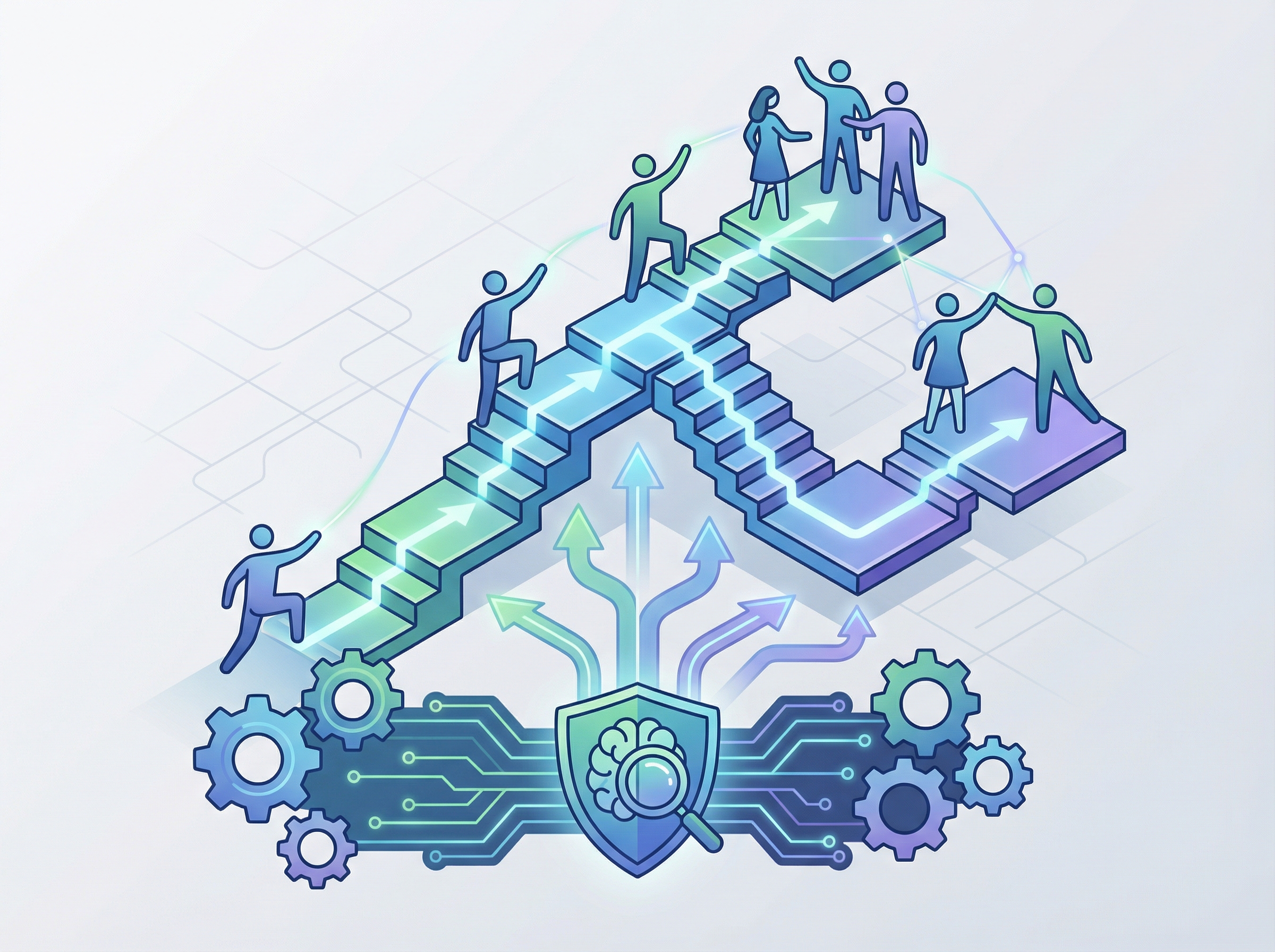
Real-World Scenario: From Stagnation to Mobility
Let's look at how a proactive Talent Director, we'll call her Elena, reversed this trend at a mid-sized tech firm facing a retention crisis. Elena recognized that the company had a "hidden talent market"—employees wanted to stay but felt they had to leave to grow.
The Assessment Phase: Stopping the Bleeding
Elena started with a simple audit of the internal mobility data. She found that while external time-to-fill was averaging 42 days, internal roles were rarely filled by existing staff because nobody knew they were open. She implemented an "Employee Intake" workflow, similar to a candidate screen, but for current staff. Using a competency model, she identified high-potential employees (HiPos) like Sarah who were at risk of flight.
Mapping the Lattice, Not just the Ladder
Traditional career ladders are rigid and often bottlenecked. Elena introduced a career lattice strategy. This framework allowed for:
- Vertical moves: Standard promotions (e.g., Junior Engineer to Senior Engineer).
- Lateral moves: Cross-functional shifts (e.g., Customer Success Rep to Product Owner) based on transferable skills.
- Individual Contributor (IC) tracks: allowing technical experts to advance in pay and prestige without being forced into people management.
The Operational Workflow
Elena operationalized this strategy using a structured workflow that mirrored her external recruiting process:
- Skill Gap Analysis: Managers used scorecards to evaluate current skills against future role requirements.
- Internal Sourcing: Before posting a role externally, the ATS (Applicant Tracking System) automatically flagged internal matches.
- Structured Calibration: Internal candidates went through structured interviews—just like external ones—to ensure fairness and reduce the "halo effect" of familiarity.
- Transparency: The criteria for moving from Level 1 to Level 2 were published openly on the company intranet.
Core Insights and Actionable Heuristics
Based on successful implementations like Elena's, here are the core heuristics for building a robust career pathing architecture.
Best Practices for Strategic Alignment
- Democratize Visibility: The number one heuristic is transparency. Employees must see the path to believe it exists. If the criteria for promotion are hidden in a manager's head, they don't exist. Publish your competency models.
- Decouple Growth from Management: A common failure mode is forcing great individual contributors to become mediocre managers just to get a raise. Build parallel tracks where a "Principal Engineer" or "Master Sales Rep" can earn as much as a Director.
- Data Over Vibes: Use structured interview scorecards for internal promotions. Relying on "vibes" or tenure breeds resentment. If an employee applies for a stretch role, interview them with the same rigor you would an outsider to validate their readiness.
Common Pitfalls to Avoid
"Analysis Paralysis": Don't wait until you have a perfect competency map for every single role. Start with your high-volume or high-turnover roles (e.g., Sales, Engineering, Customer Support) and expand from there.
- Confusing Tenure with Readiness: Just because someone has been in a seat for three years doesn't mean they are ready for the next one. Career pathing must be skills-based, not time-based.
- The "Hoarding" Manager: Managers often block their best people from transferring internally to protect their own metrics. You must incentivize managers to be "net exporters of talent" rather than talent hoarders.
The Breakthrough and Career Impact
For Elena's organization, the turning point came six months into the program. The data began to tell a new story.
Measuring Success
The "Sarahs" of the company stopped leaving. The metrics were undeniable:
- Internal Fill Rate: Jumped from 12% to 39%, meaning nearly 4 in 10 roles were filled by existing staff.
- Time-to-Fill: Decreased by 30%. Internal hires were productive in 15 days compared to 45 days for external hires.
- Retention: The company saw a 25% reduction in voluntary turnover among high performers.
HR Career Differentiation
For recruiters and HR leaders, mastering career pathing is a major career differentiator. It shifts your identity from "order taker" to "strategic talent advisor."
Q: "How have you applied career pathing to improve outcomes?"
A: "I transitioned our reactive promotion process into a standardized internal mobility program. By introducing calibrated scorecards and IC tracks, we reduced top-tier attrition by 20% and cut our external hiring spend by $50k per quarter."
Resume Bullets for Talent Leaders
- Designed and implemented a company-wide career lattice framework, increasing internal mobility by 40% YoY.
- Standardized promotion criteria using competency-based scorecards, reducing bias and improving leadership diversity.
- Partnered with engineering leadership to build technical IC career tracks, reducing turnover in critical R&D roles.
Pros & Cons of Career Pathing
| Benefit | Tradeoff |
|---|---|
| Higher Retention: Employees stay 2x longer when they see a future, saving massive rehiring costs. | Administrative Load: Requires initial heavy lifting to map competencies and maintain up-to-date role definitions. |
| Better Succession Planning: Creates a predictable pipeline of leaders ready to step up. | Manager Friction: "Talent hoarding" managers may resist losing their top performers to other departments. |
| Fairness & DE&I: Standardized criteria reduce bias in promotions. | Rigidity Risks: If not updated, paths can become obsolete as business needs change quickly. |
Frequently Asked Questions
What is the difference between career pathing and succession planning?
Career pathing is employee-driven and focuses on the individual's growth roadmap and goals. Succession planning is employer-driven, focusing on identifying replacements for critical key roles to ensure business continuity. Ideally, the two strategies overlap.
Can career pathing backfire?
Yes, if you promise paths that don't exist. Creating a rigorous path for a role that opens up only once every five years can lead to frustration. Transparency is key: be honest about the velocity of movement available.
How often should career paths be reviewed?
At minimum, annually. However, in fast-moving industries like tech, a semi-annual review is better to ensure the skills required for the "next level" are still relevant to the market and business strategy.
How does AI fit into career pathing?
AI can analyze an employee's skills profile and match them to open internal roles they might not have considered. It helps remove bias by focusing on skills adjacency rather than job titles.
Closing Insight
Mastering career pathing is not just an HR administrative task; it is a strategic defense against the volatile talent market of 2026. By building visible, fair, and structured bridges to the next level, you turn your company into a place where careers are built, not just a place where jobs are held.
If you want to operationalize career pathing with structured workflows—from internal sourcing and resume screening to AI interviews, scorecards, and offers—try tools like Foundire (https://foundire.com) to automate and standardize the process.