How to Build an Interview Plan Template

How to Build an Interview Plan Template
The Impact of a Standardized Interview Plan Template
An interview plan template is a structured, repeatable framework that maps out every phase of the hiring lifecycle, from the initial role intake to the final background checks. For modern talent acquisition teams, this template serves as a strategic blueprint that aligns recruiters, hiring managers, and interviewers on the specific competencies, standardized questions, and evaluation criteria required for a role. By eliminating guesswork and fragmented evaluations, a well-designed interview plan template directly improves hiring speed, boosts the quality of hire, and guarantees a seamless candidate experience. In a market where the global median time-to-hire hovers around 38 to 42 days, relying on ad-hoc processes leads to severe delays, biased decision-making, and high candidate drop-off rates. Mastering this structured approach allows hiring teams to replace chaotic scheduling and subjective feedback with an objective, data-driven workflow that consistently secures top-tier talent.
Consider the reality of Sarah, a Senior Recruiter at a fast-growing software company, who found herself struggling with a chaotic engineering hiring process. Before implementing a standardized system, her days were consumed by disorganized resume screening and uncoordinated technical panels. Hiring managers lacked alignment, often asking candidates redundant questions while missing critical behavioral evaluations. This friction created a measurable problem: Sarah’s average time-to-hire had ballooned to 55 days, significantly higher than the industry average, and her candidate pass-through rate was abysmal. Top candidates were abandoning the pipeline mid-process due to disjointed communication and delayed feedback.
Defining the Core Concept
At its core, an interview plan template is much more than a simple checklist. It is a comprehensive operating system for talent acquisition. It dictates the sequence of events in a hiring cycle and assigns clear responsibilities to every stakeholder involved. By outlining the exact progression—from top-of-funnel sourcing to the final offer extension—the template acts as a safeguard against inefficiency. When correctly integrated with your ATS (Applicant Tracking System), an interview plan template supports robust hiring workflow automation, ensuring that no candidate falls through the cracks and no interviewer steps into a meeting unprepared.
A Real-World Hiring Scenario
To understand the necessity of this framework, we must look at how an unstructured workflow breaks down in practice. In Sarah’s case, the hiring funnel for a Senior Full-Stack Engineer was a logistical nightmare. The workflow steps were undefined. The intake meeting was a brief, informal chat rather than a deep dive into role requirements. When candidates moved from resume screening to the first-round interview, different interviewers evaluated entirely different skill sets. Because there were no interview scorecards, the debrief sessions devolved into subjective debates based on "gut feelings" rather than objective data.
The measurable impact was devastating. With scheduling consuming nearly 38% of her time, Sarah struggled to keep candidates engaged. The lack of structured interviews meant that decisions were delayed, extending the time-to-hire to nearly two months. Furthermore, the volume of candidates passing from the technical screen to the final decision stage was less than 15%, a clear indicator that the initial screening criteria were completely misaligned with the final interview expectations. Sarah needed a system that could force alignment and accelerate the process without sacrificing the quality of the hire.
Best Practices and Pitfalls in Interview Planning
Actionable Heuristics for Success
Transforming a broken recruitment process requires implementing strict, actionable heuristics. Here are the core best practices for applying an interview plan template effectively:
- Conduct a rigorous intake to align competencies: Before any sourcing begins, the recruiter and hiring manager must define the exact technical and behavioral competencies required for the role. These competencies form the foundation of your entire interview plan template.
- Deploy standardized interview scorecards: Every interviewer must be equipped with a specific rubric. If one panelist is evaluating system design, their scorecard should exclusively reflect system design metrics. This prevents overlap and ensures structured interviews are truly objective.
- Integrate operational systems seamlessly: Do not let your template live in a static document. Map the template directly into your ATS and leverage an AI interview platform to automate top-of-funnel resume screening and preliminary assessments.
- Establish strict SLAs for feedback: A template is only as good as its momentum. Require all interviewers to submit their scorecards within 24 hours of the interview. This minimizes the risk of memory bias and accelerates the transition to offers and background checks.
Common Misconceptions to Avoid
Even well-intentioned talent acquisition teams can stumble when rolling out a new process. Be mindful of these frequent pitfalls:
- Overcomplicating the template: Adding too many stages (e.g., five or six interview rounds) creates fatigue. An effective interview plan template should streamline the process, not bloat it. Keep the workflow lean to respect the candidate's time.
- Failing to calibrate interviewers: Simply handing an interviewer a scorecard is not enough. If you do not conduct calibration sessions to train your team on how to grade consistently, your data will remain skewed.
- Ignoring candidate time constraints: A rigid process that fails to offer flexible scheduling can lead to high drop-off rates. Ensure your hiring workflow automation accounts for seamless, candidate-friendly booking.
| Benefit | Tradeoff |
|---|---|
| Dramatically reduces time-to-hire by eliminating redundant interviews and accelerating feedback loops. | Requires heavy upfront time investment from hiring managers to build rubrics and define competencies during intake. |
| Improves quality of hire by utilizing structured interviews and standardized interview scorecards. | Reduces conversational flexibility, as interviewers must stick strictly to assigned questions and grading scales. |
| Enhances compliance and fairness by ensuring every candidate is evaluated against the exact same criteria. | Necessitates continuous system updates within the ATS to keep the templates relevant as role requirements evolve. |
Transforming Outcomes and Career Growth
The Breakthrough Moment
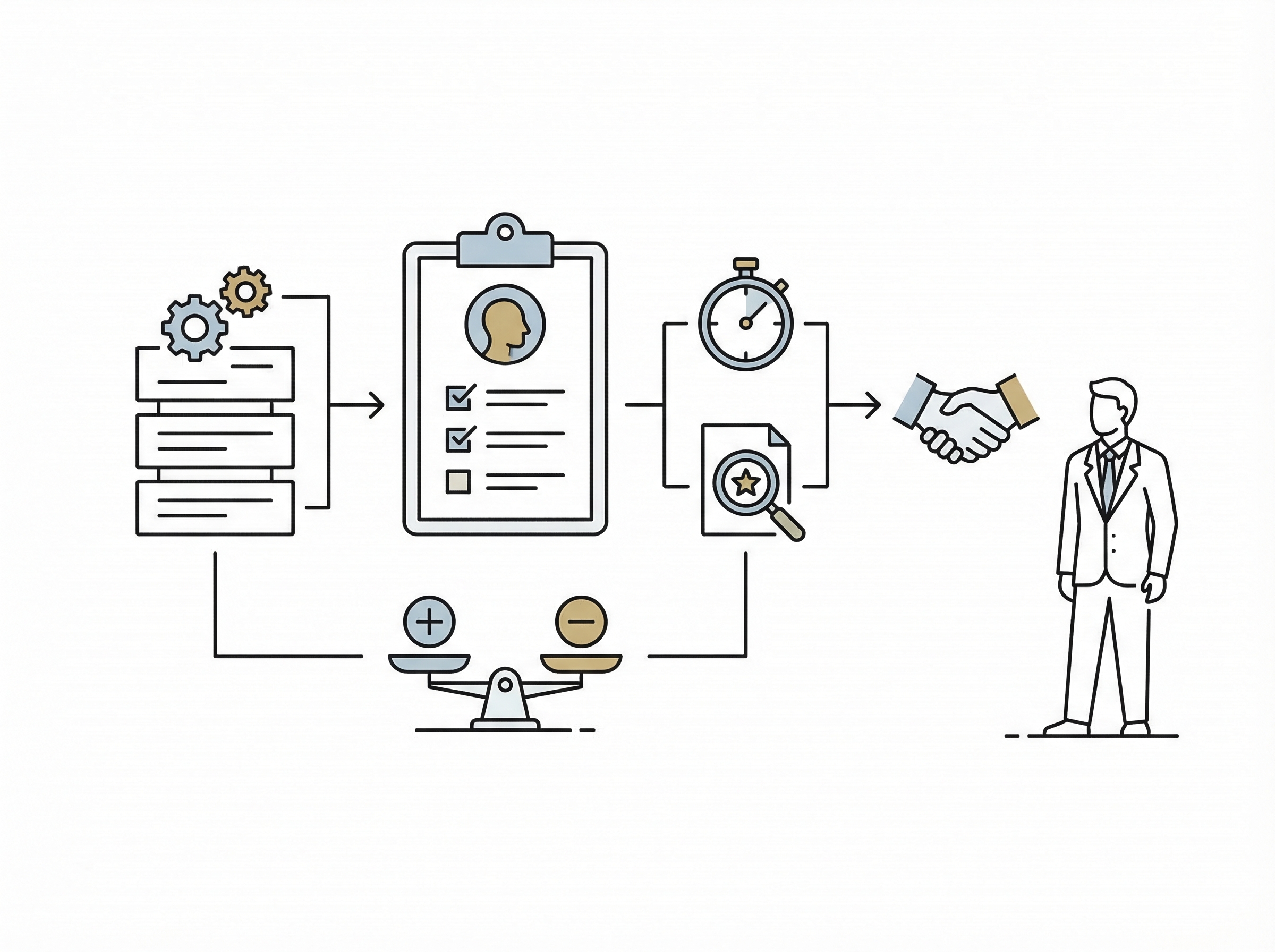
For Sarah, the turning point occurred the moment she fully operationalized her new interview plan template. By mandating a comprehensive intake meeting, she secured absolute clarity on the engineering role. She built a streamlined, four-step template: an automated resume screening phase, a standardized behavioral screen, a technical panel using strict interview scorecards, and a final executive sign-off.
The before-and-after impact was staggering. Because interviewers knew exactly what to ask and how to score it, post-interview debriefs shrank from hour-long debates to concise, 15-minute alignments. The structured interviews removed bias, leading to a much higher pass-through rate at the final stage. Most importantly, Sarah reduced the average time-to-hire by 15 days, bringing it down to a highly competitive 40 days. Candidate drop-offs virtually disappeared because the process was transparent, and expectations were clearly communicated from day one.
Mastering the Template for Career Advancement
For recruiters and talent leaders, the ability to build and execute an interview plan template is a major career differentiator. Moving from a reactive coordinator to a strategic talent advisor requires proving that you can engineer predictable hiring outcomes. Mastering this framework signals to leadership that you understand how to leverage hiring workflow automation, scale operations, and drive business impact.
Q: "How have you applied an interview plan template to improve outcomes?"
A: "I standardized our engineering recruitment by deploying a comprehensive interview plan template integrated directly into our ATS. By calibrating our panels and enforcing the use of targeted interview scorecards, I streamlined the evaluation process. This reduced our time-to-hire by 15 days, improved our pass-through rate by 22%, and significantly enhanced hiring manager alignment."
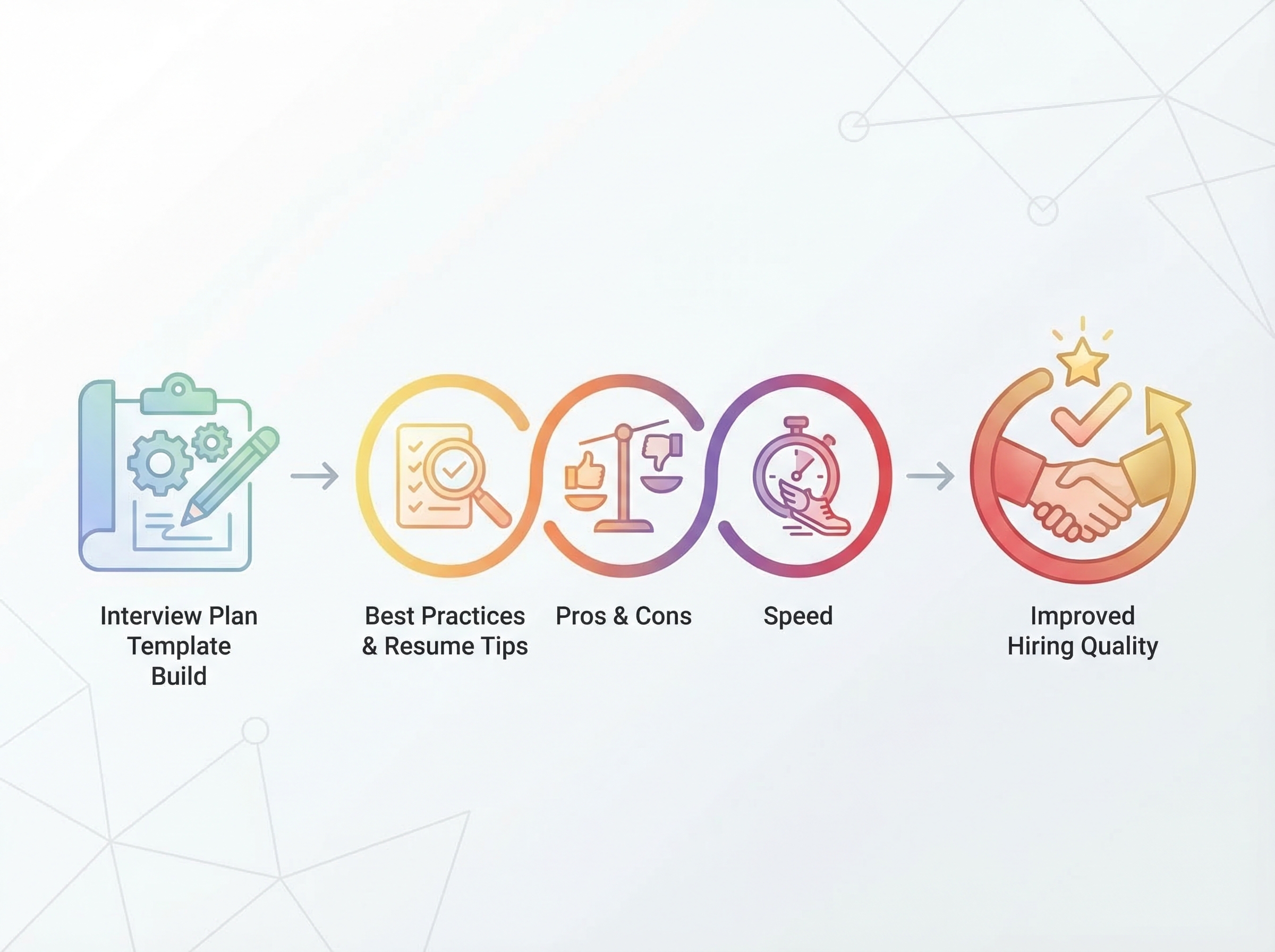
When updating your resume, use concrete, metric-driven language to highlight your expertise with these templates:
- Standardized full-cycle recruiting workflows by designing an interview plan template, reducing average time-to-hire by 25%.
- Calibrated cross-functional hiring panels using structured interviews and bespoke scorecards, resulting in a 30% increase in first-year retention.
- Streamlined the talent acquisition funnel by integrating ATS capabilities with AI interview platform tools, reducing manual resume screening time by 40%.
- Improved candidate experience scores by enforcing 24-hour feedback SLAs and automating the progression from offers to background checks.
Frequently Asked Questions and Next Steps
SEO-Focused FAQs
What is an interview plan template?
An interview plan template is a standardized document or system workflow that outlines every step of the hiring process. It defines the specific interview stages, assigns competencies to different interviewers, and standardizes the questions and interview scorecards used to evaluate candidates objectively.
Can an interview plan template backfire?
Yes, it can backfire if it is overly rigid or complicated. If an interview plan template includes too many redundant stages or if interviewers are not properly trained to use the scorecards, it can cause bottlenecks, frustrate candidates, and ultimately increase time-to-hire.
How long does it take to implement a template?
Creating a baseline interview plan template takes just a few hours of collaborative intake with a hiring manager. However, fully operationalizing it across an entire talent acquisition team and integrating it into your ATS can take several weeks of training and calibration.
How do you customize it for different roles?
While the overarching structure (screening, core interviews, final decision) remains the same, you customize the template by swapping out the specific competencies and technical assessments required for the role during the initial intake phase.
Closing Thoughts
The transition from chaotic, reactive hiring to a predictable, data-driven talent machine hinges entirely on process. An interview plan template is not just an administrative document; it is the foundation of structured interviews, fair evaluations, and exceptional candidate experiences. By standardizing the way you assess talent, you eliminate bias, save countless hours of administrative waste, and forge better partnerships with hiring managers. Mastering this essential framework creates a durable hiring advantage that will consistently set your organization—and your career—apart.
If you want to operationalize your interview plan template with structured workflows (Sourcing, resume screening, AI interviews, scorecards, offers, background checks), try tools like Foundire (https://foundire.com).