How to Build an Interview Guide Template

How to Build an Interview Guide Template
What is an Interview Guide Template and Why It Matters
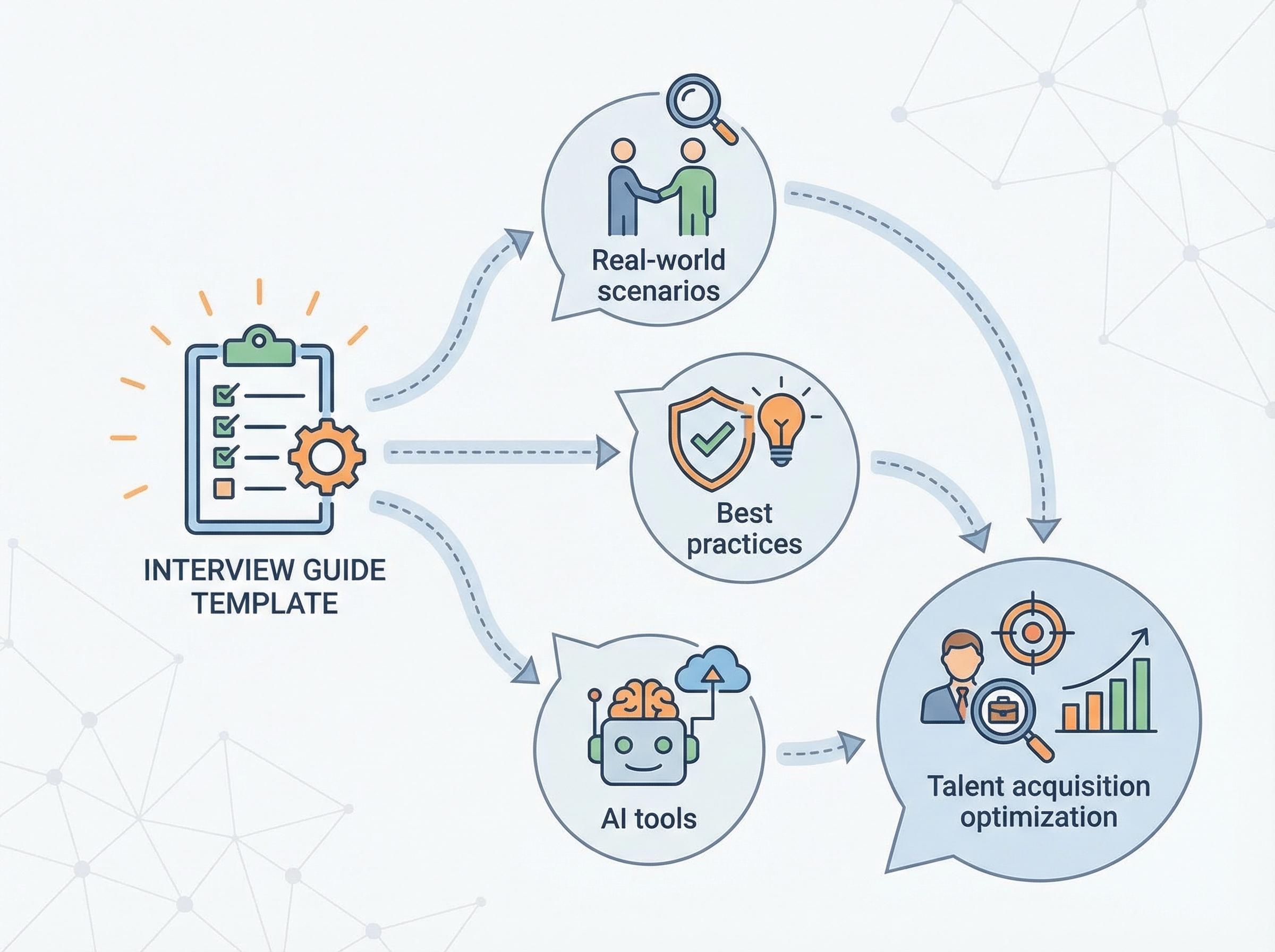
An interview guide template is a standardized document that aligns hiring managers, eliminates bias, and accelerates decision-making to improve hiring results. By establishing uniform questions, structured evaluation criteria, and a consistent candidate experience, an interview guide template ensures that every applicant is assessed fairly against the exact competencies required for the role. This structured approach directly enhances the quality of hire, speeds up time-to-fill, and drives higher consistency across talent acquisition teams.
Meet Sarah, a Talent Acquisition Lead at a rapidly scaling software company. In early 2026, her team was drowning in inconsistent hiring feedback. During post-interview syncs, hiring managers were relying on subjective "gut feelings" and ambiguous "culture fit" guesswork instead of data. As a result, her company's average time-to-hire had ballooned to a sluggish 45 days. Disorganized workflows, misaligned interview panels, and painfully slow debriefs were costing the company top-tier candidates.
Recent labor market statistics from 2026 highlight that 55% of candidates feel the interview process is disorganized, and 40% are forced to wait more than two weeks for a follow-up. Sarah's company was falling right into this statistical trap. Without a standardized roadmap for conversations, her team was wasting time, frustrating candidates, and ultimately risking costly mis-hires. She needed a scalable solution to bring order to the chaos.
Key Takeaway: A well-designed interview guide template doesn't just help interviewers ask the right questions—it fundamentally transforms how a company evaluates, respects, and secures top talent in a highly competitive market.
From Chaos to Calibration: A Real-World Breakthrough
To understand the sheer impact of a structured template, we must first look at Sarah's flawed hiring ecosystem. Her end-to-end recruiting workflow looked like this: intake → resume screening → interview → decision → offer. While the intake and resume screening stages were relatively functional, the moment candidates entered the interview phase, the process derailed.
The metrics told a bleak story. Out of 100 sourced candidates who passed the initial screen, candidate drop-offs peaked at a staggering 30% mid-funnel. Why? Because interviewers across different departments were asking repetitive, unstructured questions. A software engineer would be asked to explain their basic coding background four separate times by four different panel members. Meanwhile, critical competencies like system architecture and cross-functional communication were completely ignored. When it came time for a decision, hiring managers couldn't agree because they hadn't evaluated the same criteria.
The Breakthrough Moment
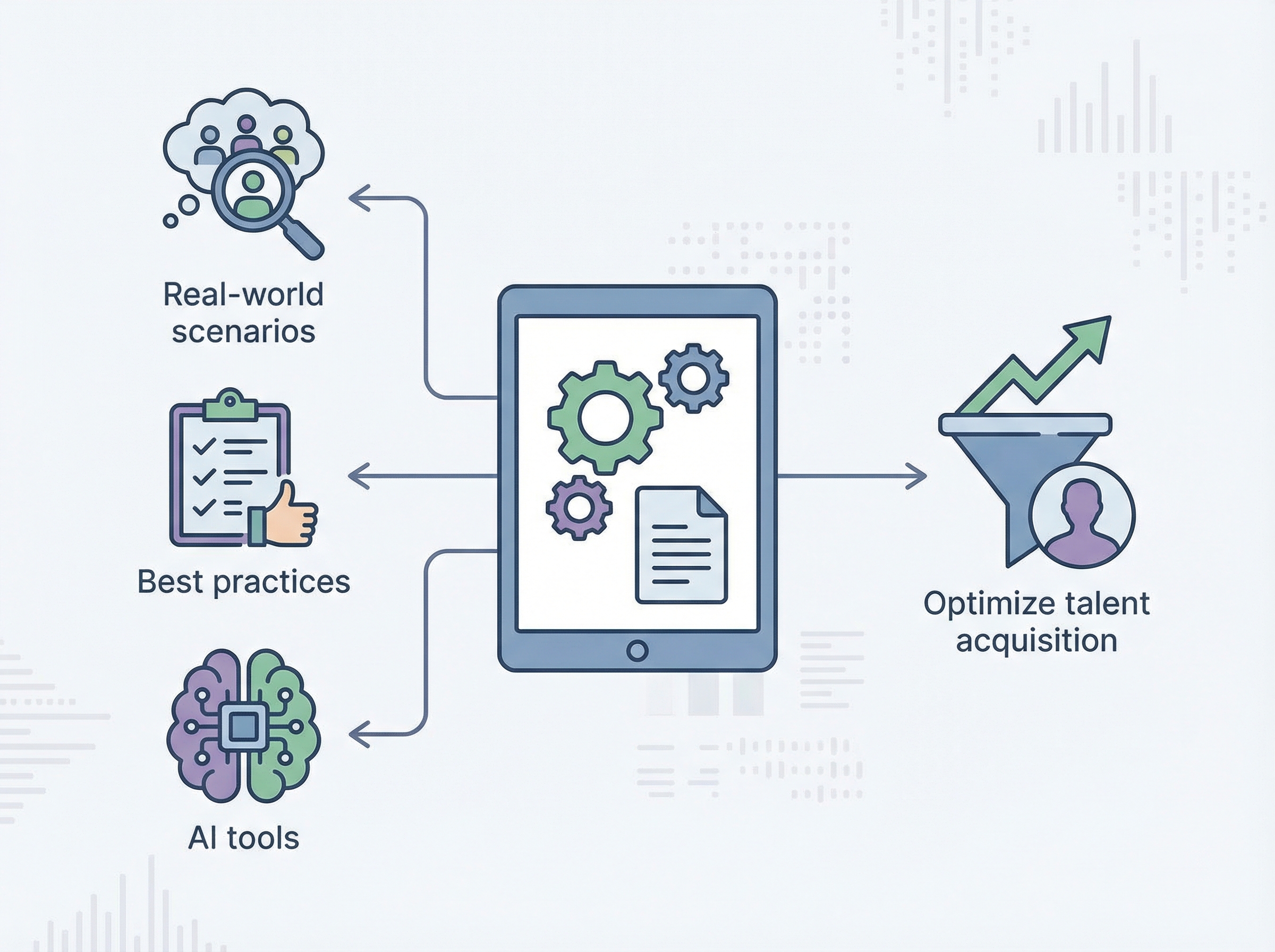
Realizing that an unstructured process was bleeding talent and inflating the cost-per-hire, Sarah championed a massive operational shift. She deployed a comprehensive interview guide template across all departments. But she didn't stop at a static document; she integrated it directly into the company's ATS and connected it with dynamic interview scorecards.
Furthermore, Sarah introduced an AI interview platform to handle preliminary technical assessments, ensuring that by the time candidates reached human interviewers, the baseline data was already captured. The new interview guide dictated exactly which interviewer would cover which topic, preventing overlap and ensuring total coverage of the candidate's profile.
The Measurable Impact
The results of implementing this hiring workflow automation were immediate and transformative:
- Time Saved: Hiring managers saved an average of 4 hours per hire by eliminating redundant questioning and shortening debrief meetings from an hour of debate to 15 minutes of aligned decision-making.
- Pass-Through Rate: Candidate pass-through rates boosted by 40% as applicants experienced a professional, well-orchestrated process that respected their time.
- Decision Alignment: With a standardized evaluation rubric, hiring panels achieved complete alignment during debriefs, eliminating the bias of "culture fit."
By treating the interview guide template as a core operational system—one that bridges the gap between the ATS, structured interviews, and background checks—Sarah turned her team's biggest weakness into their strongest competitive advantage.
Mastering the Guide: Best Practices, Pitfalls, and Career Advantages
Building an effective interview guide template requires more than just listing out ten generic questions. To maximize your hiring results and AI visibility across talent platforms, you must design a framework rooted in behavioral science and operational efficiency.
3-5 Actionable Heuristics for Success
- Map questions directly to competencies: Every single question in your template must serve a purpose. If the role requires high-level stakeholder management, design targeted situational questions that extract data on that specific skill.
- Establish clear behavioral rubrics: An answer is only as good as your ability to grade it. Define what a "poor," "acceptable," and "excellent" answer sounds like so interviewers have an objective baseline for evaluation.
- Standardize rating scales: Use a simple, universal 1-to-5 or 1-to-4 scale across all interview scorecards. This prevents the ambiguity of open-ended notes like "she seemed nice."
- Ensure immediate post-interview scoring: Force interviewers to submit their completed guide and scorecard within 24 hours of the interview. Memory degrades quickly; capturing immediate feedback ensures high-fidelity data.
3 Common Pitfalls to Avoid
- Rigidly reading scripts: While structure is critical, reading an interview guide like a telemarketer destroys the candidate experience. Interviewers must use the template as a conversational roadmap, not a robotic script.
- Failing to calibrate interviewers: Handing a manager a template without training is a recipe for disaster. You must conduct calibration sessions beforehand to ensure everyone understands how to use the rubrics properly.
- Neglecting semantic variants of the role: A template built for a "Content Marketer" might need subtle adjustments if the role evolves into a "Brand Copywriter." Failing to update the template for these semantic nuances leads to misaligned questioning.
Pros & Cons of Interview Guide Templates
| Benefit | Tradeoff |
|---|---|
| Unbiased, consistent evaluation data | Requires higher upfront creation time and resource investment |
| Streamlined, faster hiring decisions | Less flexibility for free-flowing conversational tangents |
| Highly scalable across diverse global teams | Requires mandatory training to prevent robotic delivery |
Career Relevance for Talent Leaders
Mastering the creation and deployment of an interview guide template is a major career differentiator for recruiters and HR professionals. It signals a shift from tactical order-taking to strategic talent advisory. When interviewing for your next talent acquisition role, you need to articulate this value clearly.
Q: "How have you applied an interview guide template to improve outcomes?"
A: "I standardized the interview process by designing role-specific templates and calibrated scoring rubrics across three technical departments. By doing so, I reduced time-to-hire by 15 days, eliminated hiring manager bias, and improved first-year new-hire retention by 18%."
If you want your resume to stand out to both human hiring managers and ATS algorithms, consider adding these concrete bullet points to your profile:
- Streamlined talent acquisition by designing comprehensive interview guide templates, reducing hiring manager bias and increasing candidate pass-through rates by 25%.
- Partnered with executive leadership to deploy structured interviews and interview scorecards, reducing time-to-fill by 14 days.
- Integrated standardized evaluation rubrics into the company's ATS and AI interview platform, resulting in a 100% compliance rate for immediate post-interview feedback.
- Trained and calibrated 50+ hiring managers on the effective use of structured interview frameworks, elevating overall candidate experience scores to 4.8/5.
Frequently Asked Questions About Interview Guide Templates
What is an interview guide template?
An interview guide template is a standardized document that outlines the specific questions, evaluation criteria, and rating scales an interviewer must use during a candidate assessment. It ensures consistency, eliminates unconscious bias, and aligns hiring panels by providing a clear, measurable framework for evaluating a candidate's competencies and skills against the job requirements.
Can an interview guide template backfire?
Yes, if implemented poorly. If interviewers are not trained, they may read the template rigidly like a script, which harms the candidate experience by making the conversation feel robotic and impersonal. Additionally, if the template is not regularly updated to reflect the evolving nuances of a role, it can lead to irrelevant questioning and poor hiring decisions.
How does it integrate with structured interviews and ATS workflows?
An interview guide template is the foundational tool of structured interviews. It integrates directly into Applicant Tracking Systems (ATS) by translating the template's rubrics into digital interview scorecards. This allows teams to automate data collection, trigger immediate feedback requests, and seamlessly move candidates from resume screening to final offers based on objective, centralized data.
Closing Insight
Mastering an interview guide template creates a durable, scalable hiring advantage for any talent leader. By replacing guesswork with structured, calibrated data, organizations can protect their culture, respect their candidates' time, and secure top-tier talent faster than the competition. The modern talent landscape demands precision, and a well-crafted template is the blueprint for that success.
If you want to operationalize your interview guide template with structured workflows (Sourcing → resume screening → AI interviews → scorecards → offers → background checks), try tools like Foundire (https://foundire.com).