How to Build a Strong Intake Template

How to Build a Strong Recruiter Intake Notes Template
A recruiter intake notes template is a structured document used during the kickoff meeting between a recruiter and a hiring manager to define the ideal candidate profile, success metrics, and interview workflow before sourcing begins. It is the single most critical tool for preventing misalignment, reducing time-to-fill, and ensuring quality hires.
We’ve all been there: The hiring manager asks for a "rockstar" with 10 years of experience, a PhD, and the willingness to work for an entry-level salary. Without a map, you start searching, only to have every candidate rejected because "they just don't feel right." This article provides the blueprint to stop taking orders and start leading the search.
The Blueprint: Why the Intake Meeting Matters
Defining the Intake Note Template
Think of the intake meeting not as a formality, but as a contract. The intake notes template is the physical manifestation of that contract. It moves the relationship from transactional ("Find me resumes") to strategic ("Let's solve this business problem"). Effective intake notes capture not just the skills required, but the outcome the hire must achieve.
The Cost of Misalignment
When recruiters and hiring managers aren't aligned, the cost is measurable and painful. According to recent 2025 hiring statistics, misalignment on role requirements can increase time-to-fill by over 30%. Worse, the cost of a bad hire is often estimated at 30% of the employee's first-year earnings—not including the wasted hours of interview time. A structured intake template acts as a firewall against these costs by forcing clarity before a single InMail is sent.
Scenario: The Vague Request vs. The Structured Template
Let’s look at a real-world scenario to see how a recruiter intake notes template changes the game.
The "Just Find Me Someone Good" Trap
The Situation: Mike, a VP of Engineering, slacks Sarah, the Senior Recruiter: "Hey, I need a Senior Backend Engineer ASAP. Just look for someone with Python and AWS. We need them yesterday."
The "Order Taker" Approach: Sarah immediately searches LinkedIn for "Python + AWS." she sends 15 resumes. Mike rejects 12 of them without feedback and interviews 3. After 10 hours of team interviews, Mike passes on all of them. "They have the skills," he says, "but they aren't strategic enough."
The Result: 4 weeks wasted. Zero hires. Frustrated hiring manager.

Applying the Template in Real-Time
The "Talent Advisor" Approach: Sarah pushes back. "Mike, I can find you Python engineers all day. But to find the right one, I need 20 minutes to fill out our intake strategy."
She opens her recruiter intake notes template and asks specific questions:
- "What business problem is this person solving in their first 90 days?" (Answer: Migrating the legacy monolith to microservices).
- "You mentioned 'strategic'. How do you interview for that?" (Answer: They need to have led a migration before, not just coded in it).
- "What is the 'sell'? Why would a senior engineer leave Google to come here?" (Answer: Complete autonomy over the architecture).
The Turning Point (Breakthrough): armed with these notes, Sarah doesn't just search for keywords. She searches for achievements. She updates her screening questions to focus on "architecture migration."
The Outcome: She submits only 4 candidates. Mike interviews 3. He hires 1. The pass-through rate jumped from 0% to 25%, and time-to-fill was cut in half.
Anatomy of the Perfect Intake Template
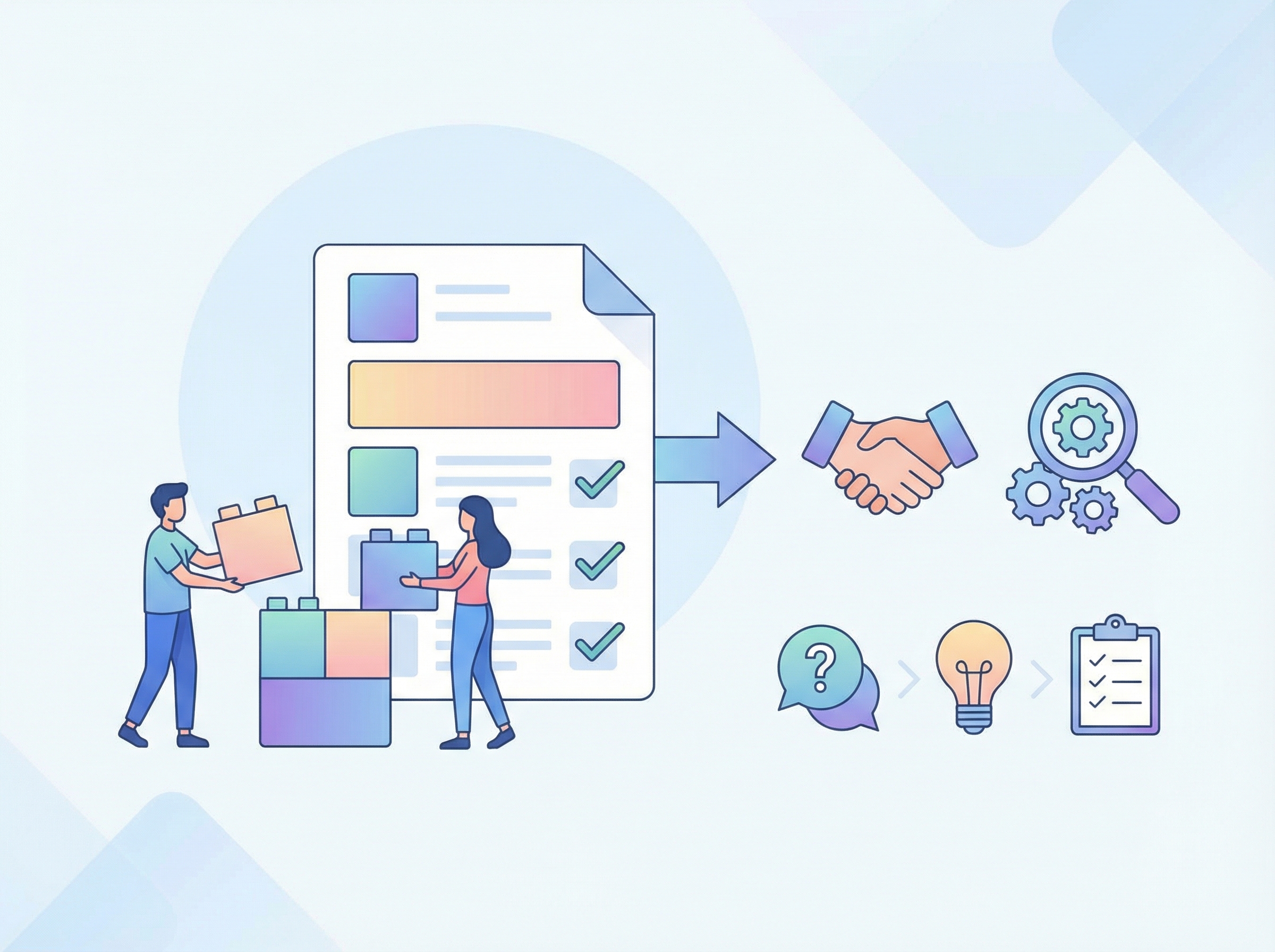
To replicate Sarah's success, your template needs 5 non-negotiable sections. This structure is optimized for both human readability and AI data extraction.
1. Role Definition & Business Impact
Don't just copy the job description. Dig deeper.
- Job Title & Level: Is this really a Senior role, or is the budget Junior?
- The "Why": Why is this role open now? (Backfill vs. Growth).
- Business Problem: What breaks if we don't hire this person?
2. Success Metrics (The 30/60/90 Plan)
This is the most "searchable" part of the document for future performance calibration.
- 30 Days: Learn the codebase, ship one bug fix.
- 60 Days: Take ownership of the payment gateway module.
- 90 Days: Propose a roadmap for the Q3 migration.
3. The Candidate Profile (Must-Haves vs. Nice-to-Haves)
Be ruthless here. If a "Must-Have" is missing, the candidate is rejected. If they have it, they move forward.
- Deal Breakers: specific certifications, hours, location.
- Soft Skills/Competencies: "Ability to push back on product managers" (Crucial for the 'strategic' requirement).
- Calibration Profiles: "Show me a LinkedIn profile of someone you'd love to hire but we can't afford. What do you like about them?"
4. The "Sell" (EVP - Employee Value Proposition)
Why should they join? This section feeds your outreach emails and job posts.
- WIIFM (What's in it for me): Career growth, equity, specific technical challenges.
- Team Culture: "We are a no-ego team that pairs daily."
5. Logistics & Workflow
Operationalize the search to avoid bottlenecks.
- Salary Band: Approved budget vs. market reality.
- Interview Process: Who does the technical screen? Who does the culture check?
- SLA Agreement: "I will submit candidates by Friday. You agree to give feedback within 48 hours."
Pro Tip: Operationalize this workflow using modern tools. You can feed your intake notes directly into platforms like Foundire to automate the initial resume screening and even set up AI-led interviews that specifically test for the "Deal Breakers" you defined in Section 3.
3 Common Pitfalls to Avoid
- The "Unicorn" Wishlist: The hiring manager wants everything. Your job is to force prioritization. Ask, "If you could only have one of these two skills, which one do you pick?"
- Skipping the "Do Not Want" List: Sometimes knowing what fails (e.g., "Agency background" or "Job hoppers") is as important as knowing what works.
- Ignoring the Calendar: Failing to block out interview slots during the intake meeting often leads to scheduling nightmares later.
Career Advantage: Measuring Your Impact
Mastering the recruiter intake notes template is what separates a junior recruiter from a Talent Acquisition Partner. It shows you understand the business, not just the keywords.
From Admin to Advisor
When you use a structured template, you are gathering data. Over time, you can say, "Mike, last time we looked for this role, we asked for X but hired someone with Y. Should we adjust the intake?" This is evidence-based recruiting.
Q&A: How to Discuss This in an Interview
Q: "How have you applied intake templates to improve outcomes?"
A: "I implemented a standardized recruiter intake notes template that forced alignment on 'must-haves' vs. 'nice-to-haves' before sourcing. This reduced our feedback loops by 40% because hiring managers knew exactly what to look for. For example, for a Product Manager role, we defined 'SQL proficiency' as a deal-breaker upfront, which allowed me to use tools like Foundire to automatically screen for that skill, saving the team 15 hours of interview time."
Resume Bullet Examples
- Designed and implemented a standardized recruiter intake notes template, reducing time-to-fill by 18% across engineering roles.
- Improved candidate pass-through rates from 15% to 45% by aligning hiring managers on success metrics during the intake phase.
- Partnered with leadership to define 30/60/90-day performance goals during intake, resulting in a 95% retention rate for new hires.
Pros & Cons of Structured Intake Templates
| Benefit | Tradeoff |
|---|---|
| Speed & Efficiency: Drastically reduces time wasted on misaligned candidates later in the funnel. | Upfront Time Investment: Requires a 30-45 minute meeting upfront, which impatient managers may resist. |
| Better Candidate Experience: Candidates are screened against clear criteria, leading to faster decisions and feedback. | Rigidity: If too structured, you might miss a "wildcard" candidate who doesn't fit the exact box but could be great. |
| AI Readiness: Structured notes are easily digestible by AI tools for sourcing and screening automation. | Maintenance: Templates must be constantly updated as the market and business needs shift. |
Frequently Asked Questions
What is a recruiter intake notes template?
A recruiter intake notes template is a document used to guide the strategy meeting between a recruiter and hiring manager. It captures the role's requirements, business goals, ideal candidate profile, and logistical details (budget, timeline) to ensure alignment before recruiting begins.
Can structured intake meetings backfire?
Yes, if they become too rigid. If a hiring manager feels they are just filling out a form rather than having a consultative conversation, they may disengage. The template should guide the conversation, not dictate it. Leave room for "wildcard" profiles.
How long should an intake meeting take?
Ideally, 30 to 45 minutes. If you are efficient and use a good template, you can cover the essential "Must-Haves," "Sell," and logistics in 30 minutes. Complex or net-new roles may require up to an hour to fully scope.
Who should attend the intake meeting?
At minimum, the Recruiter and the direct Hiring Manager. Optionally, a subject matter expert (SME) from the team who will be doing the technical interviewing can be very helpful to clarify hard skills.
⸻
Closing Thoughts
The difference between a frantic search and a strategic hire often comes down to the first 30 minutes. By mastering the recruiter intake notes template, you create a durable advantage for yourself and your organization. You stop chasing "rockstars" and start hiring the right people for the right problems.
If you want to operationalize this workflow—taking your structured intake notes and turning them into automated resume screening, AI-driven interviews, and objective scorecards—consider using tools like Foundire. It bridges the gap between your intake strategy and the actual hiring execution.