How to Build a Strong Application Review Checklist

How to Build a Strong Application Review Checklist
Introduction: The Power of Structured Screening
An application review checklist is a standardized tool used by recruiters and hiring managers to evaluate candidate materials—such as resumes, portfolios, and cover letters—against a consistent set of criteria. Unlike a casual skim, this structured framework forces decision-makers to assess every applicant using the exact same measuring stick. The result? Drastically reduced unconscious bias, faster screening times, and a higher quality of talent entering your interview funnel.
For most talent acquisition teams, the "resume black hole" is a reality. You post a role, wake up to 300 applications, and panic sets in. Without a checklist, you are likely scanning for familiar company names or universities—a habit that often leads to homogenous teams and missed opportunities.
The High Cost of Inconsistency
Imagine this common scenario: It is 2026, and Sarah, a Senior Recruiter at a growing fintech company, is drowning. She has an open requisition for a "Senior Product Manager." The role has been open for 65 days—nearly double the industry average for top-performing teams. Her inbox is flooded with 400+ applications. In her rush to clear the queue, she unintentionally rejects a candidate with perfect transferrable skills because their title didn't match the keyword search, while advancing a candidate with a shiny pedigree who lacks the specific technical grit the team actually needs.
This is the "Screening Bottleneck," and it kills hiring momentum. Sarah isn't bad at her job; she just lacks a mechanism to filter noise from signal efficiently.
Real-World Scenario: The Screening Bottleneck
The Workflow Breakdown
Let’s look at Sarah's workflow before the checklist. Her process was reactive:
- Intake: A brief 15-minute chat with the hiring manager, Mark, who says, "I just need someone who has done this before at a big tech firm."
- Screening: Sarah scans resumes for about 6 seconds each. She looks for "Google," "Amazon," or "Fintech."
- Submission: She sends 10 profiles to Mark.
- Rejection: Mark rejects 8 of them. "They have the name brand, Sarah, but they don't have experience with zero-to-one product launches."
The feedback loop is broken. Sarah wasted hours screening for the wrong criteria because the criteria were never codified.
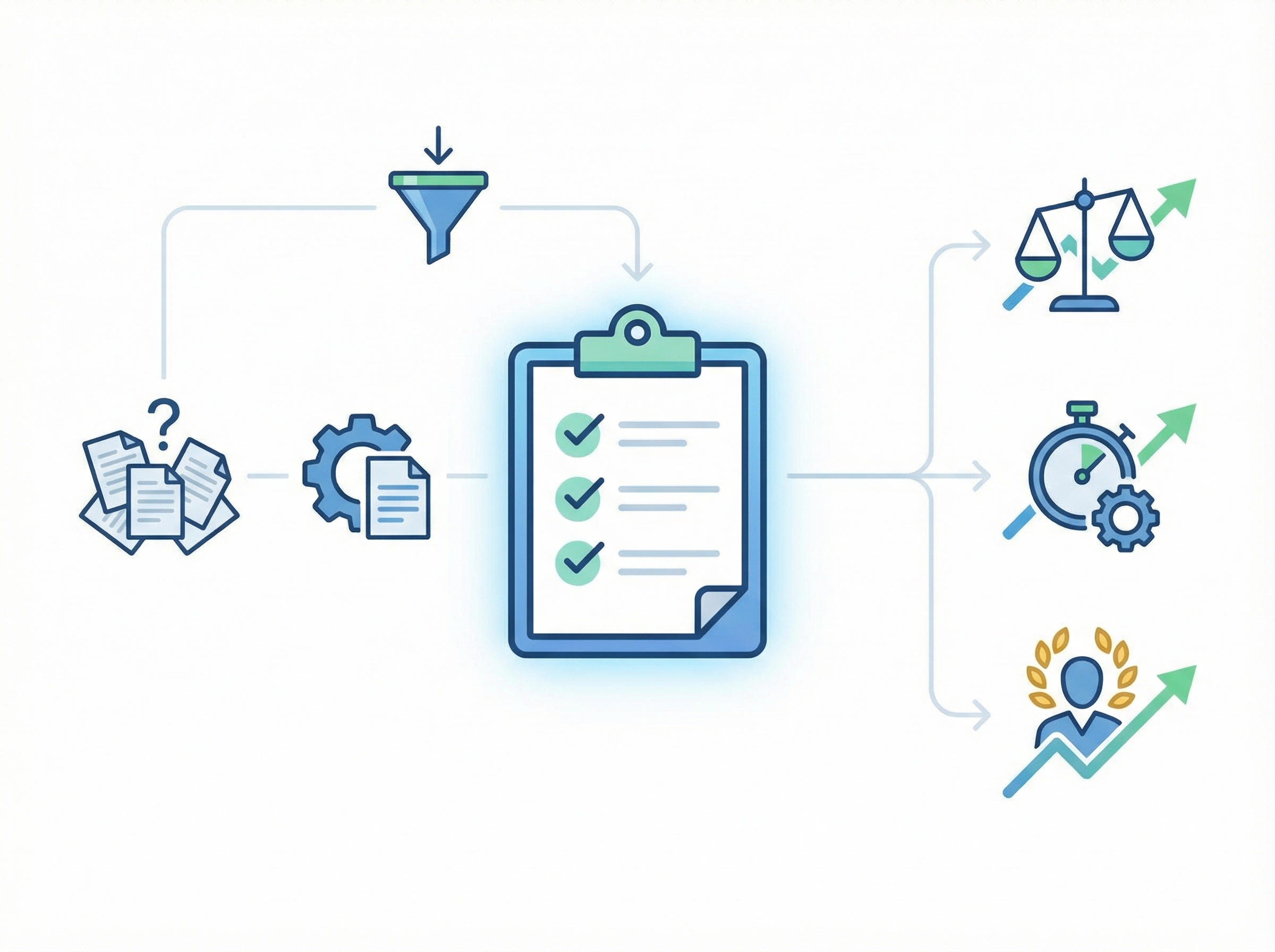
Measuring the Inefficiency
The data tells a painful story. In this unstructured environment:
- Time-to-Fill: 65 days (vs. a target of 40).
- Pass-Through Rate: Only 12% of candidates Sarah screened were accepted by the hiring manager for an interview.
- Candidate Experience: Applicants waited an average of 14 days for a rejection, or worse, were ghosted completely.
This inefficiency costs money—roughly $14,900 per bad hire or prolonged vacancy, according to historical recruitment data. The solution wasn't to work harder; it was to build an application review checklist that aligned Sarah and Mark before a single resume was reviewed.
Core Insights: Creating Your Checklist
To turn this ship around, you need a checklist that functions as a gatekeeper for quality. It shouldn't be a bureaucratic form, but a dynamic heuristic.
Actionable Heuristics for a Strong Checklist
A robust application review checklist typically includes these five components:
- Knock-Out Questions (MQs): These are binary (Yes/No). Does the candidate have work authorization? Are they located in the required time zone? If the answer is "No," no further review is needed.
- Skill Verification (The "How"): Instead of just looking for a keyword like "Python," check for the application of the skill. Does the resume describe how they used Python to solve a problem?
- Career Velocity & Gaps: Look for progression. Did they take on more responsibility over time? If there is a gap, is it explained (e.g., "Sabbatical for education")? Note: Gaps should trigger a question, not an automatic rejection.
- Outcomes over Outputs: Prioritize resumes that list metrics (e.g., "Increased revenue by 20%") over duties (e.g., "Responsible for sales").
- Values Alignment: Look for evidence of soft skills that match your culture, such as "collaboration" or "mentorship," demonstrated through volunteer work or cross-functional projects.
Pitfalls and Misconceptions
Even with a checklist, things can go wrong if you aren't careful.
- The "Pedigree" Trap: Don't use university reputation as a proxy for intelligence. Data consistently shows that success in a role is more correlated with work sample tests than where someone went to school.
- Keyword Stuffing: Be wary of candidates (or AI tools) that simply pack a resume with buzzwords. Your checklist should require context around keywords.
- Over-Automation: While AI tools are powerful, relying on them 100% to screen resumes can backfire. AI models can inherit bias, sometimes favoring specific demographics based on historical hiring data. Always keep a human in the loop for the final "Yes/No" decision on borderline candidates.
The Breakthrough: From Chaos to Calibration
The Turning Point
Sarah decided to implement a structured application review checklist. She sat down with Mark and forced a "calibration meeting." They agreed on 5 "Must-Haves" and 3 "Nice-to-Haves." They built this into their ATS (Applicant Tracking System) as a scorecard.
Now, when Sarah reviews a resume, she isn't guessing. She is checking boxes:
"Does this candidate have 0-to-1 product experience?"
"Is there evidence of managing a P&L?"
"Do they have experience in a regulated industry?"
Before and After Impact
The results were immediate and measurable. After 30 days of using the checklist:
- Pass-Through Rate: Jumped from 12% to 65%. When Sarah sent a candidate to Mark, he almost always wanted to interview them.
- Time-to-Fill: Dropped to 38 days for the next role.
- Bias Reduction: The new hire was a candidate from a non-target university whom Sarah would have previously skipped, but who scored perfectly on the "0-to-1 experience" criteria.
By shifting from "gut feeling" to "checklist verification," the hiring team moved from chaos to calibration.
Career Relevance for Talent Leaders
For recruiters and HR professionals, mastering the art of the checklist is a career accelerator. It moves you from being a "resume shuffler" to a "talent advisor."
Interview Q&A Strategy
If you are interviewing for a Head of Talent role, you might be asked how you handle high-volume hiring. Here is how to answer:
Q: "How do you ensure quality when reviewing hundreds of applications?"

A: "I move away from intuitive screening to structured evaluation. I implement an application review checklist that calibrates the hiring manager's requirements into objective criteria. For example, in my last role, this standardized approach reduced our time-to-fill by 40% and significantly improved our interview-to-offer ratio because we stopped interviewing mismatched candidates."
Resume Value Add
If you are updating your own resume, use bullets like these to show your impact:
- Designed and implemented a standardized application review checklist, increasing candidate pass-through rates by 35%.
- Reduced unconscious bias in the screening process by replacing pedigree-based filtering with competency-based scorecards.
- Partnered with hiring managers to define clear "knock-out" criteria, cutting average screening time per requisition by 15 hours.
Evaluation and FAQs
Pros & Cons of Application Review Checklists
| Benefit | Tradeoff |
|---|---|
| Reduced Bias: Focuses on skills and evidence rather than name, gender, or school. | Setup Time: Requires upfront investment to align with hiring managers on criteria. |
| Speed & Efficiency: faster decision-making once criteria are set. | Rigidity: potentially screens out "wildcard" candidates who don't fit the exact box but have high potential. |
| Defensibility: Provides a paper trail for why a candidate was rejected, useful for compliance. | Maintenance: Checklists must be updated for every new role; one size does not fit all. |
Common Questions
What is an application review checklist?
It is a structured document or digital scorecard listing the specific qualifications, skills, and experiences a candidate must possess to move to the interview stage. It serves as an objective guide to reduce bias and error.
Can a checklist backfire?
Yes, if it is too rigid. If your checklist requires "5 years of experience" and a candidate has 4 years of amazing experience, you might lose them. Use checklists as a guide, not a law, especially for "Nice-to-Have" criteria.
How does this integrate with AI?
Modern AI tools can pre-fill your checklist by parsing resumes for you. However, you should audit the AI's work to ensure it isn't hallucinating qualifications or filtering out diverse candidates due to formatting issues.
Closing
Mastering the application review checklist creates a durable hiring advantage. It transforms recruitment from a guessing game into a predictable operational engine. By investing time upfront to define what good looks like, you save weeks of wasted interview time downstream.
If you want to operationalize this level of structure across your entire workflow—from sourcing to resume screening, AI interviews, scorecards, offers, and background checks—try platforms designed for this exact purpose, like Foundire (https://foundire.com).