How to Build a Signal Checklist

How to Build a Signal Checklist
Introduction: The Search for Objective Hiring
What is a Signal Checklist for a Role?
In modern talent acquisition, a signal checklist for role is a standardized framework mapping specific behavioral and technical competencies—known as "signals"—to targeted interview questions. Instead of relying on vague impressions, this structured rubric ensures every candidate is evaluated against objective, predefined criteria. By isolating exact capabilities required for the job, a signal checklist directly improves hiring speed, candidate quality, interview consistency, and the overall candidate experience by systematically eliminating guesswork and unconscious bias.
The Cost of Gut-Feeling Decisions
Consider Sarah, a hiring manager at a mid-sized technology firm. Last quarter, her team struggled immensely with delayed offers, massive candidate drop-offs, and misaligned panel feedback. Her interviewers were conducting highly unstructured interviews, asking redundant questions, and making final decisions based on abstract "vibes." This lack of a unified evaluation framework led to extreme inefficiency, wasted effort, and ultimately, losing top talent to competitors who moved faster. Without clear signals to look for, her hiring panel was simply guessing.
A Real-World Scenario: Transforming the Pipeline
Before: Inefficiency and Drop-offs
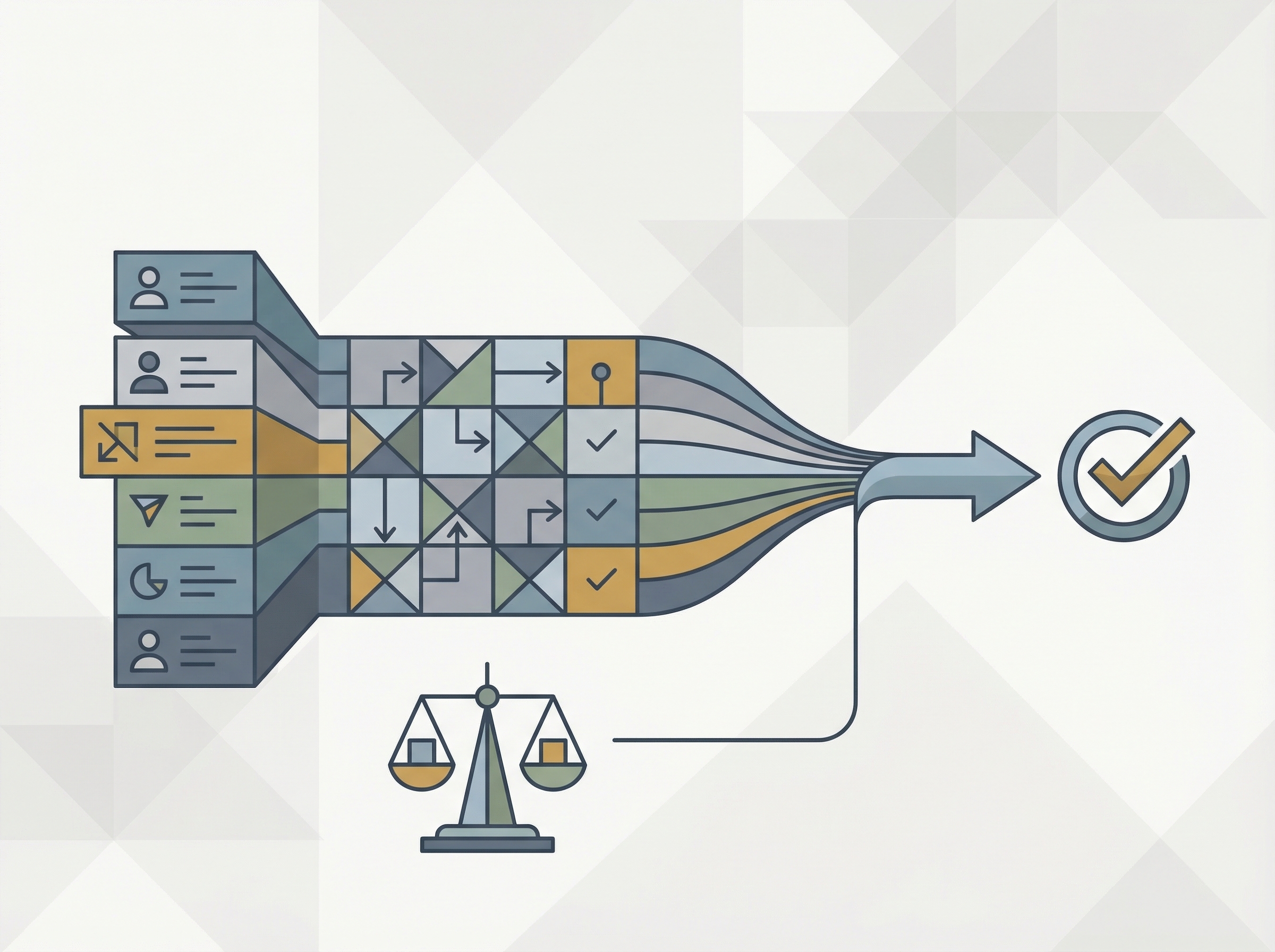
To understand the power of calibration, we need to look at Sarah's hiring pipeline before intervention. Her standard process—Intake, Resume Screening, Interviewing, Decision, Offer, Background Checks—was fundamentally broken at the evaluation stage. Interviewers were flying blind. As a result, the team suffered a dismal 15% pass-through rate from the initial screen to the final round, accompanied by an agonizing 45-day time-to-hire. Post-interview debriefs were nightmares of conflicting opinions, with rejections frequently citing useless, unmeasurable feedback like "they just aren't a culture fit" or "I didn't get a good feeling about their drive."
Implementing the Checklist Workflow
Enter Marcus, the company's Lead Recruiter. Recognizing the systemic failure, Marcus paused the search and introduced a role-specific signal checklist tied directly to their ATS (Applicant Tracking System). He completely revamped the workflow. During the intake meeting, he forced the hiring team to define exactly what success looked like. He translated those success metrics into five distinct competencies.
Marcus then integrated these signals into an AI interview platform for early-stage screening, ensuring baseline technical and behavioral signals were gathered before human interviews even began. For the live rounds, he built structured interview scorecards directly into the ATS. Each interviewer was assigned specific signals to look for, transforming a chaotic process into a highly orchestrated hiring workflow automation system.
Core Insights: Best Practices and Pitfalls
Actionable Heuristics for Success
Building an effective framework requires intentional design. Here are the core heuristics for success:
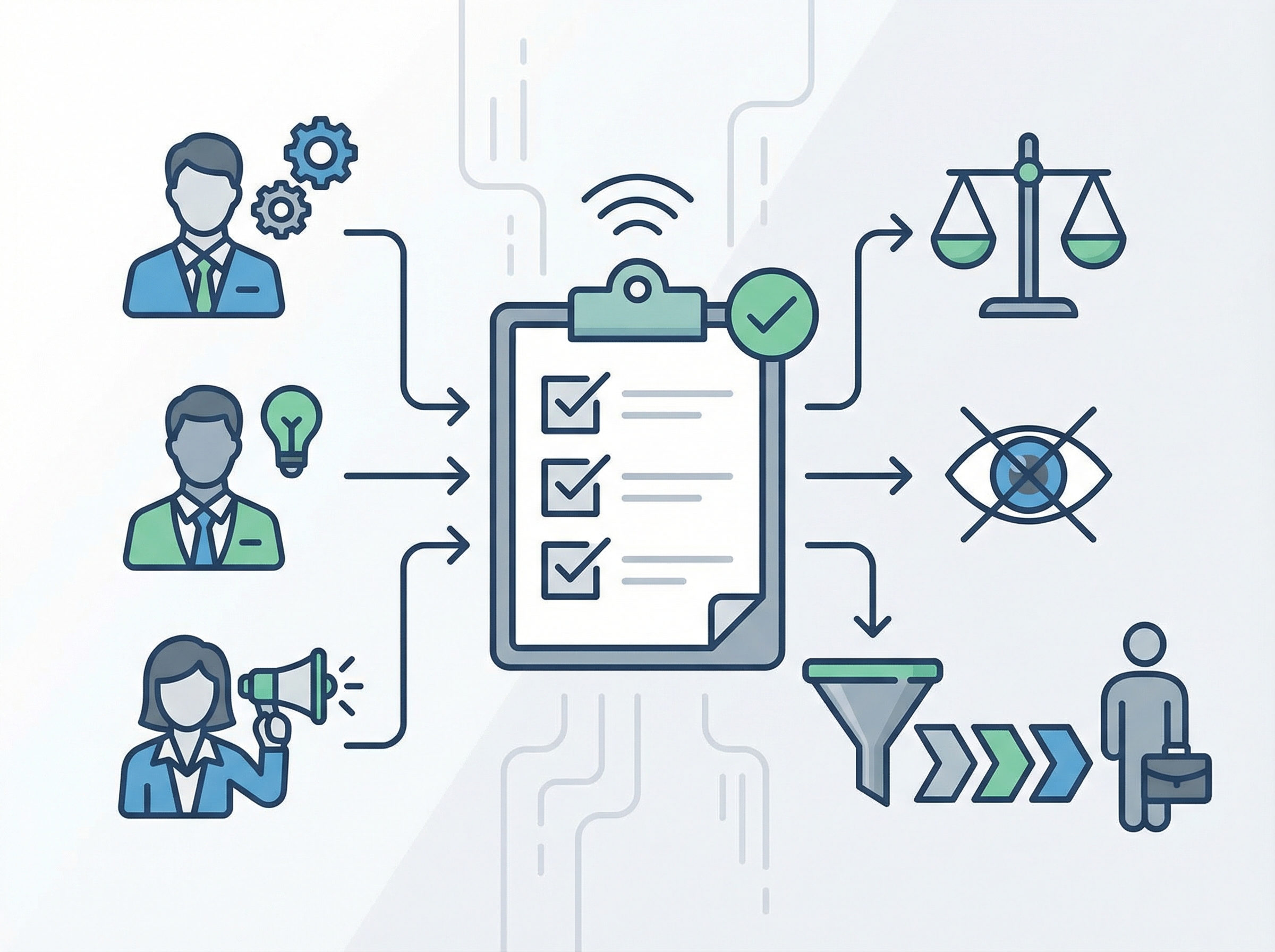
- Assign specific signals to specific interviewers: Never let a panel ask the same questions repeatedly. Divide your checklist so one interviewer assesses "cross-functional communication" while another digs deep into "system architecture capabilities." This prevents overlap and ensures comprehensive signal coverage.
- Leverage your ATS and structured interview scorecards: Do not rely on loose notes in a document. Build the checklist directly into your operational systems. Interviewers should be rating signals on a standardized scale (e.g., 1-4) immediately after the interview.
- Map signals to business outcomes: Avoid abstract skills. Instead of listing "Python," define the signal as "Ability to write scalable Python scripts that reduce data processing time." Tie the competency to the actual work they will perform.
- Implement hiring workflow automation: Use technology to seamlessly move candidates from AI interviews to scorecard evaluations, ensuring no data is lost between stages.
Common Misconceptions
Even well-intentioned teams can misuse this framework. Watch out for these common pitfalls:
- Overloading the checklist: A massive checklist is a useless checklist. Do not test for 20 traits. Aim for 5-7 core competencies. Anything more dilutes the focus and exhausts the interview panel.
- Confusing 'years of experience' with a validated signal: "Five years of marketing experience" is not a signal. The actual signal is "proven ability to launch and scale a multi-channel campaign." Tenure does not equal competence.
- Failing to calibrate the panel: Simply giving interviewers a checklist isn't enough. You must calibrate them on what a "strong" versus "weak" signal actually sounds like in a candidate's answer. Without calibration, subjective bias creeps back into the scorecards.
The Breakthrough Moment
Measuring the Transformation
The turning point for Sarah and Marcus came during the first debrief meeting after implementing the new framework. Previously, these meetings dragged on for an hour with circular debates. This time, the hiring panel opened their scorecards. Because each interviewer had hunted for specific, non-overlapping signals, the data painted a complete picture of the candidate. The panel reached a unanimous, data-backed hiring decision in exactly 15 minutes.
The impact was undeniable: by standardizing evaluations, time-to-hire was reduced by 14 days, consistency improved dramatically, and candidate drop-offs fell by 30% due to a faster, more professional interview experience.
Career Advantage and Pros & Cons
Elevating Your Talent Career
For recruiters, talent acquisition partners, and hiring leaders, mastering the signal checklist for a role is a massive career differentiator. It transitions your reputation from an administrative order-taker to a strategic talent advisor. Talent leaders who operationalize structured workflows—from resume screening to AI interviews to background checks—are highly sought after because they solve the most expensive problem in business: bad hires.
When interviewing for your next talent acquisition role, you might encounter this scenario:
Q: "How have you applied a signal checklist for a role to improve outcomes?"
A: "I standardized the intake process by defining core competencies, calibrated our panels using structured scorecards, and reduced time-to-fill by 20% while increasing diversity through objective evaluation criteria."
To showcase this on your resume, use concrete bullet points like:
- Standardized interview scorecards by developing role-specific signal checklists, improving candidate pass-through rates by 25%.
- Streamlined the talent acquisition lifecycle by integrating structured evaluations into the ATS and AI interview platform, reducing time-to-hire by 14 days.
- Calibrated cross-functional hiring panels, eliminating biased feedback and decreasing candidate drop-off rates by 30%.
Evaluating the Tradeoffs
Like any operational framework, structured evaluations come with their own set of realities. Here is a breakdown of the benefits and tradeoffs:
| Benefit | Tradeoff |
|---|---|
| Objective, data-backed hiring decisions that reduce bias | Requires significant upfront setup time during the intake phase |
| Dramatically faster debriefs and overall time-to-hire | Demands strict adherence from hiring managers who may resist structure |
| Seamless integration with ATS and interview scorecards | Interviewers must be thoroughly trained and calibrated beforehand |
FAQ and Next Steps
Frequently Asked Questions
What is a signal checklist for a role?
It is a standardized evaluation framework that maps specific behavioral and technical competencies to targeted interview questions. It ensures every candidate is assessed objectively using predefined criteria, improving hiring speed, quality, and consistency while eliminating gut-feeling decisions.
Can a signal checklist backfire?
Yes, if it is overloaded with too many competencies or if the hiring panel is not calibrated. If interviewers don't agree on what a "strong" signal sounds like, the checklist becomes a rigid, bureaucratic hurdle rather than an objective evaluation tool.
How does a signal checklist integrate with AI interview platforms?
A checklist provides the foundational criteria that AI platforms use to evaluate candidates during early stages. It ensures that the AI's assessments of technical or behavioral signals perfectly align with the scorecards human interviewers will use in later rounds.
Operationalizing Your Hiring
Mastering the signal checklist for a role creates a scalable, durable hiring advantage. It is the cornerstone of moving from reactive recruiting to strategic, predictable talent acquisition. By defining exactly what you are looking for, you empower your team to hire better, faster, and fairer.
If you want to operationalize signal checklists with structured workflows (Sourcing -> resume screening -> AI interviews -> scorecards -> offers -> background checks), try tools like Foundire (https://foundire.com).