How to Build a Requirements Mapping Matrix

How to Build a Requirements Mapping Matrix
What is a Requirements Mapping Matrix?
Defining the Concept for Modern Recruiting
A requirements mapping matrix is a strategic planning tool used in talent acquisition to cross-reference a role’s critical competencies (rows) against the assessment stages in the hiring workflow (columns). Unlike a simple job description, which lists what you want, the matrix dictates where, how, and by whom each attribute will be measured.
Core Definition: The requirements mapping matrix acts as the blueprint for structured interviewing. It ensures that every "must-have" skill is tested at least once, no single question is asked repeatedly by different interviewers, and the final hiring decision is based on data rather than gut feeling.
The High Cost of Unstructured Assessment
Without a matrix, hiring teams often fall into the trap of "unstructured assessment." This is where three different interviewers ask a candidate, "Tell me about a time you failed," but nobody checks if the candidate can actually write the code or manage the P&L they were hired for.
According to recent research from 2024 and 2025, structured interviews are approximately twice as effective at predicting job performance compared to unstructured ones. Yet, many teams skip the mapping phase, leading to bias, "zombie questions" (questions that refuse to die and keep getting asked), and costly mis-hires.
Consider Alex, a VP of Engineering at a mid-sized tech firm. Alex loves "chatting" with candidates to gauge "culture fit." But after six months, Alex is frustrated. His team has rejected 15 candidates in the final round because technical gaps were found too late, and the two candidates they did hire are struggling to onboard. Alex doesn’t have a candidate quality problem; he has a requirements mapping problem.
Scenario: The Chaos Before the Matrix
To understand the power of the matrix, we must look at the chaos that precedes it. Let’s look at a realistic failure workflow involving Alex (Hiring Manager), Jamie (Recruiter), and Sam (Candidate).
The Role: Senior Product Manager.
The "Old" Process:
- Step 1 (Resume Screen): Jamie scans for keywords.
- Step 2 (Phone Screen): Jamie asks, "Why do you want to work here?" and "What is your greatest weakness?"
- Step 3 (Panel Interview - Alex): Alex asks, "Tell me about a time you handled a conflict."
- Step 4 (Panel Interview - Peer): The peer asks, "Tell me about a conflict with a developer." (Redundant).
- Step 5 (Panel Interview - Stakeholder): The stakeholder asks, "How do you handle conflict?" (Redundant).
The Result:
Sam, the candidate, leaves the process feeling frustrated. "They asked me the same thing three times," Sam tells a friend. Meanwhile, nobody assessed Sam’s ability to build a product roadmap or analyze SQL data—two critical hard skills for the job.
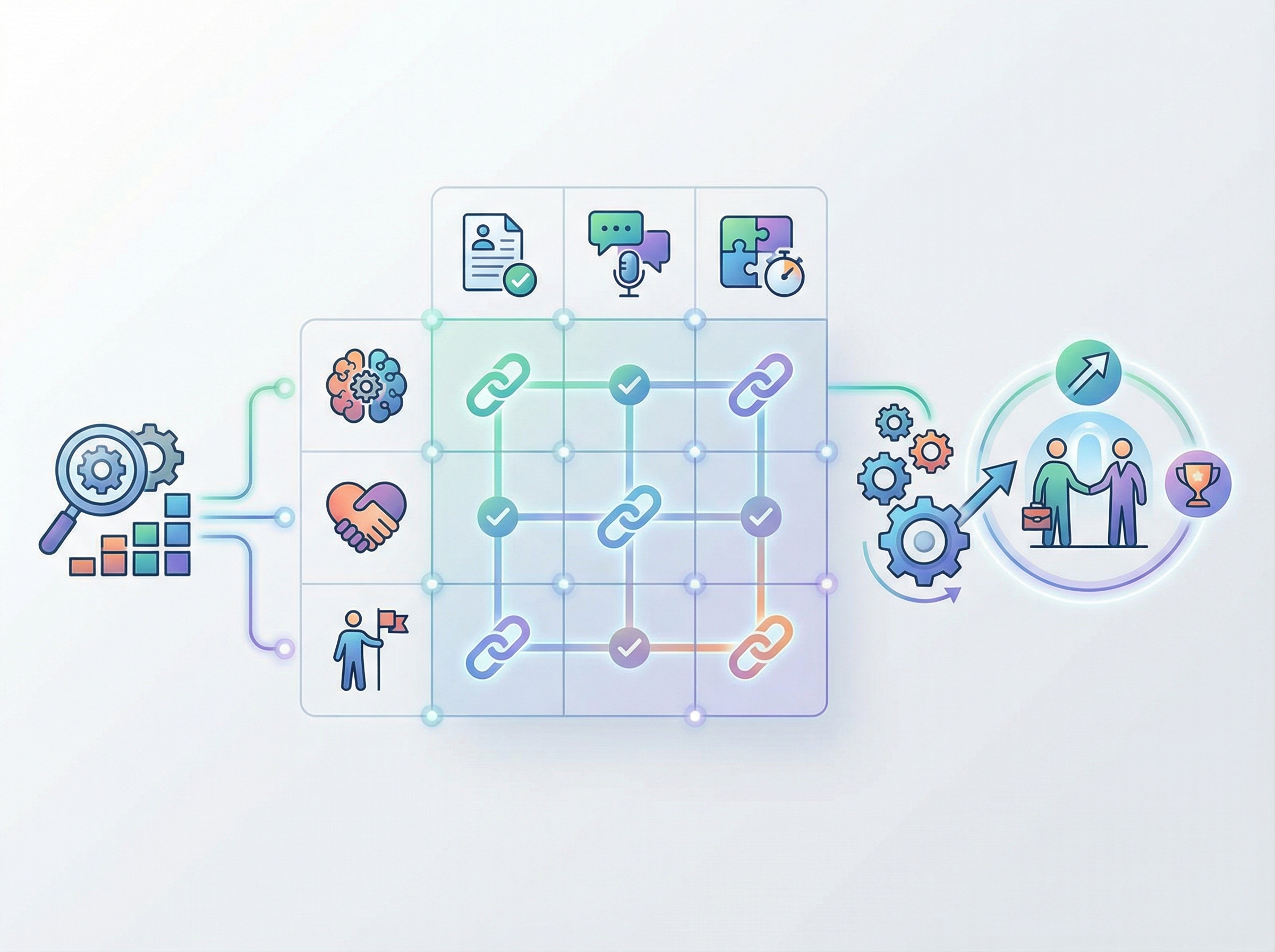
The Metrics of Failure:
- Time-to-Fill: 65 days (delayed by indecision).
- Drop-off Rate: 40% of candidates withdraw after the panel round due to a perceived lack of professionalism.
- The "Halo Effect": Interviewers liked Sam’s charisma (soft skill) and assumed Sam had the technical chops (hard skill) without verifying.
Constructing the Matrix: A Step-by-Step Guide
Building a requirements mapping matrix turns this chaos into a predictable engine. Here is how to construct one that allows for hiring workflow automation and seamless integration with modern ATS tools.
Step 1: Isolate Core Competencies
Don't map the entire job description. Isolate the 5–7 critical competencies that differentiate a top performer from an average one. These should be a mix of:
- Technical Skills (Hard): e.g., Python scripting, GAAP accounting, Figma prototyping.
- Behavioral Traits (Soft): e.g., Ambiguity tolerance, Cross-functional influence.
- Cultural Add: e.g., Bias for action, Customer obsession.
Step 2: Assign Assessment Methods
Create a grid. The rows are your competencies. The columns are your workflow stages (Screening, Take-Home, Interview 1, Interview 2). Place an "X" where each skill will be tested.
Heuristic: Map "knockout" criteria (must-haves) to the earliest possible stage. If a candidate must know SQL, test it in the Resume Screening or an AI interview platform before they ever speak to a human. This protects your hiring manager's time.
Step 3: Define Passing Criteria (The Rubric)
A matrix is useless if interviewers don’t know what "good" looks like. For every "X" on your grid, define the evidence required.
- Bad Criteria: "Good communication."
- Matrix-Ready Criteria: "Candidate concisely explains complex technical concept to a non-technical audience in under 2 minutes."
- Tool Tip: Modern platforms like Foundire allow you to embed these rubrics directly into the interview interface, ensuring interviewers score against the matrix in real-time.
The Breakthrough: Impact on Hiring Outcomes
Let’s return to Alex and Jamie. They decide to implement a requirements mapping matrix for the next open role: Lead Backend Engineer.
The Turning Point:
Instead of a vague intake meeting, Jamie forces Alex to fill out the matrix. They discover that "Leadership" is actually "Mentoring Junior Devs"—a specific skill, not a vibe.
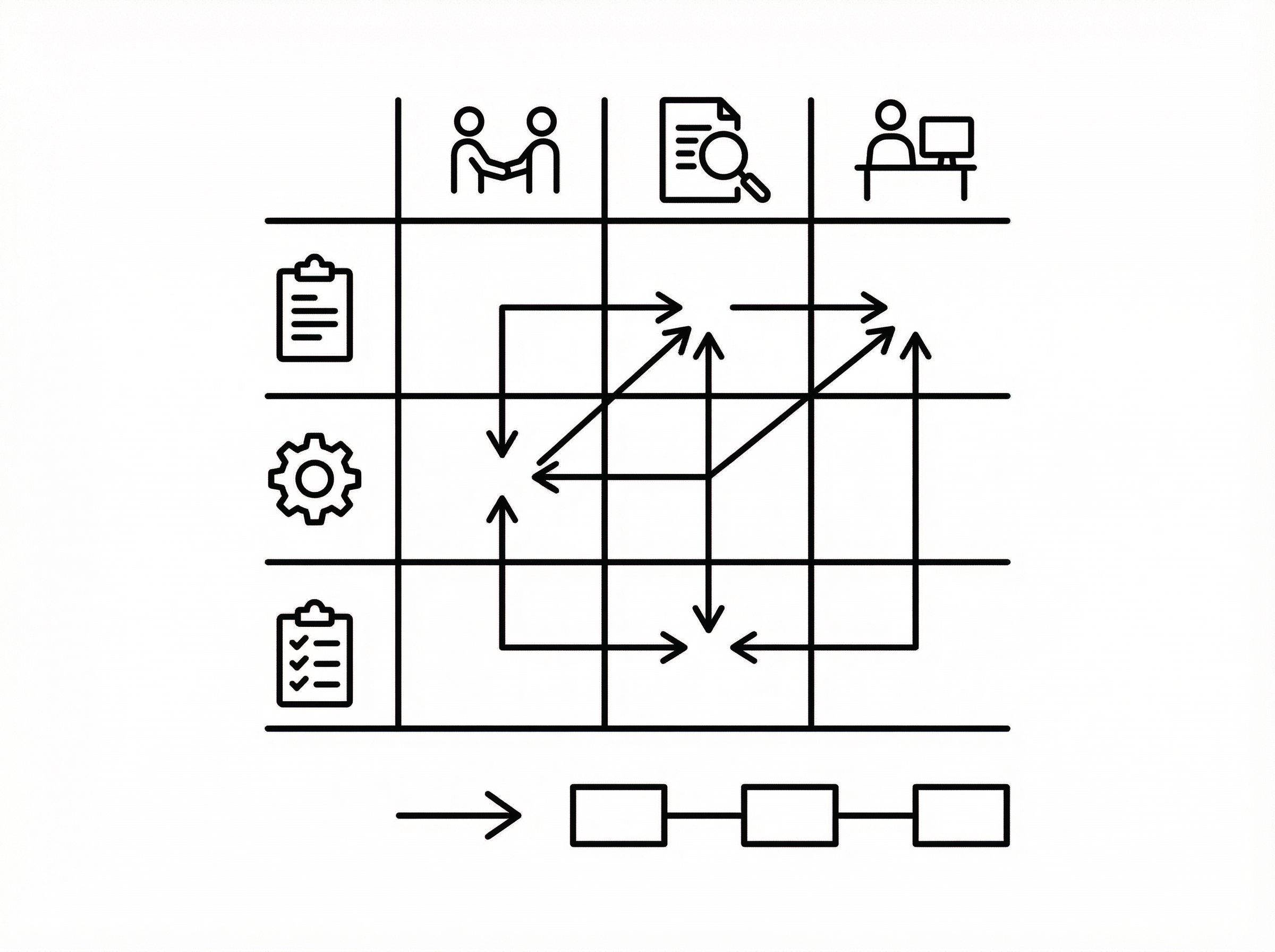
The New Workflow:
- Screening: Foundire AI interview validates "System Design basics" automatically. (Time saved: 5 hours/week).
- Interview 1 (Alex): Alex focuses only on "Architecture Scalability." He doesn't ask about culture.
- Interview 2 (Peer): The peer focuses only on "Code Review Etiquette."
- Final Round: The founder assesses "Mission Alignment."
The Result: The time-to-fill drops to 32 days. Even more importantly, the debrief meeting changes. Instead of arguing opinions ("I didn't click with him"), the team compares data ("He scored a 4/5 on Architecture but a 1/5 on Mentorship. Can we train the mentorship?"). The decision is binary, fast, and defensible.
Common Pitfalls & Misconceptions
Even with a matrix, teams can stumble. Avoid these three common errors:
1. The "Kitchen Sink" Matrix
The Pitfall: Trying to assess every single bullet point in the job description.
The Fix: If you try to measure 20 things, you measure nothing. Stick to the "Power Law" of hiring: 80% of the success comes from 20% of the skills.
2. Static Matrices
The Pitfall: Creating a matrix once and never updating it.
The Fix: If the market changes (e.g., AI becomes a requirement for engineers), your matrix must evolve. Treat it as a living document.
3. Ignoring Soft Skills
The Pitfall: Mapping only technical skills because they are easier to measure.
The Fix: Soft skills predict long-term retention. Use "Structured Behavioral Interviews" (SBI) within the matrix to quantify traits like "Adaptability."
Career Relevance for Talent Leaders
Mastering the requirements mapping matrix is a career accelerator for recruiters and HR professionals. It moves you from being a "scheduler" to a "talent architect."
Interview Q&A for Recruiters
Q: "How do you ensure quality of hire?"
A: "I move beyond gut feeling by implementing a requirements mapping matrix. For example, in my last role, I partnered with VPs to calibrate competencies before the search began. This reduced our interview hours by 30% and improved our pass-through rate because every candidate who reached the final stage was already vetted for non-negotiables."
Resume Bullets to Steal
- Designed and implemented a competency-based requirements matrix, reducing interview redundancies and cutting time-to-fill by 18%.
- Standardized assessment criteria across Engineering and Sales, resulting in a 25% increase in interviewer calibration scores.
- Operationalized structured interviewing using Foundire and ATS scorecards to eliminate bias in high-volume hiring funnels.
Pros & Cons of Requirements Mapping
| Benefit (Why do it?) | Tradeoff (What is the cost?) |
|---|---|
| Reduces Bias: By focusing on pre-mapped criteria, interviewers are less likely to fall for the "similar-to-me" bias or the "halo effect." | Upfront Time Investment: It requires 60–90 minutes of intake and planning before a role goes live, which can feel slow to impatient managers. |
| Legal Defensibility: If a candidate claims discrimination, the matrix provides a documented, objective paper trail of why they were rejected based on skills. | Requires Rigidity: Hiring managers who prefer "casual chats" may resist the structure and feel constrained by the process. |
| Candidate Experience: Candidates respect a process that feels organized, professional, and non-repetitive. | Maintenance Overhead: As roles evolve, the matrix and associated scorecards must be manually updated in the ATS. |
Frequently Asked Questions
What is a requirements mapping matrix in recruitment?
It is a planning document that outlines exactly which skills and competencies are required for a job and assigns specific interview stages or assessment methods to measure them. It prevents interview overlap and ensures no critical skill is overlooked.
Can a requirements mapping matrix backfire?
Yes, if it is too rigid or complex. If a matrix has too many competencies (over 10), interviewers typically suffer from "scorecard fatigue" and default to generic scores. It must remain simple enough to be usable in real-time.
How does requirements mapping improve diversity?
It enforces structured interviewing. When every candidate is asked the same questions and scored against the same rubric, the influence of unconscious bias (gender, race, accent) is significantly reduced, leveling the playing field for underrepresented talent.
Should I use Excel or my ATS for the matrix?
Start with a spreadsheet for the planning phase (mapping rows and columns). Once finalized, build the output into your ATS scorecards or interview platform to ensure data capture during the actual interview.
Conclusion: The Foundation of Modern Hiring
The requirements mapping matrix is not just an administrative document; it is the difference between hoping for a good hire and engineering one. As we move deeper into the era of AI and automation, having structured data is no longer optional—it is the prerequisite for using advanced tools effectively.
By doing the hard work of mapping competencies upfront, you respect your candidates' time, protect your company from bias, and give your hiring managers the data they need to make confident decisions.
If you want to operationalize this workflow—from sourcing to resume screening and AI-driven structured interviews—try tools like Foundire (foundire.com) to automate your matrix and ensure every candidate gets a fair, data-backed shot at the role.