How to Build a Perfect Requisition Intake Checklist

How to Build a Perfect Requisition Intake Checklist
What is a Requisition Intake Checklist?
A requisition intake checklist is a structured strategic document used during the initial "kick-off" meeting between a recruiter and a hiring manager. Its purpose is to move beyond the basic job description to align on three critical pillars: the business problem the role solves, the measurable outcomes required in the first 90 days, and the exact interview workflow (from sourcing to offer).
It is not just a form; it is a contract of alignment. When executed correctly, it reduces time-to-fill, prevents "phantom jobs" (roles that stay open indefinitely because requirements are vague), and dramatically improves candidate experience.
The Hook: The "Phantom Job" Trap
We’ve all seen it. A role sits open for 120 days. The hiring manager rejects every resume, saying, "I’ll know the right one when I see them." The recruiter is burnt out, the team is overworked, and the budget is bleeding. This isn't a sourcing problem; it's an intake problem. A robust requisition intake checklist prevents this chaos by forcing clarity before a single candidate is contacted.
The Cost of Misalignment: A Real-World Scenario
To understand why the intake checklist is the most powerful tool in a recruiter’s arsenal, let’s look at a scenario that plays out in companies every day.
The Scenario: Sarah (Recruiter) vs. Mike (Hiring Manager)
Sarah, a senior recruiter, receives a slack message from Mike, the VP of Engineering: "Hey, we need a Senior Product Manager ASAP. I put the req in the ATS. Just use the JD from the last hire. Thanks!"
Sarah, eager to be helpful, launches the search immediately. She scrapes the old job description—which lists generic requirements like "good communicator" and "5+ years of experience"—and starts sourcing.

The Workflow Failure
Over the next six weeks, the following happens:
- Volume without Value: Sarah screens 50 candidates. She passes 15 to Mike.
- The "Vibe" Check: Mike rejects 12 of them instantly because they "don't have B2B SaaS experience" (a requirement he never mentioned).
- The Interview Black Hole: The remaining 3 candidates go through 6 rounds of interviews because the panel wasn't prepped.
- The Result: 0 offers. 60 days wasted. Mike is frustrated ("Why can't we find good people?"), and Sarah is exhausted.
Quantifying the Waste
This isn't just annoying; it's expensive. According to 2025 labor statistics, the cost of a bad hire or prolonged vacancy can equal 30% of the role's first-year earnings. For a $150k Product Manager role, Sarah and Mike just torched roughly $45,000 in lost productivity and wasted interview hours.
The root cause? They skipped the intake strategy session. They focused on the title, not the deliverables.
Essential Components of a Strategic Intake Checklist
To avoid Sarah’s fate, you need a checklist that acts as a forcing function for clarity. This document transforms you from an "order taker" into a "talent advisor."
1. Defining the "Must-Haves" vs. "Nice-to-Haves"
Research shows that limiting "must-haves" increases the diversity and quality of the funnel. Your checklist must challenge the manager to prioritize.
- The Rule of 5: Force the manager to list only top 5 non-negotiable skills. If they list 15, nothing is a priority.
- The "Magic Wand" Question: Ask, "If this person starts on Monday, what is the one problem they must solve immediately so you can sleep at night?"
- Calibration Profile: Before sourcing, find 3 LinkedIn profiles. Ask the manager: "Would you interview this person? Why or why not?" This calibrates your eye before you waste time on calls.
2. Structuring the Workflow & Scorecards
Alignment on who you want is useless if you don't agree on how to evaluate them. Your checklist must map the funnel:
- Sourcing: Which companies are targets? Which are "hands-off"?
- Screening: Will you use a phone screen or an AI interview tool?
- Interview Panel: Who is assessing "Technical Skills"? Who is assessing "Culture Add"? (Assign these now to avoid duplicate questions).
- SLA (Service Level Agreement): "I commit to submitting 3 candidates by Friday; you commit to giving feedback within 24 hours."
Pro Tip: Modern workflows are evolving. Instead of manual phone screens, many teams now use platforms like Foundire to automate the first layer of screening with adaptive AI interviews, ensuring every candidate gets a fair, structured opportunity to demonstrate their skills before a human reviews the scorecard.
3. The 30-60-90 Day Deliverables
Stop asking for "years of experience." Ask for outcomes.
- Day 30: "Must audit our current React codebase."
- Day 60: "Must ship one feature to production."
- Day 90: "Must hire two junior devs."
This clarity allows you to write a job description that attracts performers, not just people who fit a keyword search.
The Breakthrough: From Chaos to Clarity
Let’s rewind Sarah’s story. This time, she pushes back. She schedules a 30-minute Requisition Intake Meeting with Mike before opening the role.
The Turning Point:
Using her checklist, Sarah discovers that Mike doesn't actually need a "Senior PM" with 10 years of experience. He needs someone who has specifically launched a mobile app in a regulated industry.
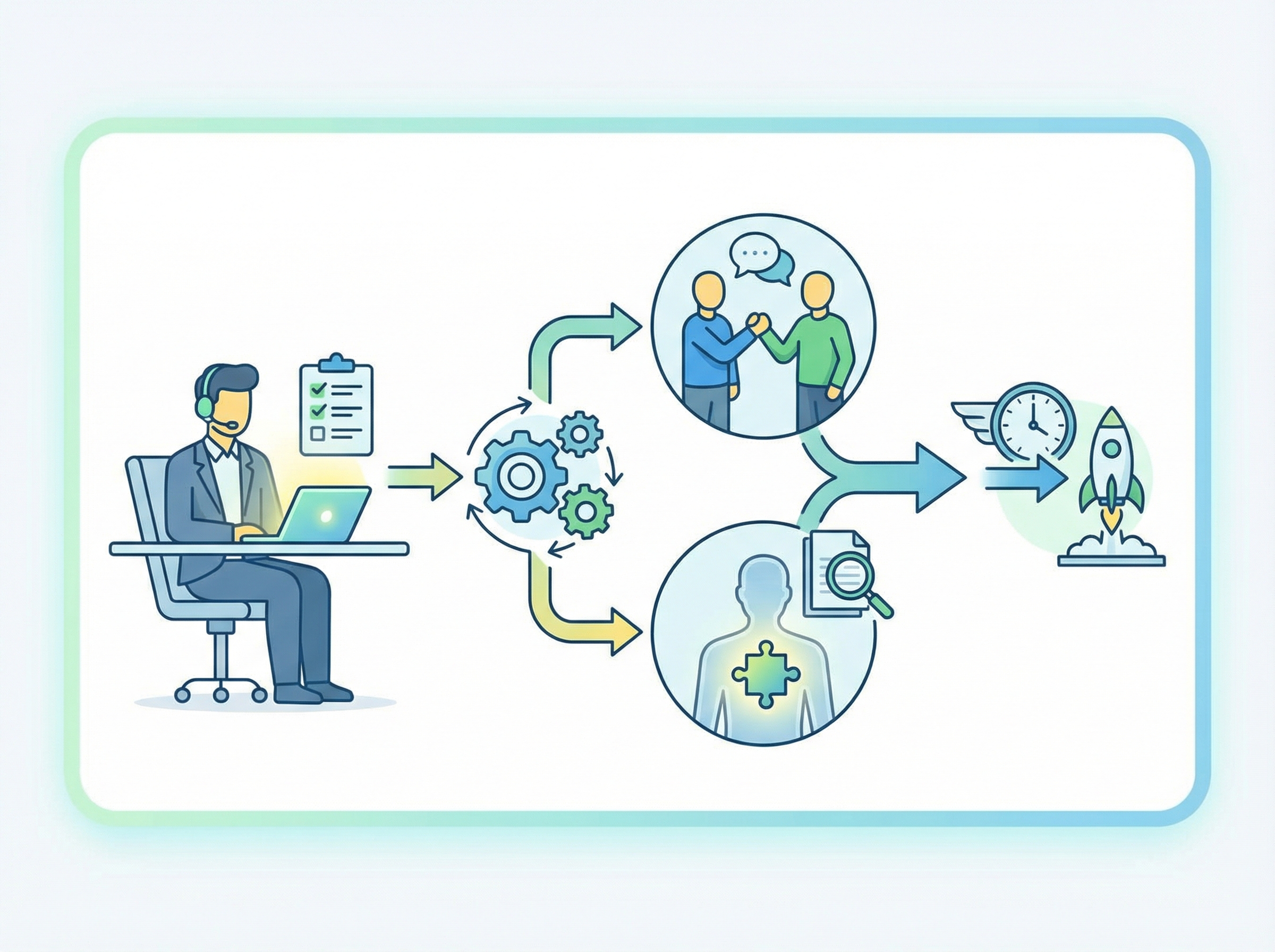
They agree on a structured interview workflow:
Intake → Sourcing → Resume Screen → AI Interview (Technical Screen) → Onsite Panel → Offer.
The Results:
- Pass-through Rate: Increases from 10% to 60% because Sarah knows exactly what to look for.
- Speed: Time-to-fill drops from 60+ days to 28 days.
- Manager Trust: Mike stops micromanaging because he trusts the scorecard they built together.
Elevating Your Recruiter Brand with Intake Mastery
For talent professionals, mastering the intake is a career accelerator. It is the difference between being viewed as admin support and being viewed as a strategic business partner.
Q&A: Talking About Calibration
Interviewer: "How do you handle difficult hiring managers who reject all your candidates?"
You: "I prevent that friction upfront with a rigorous requisition intake checklist. I use the kickoff meeting to align on calibration profiles and define structured interview scorecards. For example, in my last role, this process reduced our rejection rate at the resume review stage by 40%."
Resume Bullets That Sell Strategy
- "Reduced time-to-fill by 25% by implementing a standardized requisition intake checklist across Engineering and Product departments."
- "Increased interview-to-offer ratio from 4:1 to 2:1 through strict intake calibration and structured interview guides."
- "Partnered with VP-level stakeholders to define 'Quality of Hire' metrics during intake, resulting in a 95% retention rate for new hires."
Pros, Cons, and Implementation Strategy
| Benefit | Tradeoff |
|---|---|
| Higher Quality of Hire: Clear criteria leads to better assessment and less bias. | Upfront Time Investment: Requires 30–60 minutes of deep focus before the search begins. |
| Speed (Downstream): Eliminates weeks of wasted interviews and misalignment. | Manager Friction: Impatient managers may resist the "slow down to speed up" approach. |
| Legal Defensibility: Structured criteria protect against bias accusations. | Rigidity: If the market shifts, you must formally "reset" the intake to adjust expectations. |
Frequently Asked Questions
What is the most important part of a requisition intake meeting?
The most critical element is calibration. Agreeing on 3–5 "must-have" competencies and reviewing real candidate profiles to ensure the recruiter and hiring manager share the same mental model of the ideal candidate.
Can a requisition intake checklist backfire?
Yes, if it becomes too rigid. If the market data shows that the "purple squirrel" candidate doesn't exist at the budgeted salary, the checklist must be a living document that triggers a conversation about adjusting the budget, level, or location.
Who should attend the intake meeting?
Ideally, the recruiter and the hiring manager. For high-stakes roles, including a "Bar Raiser" (an interviewer from another team) or the skip-level manager can ensure the requirements align with broader company goals.
How does AI fit into the intake process?
AI tools can audit your checklist for bias or use the intake data to automate screening. Platforms like Foundire use the criteria defined in the intake to drive autonomous first-round interviews, delivering decision-ready insights without human bias.
Conclusion
The requisition intake checklist is the foundation of modern, data-driven recruiting. It transforms the hiring process from a game of luck into a repeatable operational system. By investing time upfront to align on the "who," "what," and "how," you build a defensible, efficient, and successful hiring machine.
If you are ready to operationalize this level of structure—from sourcing and resume screening to AI interviews and background checks—consider upgrading your stack. Tools like Foundire can help you turn your intake criteria into automated, consistent workflows that scale.