How to Build a Fast Applicant Triage Workflow

The High-Stakes Game of Applicant Triage
If you have ever stared at an inbox with 400 unread applications and felt a sinking sensation in your stomach, you already know why an applicant triage workflow is critical. It is the single most effective defense against "recruiter burnout" and the notorious "resume black hole."
What is an applicant triage workflow?
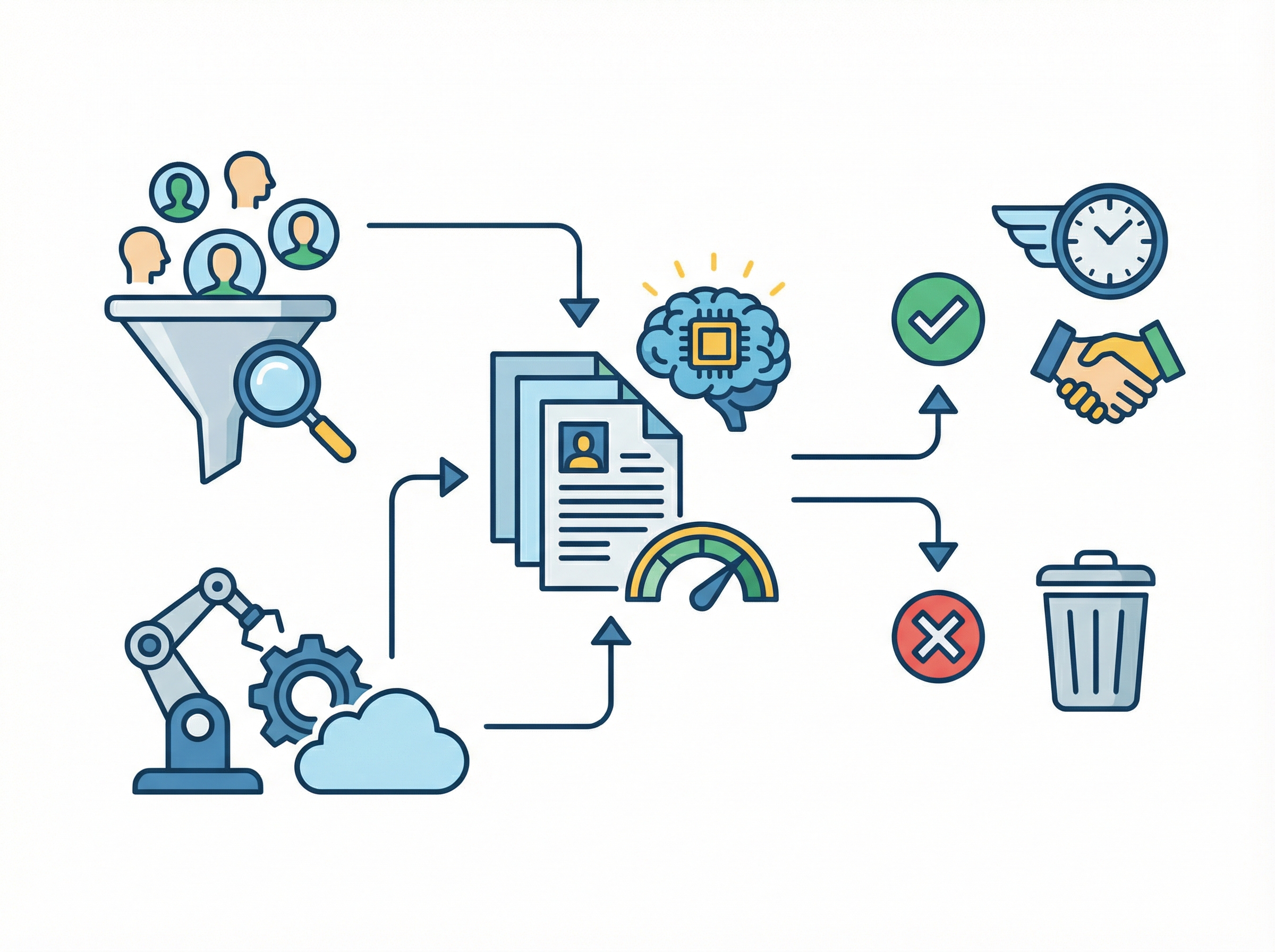
An applicant triage workflow is a systematic process for sorting incoming candidates into priority buckets—Must-Interview, Maybe, and Reject—immediately upon intake. Much like medical triage, the goal is to direct resources (your time) to the most critical cases (top talent) before it’s too late.
In 2026, this is no longer just about scanning PDFs for keywords. It is about using intent detection and automation to distinguish signal from noise. A robust triage workflow reduces time-to-hire, improves the quality of every conversation, and ensures that no qualified candidate is ignored simply because they applied on a Friday afternoon.
Key Insight: Triage is not about rejection; it is about prioritization. The objective is to surface the top 10% of candidates within hours of their application, not weeks.
The hidden cost of resume fatigue
Let’s look at a realistic scenario. Meet Sarah, a Senior Tech Recruiter at a mid-sized fintech company.
The Scenario: Sarah opens a requisition for a "Senior Product Manager." By Tuesday, she has 530 applications.
The Manual Problem: Sarah is manually reviewing resumes. By application #150, her eyes are glazing over. She unknowingly rejects a candidate who had perfect transferable skills but a messy resume layout. Worse, she completely misses a "unicorn" candidate—someone who led a similar product launch at a competitor—because their application is buried at #480. By the time she reaches it five days later, that candidate has already accepted an interview with a competitor.
This is decision fatigue in action. It leads to missed unicorns, inconsistent hiring standards, and a "post-and-pray" strategy that relies more on luck than logic.
Anatomy of a Broken vs. Optimized Process
To fix the funnel, we first have to visualize where it breaks. Most manual processes look like a funnel that is clogged at the top.
The manual bottleneck scenario
- Intake: Candidates apply via LinkedIn, Indeed, and the career page.
- Visual Scan: The recruiter spends 6–10 seconds per resume (a widely cited industry stat).
- Bias Creep: Subconscious bias slips in. "This school sounds prestigious" or "I don't know this company name" becomes a proxy for quality.
- Delayed Decisions: "Maybes" pile up in a folder labeled "Review Later" that is rarely opened again.
- Result: High time-to-fill (45+ days) and low pass-through rates.
The streamlined automated workflow
Now, let’s look at how Sarah’s workflow changes when she operationalizes applicant triage using modern tools like Foundire.
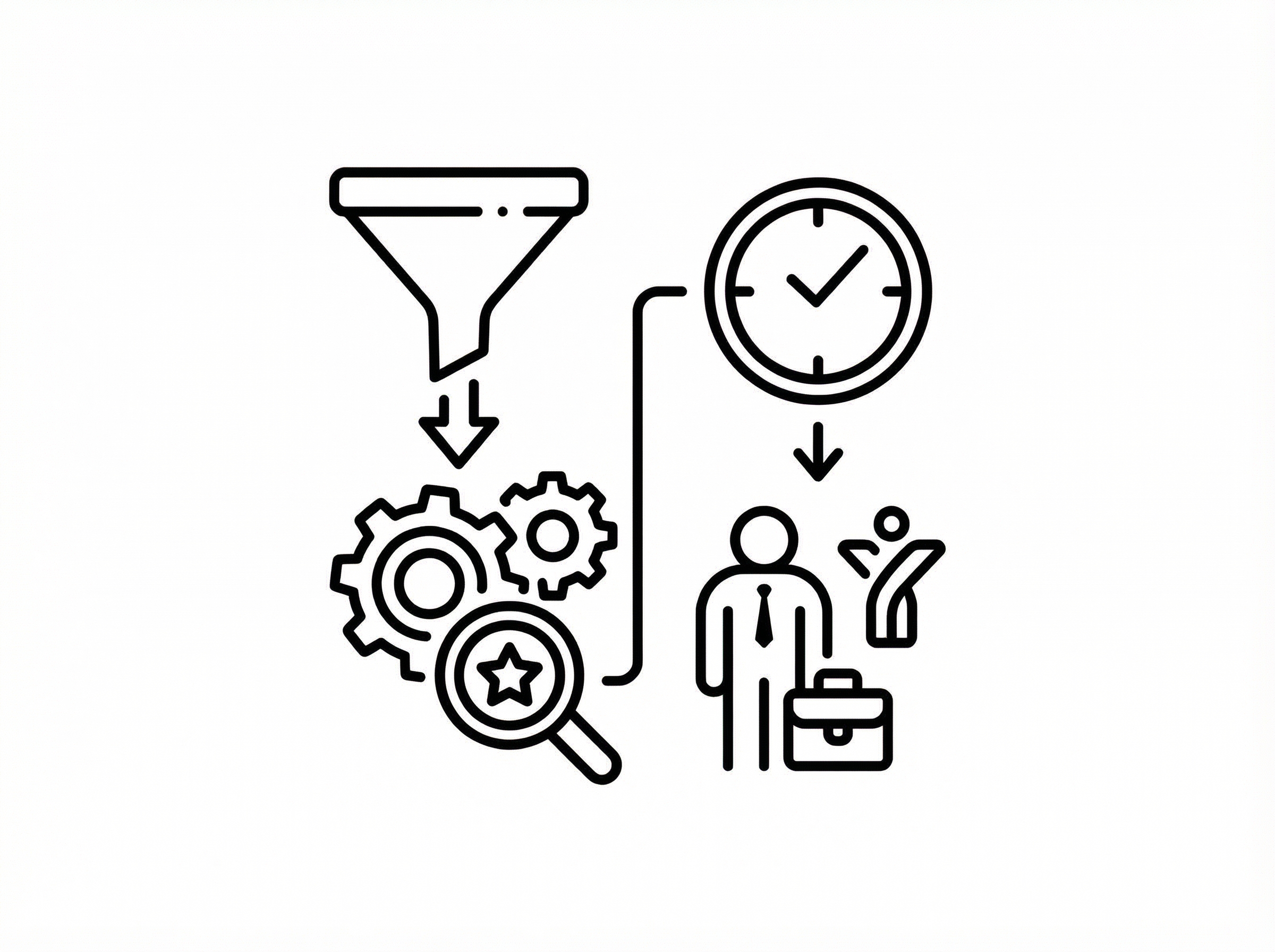
Step 1: Intake & Auto-Enrichment
Candidates apply. Instead of a flat PDF, the system parses the data, enriching the profile with public data points (e.g., GitHub repositories, portfolio links) to give a fuller picture instantly.
Step 2: AI-Driven Ranking (The Triage)
The system scores applicants based on weighted criteria—not just keywords. It flags non-negotiables (e.g., "Must be located in EST time zone") and auto-rejects mismatches. The "Must-Interview" candidates are pushed to the top of the dashboard.
Step 3: The "Soft Skills" Filter (AI Interview)
This is the breakthrough. Instead of Sarah phone-screening 50 people, the top 30 candidates are invited to an AI voice interview. The AI asks adaptive questions (e.g., "Tell me about a time you managed a roadmap conflict"), probing for depth. It generates a transcript and a "Decision-Ready Scorecard" for Sarah.
Step 4: Human Precision
Sarah starts her day reviewing scorecards, not raw resumes. She listens to 3-minute audio clips of the top 5 candidates. She invites the best 3 to a final interview.
Core Heuristics for Effective Triage
Building this workflow requires more than just software; it requires a new set of rules for your recruiting team. Here are three heuristics to master applicant triage.
1. The "Knockout" Rule
Never review a resume that hasn’t passed a binary filter. Use 3–5 "knockout questions" in the application form for non-negotiables.
- Do you have valid work authorization?
- Are you willing to work onsite 3 days a week?
- Do you have a specialized certification (e.g., CPA, RN, PMP)?
If the answer is "No," the candidate is automatically triaged to the rejection bucket with a polite, immediate email. This clears 20–40% of the queue instantly.
2. Calibrate Early, Not Late
The biggest cause of "Maybe" pileups is misalignment with the hiring manager. Implement a Calibration Loop within the first 48 hours of a role going live.
Action: Send the first 10 "triage-passed" profiles to the hiring manager. Ask for a simple "Yes/No/Why" on each. Adjust your scoring criteria based on this feedback immediately. This prevents you from screening 100 people against the wrong standard.
3. Triage for Potential, Not Just Pedigree
Manual screening over-indexes on "Pedigree" (School/Company names). Automated triage should over-index on "Potential" (Skills/Adaptability).
Best Practice: Use AI interview platforms to screen for communication clarity and problem-solving early in the process. A candidate might have a messy resume but excellent verbal reasoning. An AI interviewer can catch this signal where a human eye scanning a PDF would miss it.
Common pitfalls in automation
- The Keyword Trap: Setting filters too strictly (e.g., requiring "Java" but excluding "J2EE") creates false negatives. Use semantic matching that understands related terms.
- The "Black Hole": Automating intake but failing to automate rejection. If a candidate is triaged out, tell them immediately. Silence damages your employer brand more than rejection does.
- Ignoring Silver Medalists: A great triage system should tag "Maybe" candidates for future roles. Don't just archive them; pool them.
The Breakthrough: Measuring Impact
Returning to Sarah’s story: After implementing a structured applicant triage workflow, the metrics shifted dramatically.
- Time-to-Screen: Reduced by 70%. Sarah no longer spends 15 hours a week reading resumes; she spends 4 hours reviewing AI scorecards.
- Interview Quality: The "Pass-through Rate" from First Human Interview to Final Round jumped from 20% to 60%. Why? Because the candidates reaching her were already vetted for communication skills and core competencies by the AI.
- Candidate Experience: Applicants received feedback (either an interview invite or a rejection) within 48 hours, skyrocketing the company's Glassdoor reputation.
This is the power of operationalizing triage. It turns Talent Acquisition from a cost center into a strategic partner.
Career Advantage: Triage as a Skill
For recruiters and talent leaders, mastering this workflow is a major career differentiator. It shows you understand RecOps (Recruitment Operations) and can handle scale.
Answering the "Process" interview question
Q: "How do you handle high-volume requisitions without sacrificing quality?"
A: "I don't rely on manual scanning. I build an applicant triage workflow that standardizes the intake. I use knockout questions for non-negotiables to protect my time. Then, I leverage AI tools to screen for soft skills and intent early. This allows me to focus my human energy on the top 10% of candidates who are actually qualified, rather than drowning in the 90% who aren't."
Resume boosters for recruiters
- "Designed an automated applicant triage workflow that reduced time-to-fill by 15 days using Foundire for AI resume screening and ranking."
- "Implemented structured interview scorecards, increasing hiring manager calibration and pass-through rates by 40%."
- "Managed a high-volume funnel of 500+ applicants/week with zero backlog using automated knockout filters and asynchronous interview loops."
Pros & Cons of Automated Triage
| Benefit | Tradeoff |
|---|---|
| Speed & Scale: Drastically reduces administrative load, allowing teams to handle 10x volume without adding headcount. | Setup Time: Requires deep initial alignment with hiring managers to define "quality" criteria accurately. |
| Bias Mitigation: Standardized criteria and AI scoring reduce unconscious bias related to names, schools, or formatting. | False Negatives: Rigid "knockout" logic may reject non-traditional candidates who would have been great hires. |
| Candidate Experience: Provides faster answers and consistent feedback loops, preventing the "ghosting" phenomenon. | Perceived Impersonality: Some candidates may dislike interacting with AI tools early in the process if not framed correctly. |
Frequently Asked Questions
What is an applicant triage workflow?
An applicant triage workflow is the automated process of evaluating and prioritizing job applications immediately upon receipt. It uses data parsing, knockout questions, and AI scoring to sort candidates into categories (Interview, Hold, Reject), ensuring recruiters focus only on the most qualified talent.
Can automated triage backfire?
Yes, if the criteria are too rigid. Over-relying on strict keywords (e.g., rejecting anyone without "SaaS" on their resume) can filter out high-potential candidates with transferable skills. It is essential to audit your rejection logs regularly to ensure you aren't missing hidden gems.
How does AI fit into applicant triage?
AI moves triage beyond keywords to "semantic matching" and "intent detection." Tools like Foundire can conduct first-round voice interviews to assess soft skills and communication ability, providing a richer data point for triage than a resume alone.
Is triage the same as rejection?
No. Triage is about prioritization. While it does accelerate rejections for unqualified candidates, its primary purpose is to fast-track the best candidates so you can interview them before your competitors do.
Mastering the applicant triage workflow is the difference between being a reactive ticket-closer and a proactive talent advisor. It creates a durable advantage that allows your team to hire faster, fairer, and with greater confidence.
If you want to operationalize applicant triage with structured workflows (Sourcing → resume screening → AI interviews → scorecards → offers → background checks), try tools like Foundire (foundire.com) to automate the heavy lifting while you focus on the human connection.