How to Build a Decision Log

How to Build a Decision Log
What is a Hire/No-Hire Decision Log?
Defining the Concept
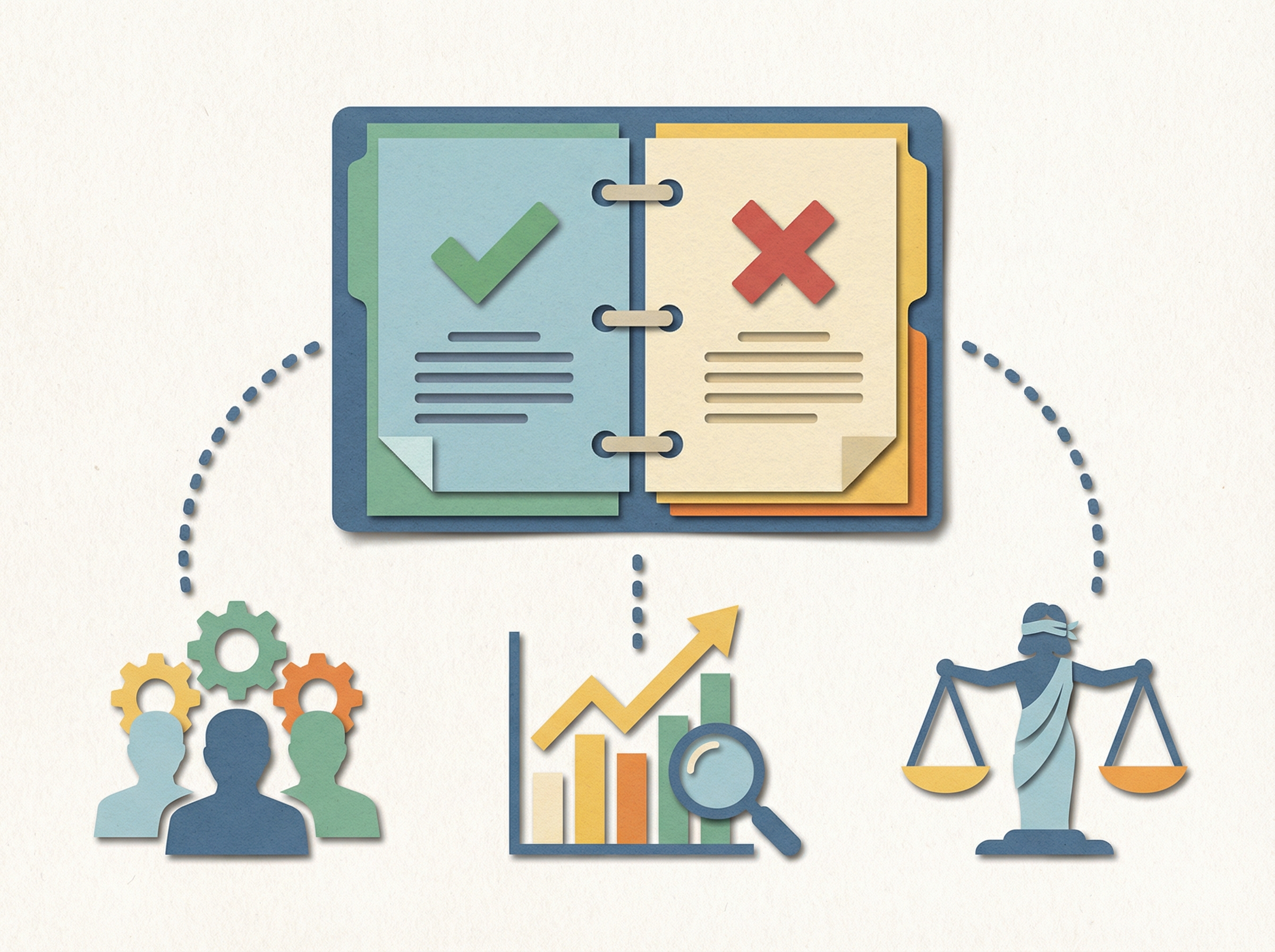
If you are struggling with slow recruitment cycles and misaligned hiring committees, you are likely wondering how to fix your evaluation process. A hire/no-hire decision log is a structured system that records interview feedback, scoring, and the explicit rationale behind every hiring choice. By centralizing this data, talent acquisition teams can transition from relying on subjective impressions to making evidence-based choices. This documentation matters because it directly improves speed, hiring quality, consistency, and the overall candidate experience. Instead of debating vague feelings in a debrief room, a hire/no-hire decision log replaces bias with calibrated data, ensuring that every candidate is measured against the exact same competencies.
To understand why this is a critical asset for modern talent acquisition, we must look at the standard lifecycle of filling a role. From the initial intake meeting and sourcing efforts to resume screening, conducting interviews, and extending offers, the volume of data collected is massive. Without a centralized log, that data scatters across direct messages, scribbled notes, and memory. The result is a broken hiring workflow automation process where recruiters spend more time chasing feedback than actually closing top-tier talent. A formalized log solves this by creating an auditable, transparent, and highly efficient trail of evidence.
The Tale of Inefficient Debriefs
Consider the story of Sarah, a Lead Recruiter, and Tom, a seasoned Engineering Manager. Last year, they were tasked with scaling a critical engineering pod. Their initial workflow seemed standard: intake, screening, interview, decision. Yet, their reality was a frustrating maze of inefficiency, inconsistency, and wasted effort. After a grueling round of technical interviews, Sarah would schedule a debrief meeting, only to find Tom and the rest of the hiring committee completely misaligned.
The pre-log problem was painfully explicit. Feedback was delivered in vague, unhelpful statements like, "I just didn't get a good vibe," or "She seems like a solid culture fit." Because expectations were never explicitly calibrated, Tom was evaluating coding speed, while another interviewer was hyper-focused on software architecture. This misalignment led to a sluggish 14-day decision time post-interview. Consequently, their pass-through rate plummeted, and top candidates simply walked away. According to recent 2026 reports, 42% of candidates drop out due to scheduling and decision delays. Sarah and Tom were losing the exact A-players they desperately needed simply because they could not make a unified, data-driven decision quickly.
Real-World Scenario and Breakthrough Impact
Implementing the Log
Determined to fix this broken pipeline, Sarah spearheaded the implementation of a comprehensive hire/no-hire decision log. She knew that simply asking for better notes wouldn't work; she needed to fundamentally overhaul their hiring workflow automation. The transformation began by integrating the new log directly into their ATS (Applicant Tracking System). This ensured that from the very first moment of resume screening, every piece of candidate data was funneled into a single source of truth.
Next, Sarah standardized the evaluation phase by rolling out structured interviews. She mandated that every candidate for the engineering role face the exact same questions in the exact same order. To support this, the team adopted an AI interview platform that allowed for asynchronous initial screenings, feeding preliminary competency scores directly into the log. For the live rounds, Sarah equipped Tom and the committee with rigorous interview scorecards. Instead of free-text boxes that encouraged biased rambling, the scorecards required interviewers to rate specific technical and behavioral competencies on a 1-to-5 scale, accompanied by mandatory evidence-based justification. Only when these scorecards were completed would the hire/no-hire decision log calculate the aggregate scores for the final debrief.
The Breakthrough Moment
The turning point arrived during the evaluation of a highly competitive full-stack developer candidate. In the past, this candidate's slightly unconventional background would have triggered endless debate. But this time, the process was entirely different. Within hours of the final interview, the scorecards populated the hire/no-hire decision log. Tom could immediately see that while the candidate scored a 3/5 on legacy system maintenance, they achieved a perfect 5/5 on cloud architecture and problem-solving—the exact core competencies the intake meeting had defined as non-negotiable.
When the committee met, there was no debate about "vibes" or "culture fit." The log provided a crystal-clear, calibrated view of the candidate's capabilities. The breakthrough impact was staggering and measurable. By relying on structured data, the committee aligned instantly. Their decision time dropped dramatically from an agonizing 14 days to just 48 hours. Furthermore, because candidates were no longer left waiting in the dark, candidate drop-offs were reduced by 40%. The consistency of their hiring skyrocketed, proving that structured interviews—which research shows have a predictive validity of roughly 0.42 to 0.51 compared to a mere 0.19 for unstructured chats—combined with a rigid decision log, fundamentally transform recruitment outcomes.
Actionable Insights, Pitfalls, and Tradeoffs
Best Practices for Decision Logging
To successfully operationalize a hire/no-hire decision log, talent leaders must adopt rigid heuristics that enforce consistency. Treating the log as a casual administrative task will yield poor results. Here are the core best practices for maximizing its impact:
- Use Standardized Interview Scorecards: A log is only as good as the data fed into it. Develop clear scorecards that map directly to the role's requirements. Every interviewer must evaluate the same core competencies, using standardized rating scales to ensure fairness and accuracy.
- Mandate Logging Within 24 Hours: Human memory is incredibly fallible. If an interviewer waits three days to log their feedback, they will inevitably rely on the "peak-end rule," remembering only the most intense moment or the final few minutes of the conversation. Enforcing a strict 24-hour Service Level Agreement (SLA) for log entry prevents memory fade.
- Tie Feedback to Specific Competencies: Ban generic feedback. If an interviewer writes "strong communicator," the log must prompt them to provide evidence, such as, "Candidate clearly explained a complex microservices architecture to a non-technical stakeholder."
- Integrate with Your ATS and Tooling: Do not make the log an isolated spreadsheet. It must live within your existing hiring workflow automation. Whether you are moving candidates from an AI interview platform to the offer stage or triggering background checks, the log should act as the central nervous system of your talent acquisition tech stack.
Common Misconceptions
Even with the best intentions, organizations frequently stumble when rolling out decision logs. Recognizing these pitfalls early is essential for maintaining the integrity of your hiring process.
- Allowing Vague "Gut Feeling" Notes: The most dangerous misconception is that a log is just a digital notepad. If hiring managers are permitted to enter subjective, unanchored opinions, the log merely digitizes bias. You must enforce evidence-based writing.
- Delaying Entry Which Causes Memory Fade: As mentioned, delaying data entry destroys validity. A common pitfall is allowing interviewers to wait until the debrief meeting to fill out the log. This leads to groupthink, where junior interviewers adjust their scores based on what the senior manager says.
- Confirmation Bias During Committee Calibration: If interviewers can see each other's scores before submitting their own, confirmation bias will skew the results. The log must keep individual scorecards blind until everyone has submitted their hire/no-hire recommendation.
Pros & Cons Analysis
Implementing a rigorous decision logging framework is a strategic choice. The following table outlines the measurable advantages against the realistic tradeoffs you must navigate.
| Benefit | Tradeoff |
|---|---|
| Auditability and Legal Compliance: Clear, competency-based documentation of every hiring decision reduces unconscious bias and protects the organization against compliance risks. | Upfront Administrative Burden: It requires talent acquisition teams to spend significant time configuring scorecards, defining competencies, and training hiring managers. |
| Drastic Reduction in Decision Latency: Calibrated data eliminates endless committee debates, slashing the time-to-hire and preventing top-tier candidate drop-off. | Process Rigidity: Strict enforcement of the 24-hour logging rule and mandatory structured feedback can frustrate untrained or deeply opinionated interviewers. |
| Higher Predictive Validity: By forcing alignment through structured interviews, the log ensures you are actually measuring future job performance rather than conversational charisma. | Requires Tooling Adoption: Teams must successfully integrate the log with their ATS, resume screening tools, and background check providers to avoid data silos. |
Career Impact and Frequently Asked Questions
Differentiating Your Talent Career
For recruiters, HR teams, and talent leaders, mastering the hire/no-hire decision log is a massive career differentiator. In a landscape where companies are heavily scrutinizing the return on investment for every new hire, the ability to build data-driven, automated recruitment pipelines elevates you from an operational recruiter to a strategic talent architect. When you can prove that your workflows reduce bias, increase pass-through rates, and save engineering hours, you become indispensable to executive leadership.
Q: "How have you applied a hire/no-hire decision log to improve outcomes?"
A: "I implemented a centralized decision log that integrated seamlessly with our ATS. By standardizing our interview scorecards and calibrating feedback loops, I reduced our decision latency by 60%. This streamlined approach eliminated subjective bias, improved the quality of hire, and ultimately dropped our candidate abandonment rate by 40%."
To showcase this expertise in your career progression, consider adding these concise resume bullet points:
- Streamlined hiring workflow automation by integrating an ATS-linked decision log, reducing post-interview decision times from 14 days to 48 hours.
- Improved quality of hire by designing and enforcing structured interview scorecards that anchored feedback to core competencies rather than subjective bias.
- Calibrated hiring committees across engineering and product teams, reducing candidate drop-offs by 40% through faster, data-backed offer approvals.
- Standardized talent acquisition protocols from initial resume screening and AI interviews to final background checks, ensuring 100% compliance and auditability.
Essential FAQs
What is a hire/no-hire decision log?
A hire/no-hire decision log is a centralized, structured document or system used by hiring teams to record objective interview feedback, standardized competency scores, and the final rationale behind extending an offer or rejecting a candidate. It replaces subjective debriefs with calibrated, auditable data.
Can a hire/no-hire decision log backfire?
Yes. If poorly implemented, it can become a bureaucratic bottleneck. If interviewers are allowed to see others' scores before entering their own, it fosters groupthink. Furthermore, if the log accepts vague, unanchored feedback, it merely digitizes and legitimizes existing unconscious biases rather than removing them.
How does it integrate with the rest of the hiring workflow?

A modern log should not exist in isolation. It must pull data from initial resume screening and AI interview platforms, aggregate scorecard data during live rounds, and eventually trigger downstream actions like generating offers or initiating background checks through your ATS.
Why is speed so important in this process?
With top-tier candidates often receiving multiple offers within days, a delayed hiring decision directly causes talent loss. A structured log eliminates prolonged debates, allowing teams to confidently move from interview to offer in a fraction of the traditional time.
Conclusion
Ultimately, transitioning away from unstructured, gut-driven hiring is not just a trend; it is a necessity for modern recruitment. Mastering the hire/no-hire decision log creates a durable hiring advantage, allowing your organization to move faster, decide smarter, and secure the best candidates in the market. By treating every step of the talent acquisition lifecycle as a critical data point, you protect your company from costly mis-hires and elevate the entire candidate experience.
If you want to operationalize hire/no-hire decision logs with structured workflows (Sourcing → resume screening → AI interviews → scorecards → offers → background checks), try tools like Foundire (https://foundire.com).