How to Build a Candidate Evaluation Form

How to Build a Candidate Evaluation Form Template
Defining the Candidate Evaluation Form and Why It Matters
A candidate evaluation form template (often called a scorecard or interview rubric) is a structured document used by hiring teams to assess job applicants against a standardized set of criteria. Unlike a blank notepad or a mental checklist, this tool forces interviewers to rate specific skills, competencies, and behavioral indicators using a defined scale.
The primary intent behind using this template is to move hiring from a subjective "gut feeling" exercise to an objective, data-driven process. By operationalizing how you assess talent, you improve consistency, reduce unconscious bias, and protect your organization from legal risks associated with unfair hiring practices. It transforms the chaotic "Did you like them?" conversation into a rigorous "Did they meet the criteria?" analysis.
The "Gut Feeling" Trap
We’ve all been there. You finish an interview and think, "I liked them! They had great energy." But when asked why they are qualified for the role, the answers get fuzzy. "Good vibe" and "rockstar potential" are not measurable competencies. Without a structured candidate evaluation form, hiring decisions often rely on affinity bias—hiring people who remind us of ourselves—rather than actual job performance predictors.
The Cost of Chaos: Research consistently shows that structured interviews are nearly 2x more predictive of on-the-job performance than unstructured ones. Yet, nearly 48% of hiring managers admit that unconscious bias impacts their decisions.
Real-World Scenario: From Chaos to Clarity
The Broken Workflow
Let’s look at Sarah, a Director of Engineering at a mid-sized tech firm. Her team was scaling fast, but her hiring process was leaking time and talent. Her workflow looked like this:
- Intake: Sarah told recruiters she needed "smart problem solvers."
- Screening: Recruiters passed anyone with a decent GitHub profile.
- Interview: Four different engineers interviewed a candidate, asking random brain-teasers they found online.
- Decision: The "debrief" meeting was a 45-minute debate about personality quirks rather than coding ability.
The result? A high candidate drop-off rate because the process felt disorganized to applicants, and a time-to-hire average of 65 days. Worse, Sarah had to fire two "culture fit" hires within six months because they lacked the specific technical discipline required for the roadmap.
Implementing the Template
Sarah decided to stop "winging it." She worked with her Talent Acquisition leader to build a specific candidate evaluation form template for the Senior Engineer role. Here is how they operationalized it:
They broke the role down into five core competencies (e.g., System Design, Mentorship, Python Fluency). For each competency, they assigned specific interview questions and a 1-5 rating scale with definitions. The new workflow shifted:

- Intake: Defined the scorecard criteria upfront.
- Interview: Interviewer A focused only on System Design using the template; Interviewer B focused on Mentorship.
- Scorecards: Feedback was submitted into the ATS before the debrief meeting.
Core Insights: Anatomy of a High-Impact Template
To replicate Sarah's success, your template needs more than just empty text boxes. It requires a design that guides behavior.
Essential Components (Heuristics)
1. Anchored Rating Scales
Don't just use 1-5 stars. Define what a "3" means versus a "5".
- 1 (Does Not Meet): Unable to provide an example or answer.
- 3 (Meets Expectations): Provided a standard example with average results.
- 5 (Exceeds Expectations): Provided a complex example with quantifiable business impact and retrospective learning.
2. Map Questions to Competencies
Every question on your form must link to a specific skill. If you are assessing "Strategic Thinking," the form should prompt the interviewer to ask: "Tell me about a time you identified a long-term market trend and adjusted your strategy." This ensures every candidate faces the same scrutiny.
3. "Culture Add" over "Culture Fit"
Replace the vague "Culture Fit" section, which is often a proxy for bias, with "Culture Add" or "Values Alignment." Ask: "How will this person’s background or perspective challenge our thinking and make us better?" This subtle shift actively promotes diversity.
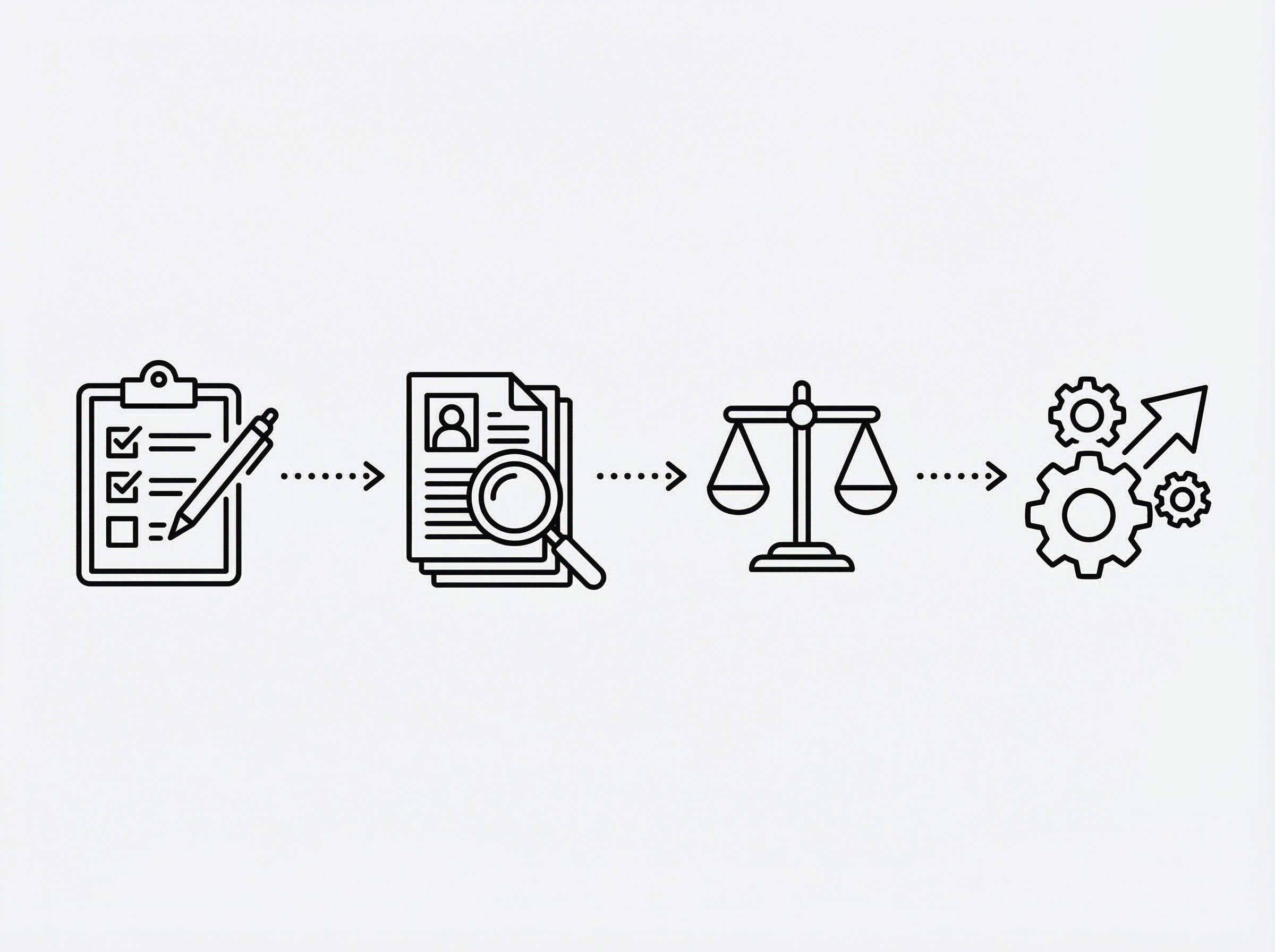
Common Pitfalls to Avoid
- The "General Comments" Dump: Avoid relying solely on a large text box at the end. This invites bias. Force interviewers to score specific sections first.
- Rating Inflation: Interviewers tend to rate everyone a "4" to be nice. Counter this by requiring written evidence for any score of 1 or 5.
- Over-Engineering: A 10-page form will be ignored. Keep it to 4-6 key competencies per interview stage.
The Breakthrough: Measuring the Difference
Six months after implementing the structured evaluation forms, Sarah’s team saw a measurable breakthrough.
Before and After Metrics
- Pass-through Rate: The percentage of candidates making it from onsite to offer increased from 20% to 45%. Why? Because unqualified candidates were filtered out earlier using the screening scorecard.
- Debrief Efficiency: Decision meetings dropped from 45 minutes to 15 minutes. The data was already there; the team only discussed discrepancies in the scores.
- Quality of Hire: Retention rates for new hires hit 95% for the first year, proving the new criteria actually predicted success.
Pros & Cons of Structured Evaluation
| Benefit | Tradeoff |
|---|---|
| Reduces Bias: Forces focus on job-relevant skills rather than personality or affinity. | Setup Time: Requires upfront effort to define competencies and write specific questions for every role. |
| Legal Defense: Provides a documented audit trail of why a candidate was selected or rejected. | Perceived Rigidity: Some hiring managers may feel "boxed in" and unable to follow interesting tangents during the interview. |
| Scalability: Allows different interviewers to step in and assess candidates using the same standard. | Training Required: Interviewers must be trained on how to use the scale to ensure calibration across the team. |
Career Relevance for Recruiters
Mastering the design and implementation of candidate evaluation forms is a strategic skill that separates operational coordinators from true Talent Partners.
Talking Points for Interviews
Q: "How have you improved quality of hire in your previous roles?"
"I moved the organization away from gut-feeling hiring by designing standardized candidate evaluation forms. I calibrated the hiring managers on a 5-point competency scale, which reduced our debrief times by 50% and increased our offer acceptance rate by aligning the team on what 'good' looks like before we even started interviewing."
Resume Boosters
- Designed and implemented competency-based evaluation templates for 20+ roles, reducing time-to-fill by 15%.
- Led interviewer calibration training, ensuring 100% adoption of structured scoring rubrics across the Engineering department.
- Reduced hiring bias by operationalizing structured interview scorecards, resulting in a 30% increase in diverse finalist representation.
Frequently Asked Questions
What is a candidate evaluation form template?
A candidate evaluation form template is a standardized document used by interviewers to rate a job applicant's qualifications. It lists specific skills, competencies, and behavioral traits required for the role, providing a rating scale (e.g., 1-5) and space for comments to ensure objective, consistent assessment.
Can structured evaluation forms backfire?
Yes, if they are too rigid or too long. If a form is overly complex, interviewers may "pencil whip" it (fill it out randomly just to be done). Also, if the criteria aren't relevant to the actual job, you might systematically screen out great talent based on the wrong metrics.
What are the key categories to include in an evaluation form?
Most effective forms include: Technical/Functional Skills (can they do the job?), Behavioral Competencies (how do they work?), Problem Solving (cognitive ability), and Values Alignment (culture add). Avoid generic categories like "Personality" or "Background."
How does AI impact candidate evaluation templates?
AI tools can now auto-generate evaluation criteria based on job descriptions and analyze interview transcripts to pre-fill scorecards. This augments human decision-making by flagging inconsistencies and ensuring every candidate is evaluated against the exact same rubric.
Conclusion
The transition from unstructured conversations to using a candidate evaluation form template is often the turning point for a recruiting function. It is the moment a company decides that hiring is not an art based on intuition, but a science based on evidence. By standardizing what you look for, you don't just hire faster; you hire fairly, consistently, and successfully.
If you want to operationalize these templates with structured workflows—from resume screening to AI interviews, scorecards, offers, and background checks—try tools like Foundire (https://foundire.com).