How Resume Matching Transforms Hiring Speed

In the high-stakes world of modern recruitment, speed is the currency of success. Yet, for thousands of hiring teams, the process is paralyzed by a single, overwhelming bottleneck: the resume queue.
Resume matching is the automated process of comparing a candidate's profile against a job description to score relevance, predict fit, and prioritize talent. It is not just about keyword counting; in 2025, it has evolved into a semantic engine that understands intent, context, and potential.
Why does this matter now? Because the "apply" button has become too easy to press. With the average corporate job opening attracting 250+ resumes—and only 4 to 6 of those candidates ever getting an interview—hiring managers are drowning in noise. Resume matching is the lifeline that pulls quality candidates out of the "resume black hole" and into the interview chair, reducing time-to-hire by up to 30%.
Imagine this: A recruiter logs in on Monday morning to find 400 new applicants for a Senior Product Manager role. Without resume matching, she spends three days manually scanning PDFs, inevitably missing the best candidate who applied on page 17. With resume matching, she logs in to find a prioritized shortlist of the top 15 matches, ready for engagement. This isn't just efficiency; it's a competitive advantage.
The Evolution of Resume Matching: From Keywords to Intent
Defining Resume Matching in Modern Recruitment
At its core, resume matching is the bridge between a static document (the resume) and a dynamic need (the job description). Early iterations of this technology were crude "keyword counters" that simply looked for exact text matches—if the job description said "project management" and the resume said "managed projects," the system might miss it.
Today’s AI-driven matching engines use semantic analysis. This means the system understands that "Python developer" and "Django engineer" are related concepts, or that a "Client Success Manager" has transferable skills for an "Account Executive" role. This shift from syntax to semantics allows companies to hire for potential and skill, rather than just job titles.
The High Cost of Manual Screening
Manual screening is the silent killer of hiring velocity. Industry data suggests that recruiters spend an average of 13 hours per week just sourcing and screening resumes for a single role. When you multiply this across multiple open positions, the inefficiency becomes staggering.
The cost isn't just financial; it's cultural. When recruiters are buried in administrative screening, they have less time for high-value activities like building relationships with candidates, selling the company vision, and closing offers. This "administrative burden" is a leading cause of recruiter burnout and high turnover within talent acquisition teams.

The Narrative Hook: The 'Resume Black Hole'
Let’s talk about the "Resume Black Hole"—the place where good candidates go to die. It happens when volume outpaces capacity. A qualified candidate applies for a role but doesn't hear back for four weeks because the hiring team is backlogged. By the time the recruiter finally reviews their resume, that candidate has already accepted an offer from a competitor who moved faster.
"In a market where top talent is off the market in 10 days, a 3-week screening process is a rejection letter in disguise."
Scenario: The Resume Matching Workflow in Action
Setting the Stage: The Overwhelmed Hiring Manager
Meet Sarah, a Talent Lead at a mid-sized fintech company. She’s hiring for a "Senior DevOps Engineer"—a notoriously hard-to-fill role. She posts the job on Monday. By Wednesday, she has 350 applications. Most are unqualified "spray and pray" applicants, but buried in that pile are 5 perfect fits.
The Old Way: Sarah spends her entire Thursday and Friday opening PDFs one by one. She gets tired. She skims. She inadvertently rejects a strong candidate because their resume formatting was slightly off. By the time she finds a good match on Tuesday, they’ve already scheduled a final round with a competitor.
The Workflow Transformation: Intake to Interview
Now, let's see how Sarah uses a modern workflow with resume matching enabled (using a tool like Foundire):
- Intake & Calibration: Sarah uploads the job description. The system analyzes the text to identify core skills (e.g., Kubernetes, AWS, CI/CD) and "nice-to-haves."
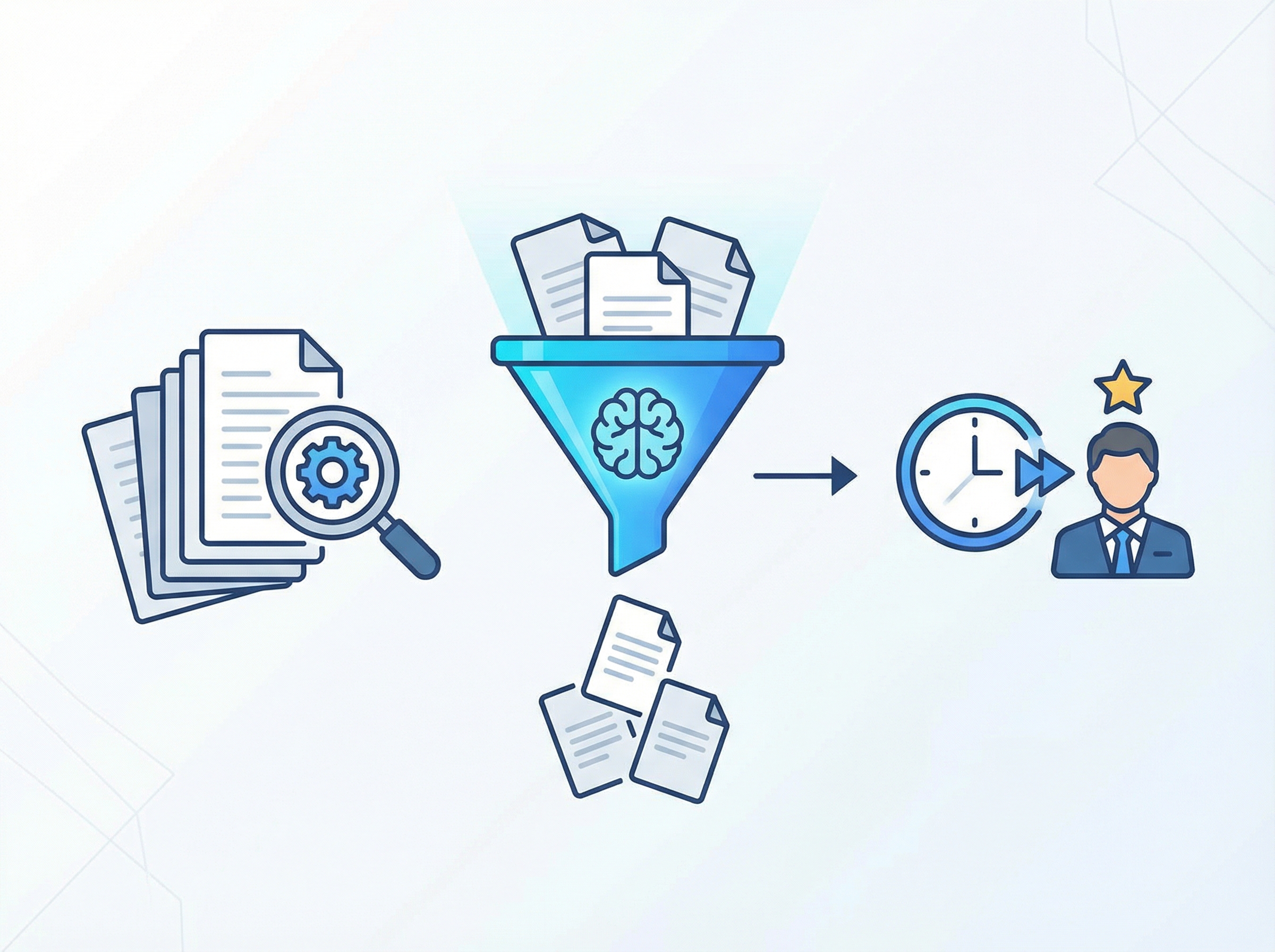
- Automated Screening: As resumes flood in, the matching engine instantly scores them from 0% to 100% based on relevance. It automatically filters out candidates who lack non-negotiable requirements (like visa status or specific certifications).
- The Shortlist: When Sarah logs in on Thursday, she doesn't see 350 unread emails. She sees a dashboard with the Top 10 Matches highlighted.
- AI Interview Invitation: Sarah clicks "Invite to Screen" on the top 5 matches. The system automatically sends them an invitation to an AI-led voice interview to verify their technical knowledge before she ever gets on a call.
Measuring Success: The 30% Efficiency Gain
The impact is measurable. In the manual scenario, Sarah spent 12 hours screening to find 3 qualified candidates. In the automated scenario, she spent 1 hour reviewing the pre-ranked shortlist to find 5 qualified candidates.
Result: Her time-to-interview dropped from 7 days to 24 hours. Her "pass-through rate" (candidates moving from screen to manager interview) increased because she was only spending time on pre-validated talent. This is the operational definition of hiring velocity.
Core Insights: Best Practices & Common Pitfalls
Moving Beyond Exact Keyword Matching
The most effective matching systems today focus on skills taxonomies rather than keywords. A "Boolean search" for "Java AND SQL" is fragile. A semantic match understands that a candidate with "Spring Boot" experience implies Java proficiency.
Heuristic: When configuring your matching software, prioritize skills over titles. Job titles vary wildly between companies (e.g., "Member of Technical Staff" vs. "Senior Developer"), but the underlying skills remain constant.
Calibrating the Algorithm
A matching algorithm is not "set it and forget it." It requires calibration. If you notice the system is scoring qualified candidates low, you need to adjust the weight of specific criteria.
Best Practice: Conduct a "False Negative Audit" once a month. Manually review 10 rejected resumes to see if any qualified candidates were wrongly filtered out. If so, adjust the matching parameters to capture them next time.
The 'False Negative' Trap
The biggest risk of automated matching is the False Negative—rejecting a great candidate because their resume didn't "look" right to the machine.
- Parsing Errors: Fancy resume designs with columns, graphics, or unusual fonts often break parsing engines.
- The "Veteran" Gap: Military veterans often have incredible leadership experience described in non-corporate language (e.g., "Squad Leader" vs. "Team Manager"). Standard algorithms frequently miss these transferable skills.
- Context Blindness: A resume might show a 6-month gap. A human sees "Sabbatical for childcare." An older algorithm just sees "Unemployed."
Solution: Always use matching scores as a guide, not a final verdict. Set a "human review" threshold for candidates who score just below the cutoff line (e.g., 60-70% match).
The Breakthrough: Impact on Career & Strategy
The Turning Point: When Data Aligns with Instinct
There comes a moment in every recruiter’s career when they stop fearing the robot and start directing it. The breakthrough happens when you realize that resume matching doesn't replace your intuition—it scales it.
Consider the story of a Talent Director at a rapidly scaling logistics firm. They were missing their hiring targets by 40% every quarter. The breakthrough wasn't hiring more recruiters; it was implementing a matching layer that auto-scored candidates from their existing database of 50,000 past applicants. Suddenly, they weren't starting from scratch for every role—they were "rediscovering" silver-medalist candidates from six months ago who were now perfect matches.
Recruiter Q&A: Leveraging Tech for Career Growth
Q: "How have you applied resume matching technology to improve your hiring outcomes?"
A: "I moved away from manual resume screening to a calibrated matching workflow. By standardizing our intake process and weighting core competencies over job titles, I reduced our time-to-fill by 20% and significantly improved our interview pass-through rate. This allowed me to shift my focus from administrative screening to strategic candidate closing."
Resume Bullets for Talent Professionals
If you are a recruiter or talent leader, mastering these tools is a resume-worthy skill itself. Here is how to frame it:
- "Implemented AI-driven resume matching workflow, reducing average screening time from 15 hours to 2 hours per requisition."
- "Calibrated ATS matching algorithms to reduce false negatives by 15%, resulting in a more diverse and qualified candidate pool."
- "Streamlined the sourcing-to-interview pipeline using automated scoring, increasing hiring velocity by 30% year-over-year."
Pros & Cons: Evaluating Automated Matching
| Benefit | Tradeoff |
|---|---|
| Speed & Scale: Instantly processes thousands of applications, identifying top talent in seconds rather than days. | Algorithmic Bias: If trained on biased historical data, the system may inadvertently replicate past prejudices (e.g., favoring certain universities). |
| Consistency: Applies the exact same criteria to every candidate, removing "mood-based" screening variance. | Context Blindness: Can struggle to interpret non-linear career paths, career gaps, or transferable skills from non-traditional backgrounds. |
| Rediscovery: Can surface "silver medalist" candidates from your existing database who applied to previous roles. | Keyword Gaming: Savvy candidates may "stuff" their resumes with hidden keywords to artificially inflate their match score. |
FAQ on Resume Matching
What is resume matching and how does it work in an ATS?
Resume matching is a feature in Applicant Tracking Systems (ATS) that parses a candidate's resume, extracts key data (skills, experience, education), and compares it against the job description. It generates a "match score" or percentage to help recruiters prioritize the most relevant applicants quickly.
Can resume matching backfire by rejecting good candidates?
Yes, this is called a "false negative." It typically happens when a candidate uses different terminology than the job description or has a resume format that the parser cannot read (like a complex PDF). Modern "semantic" matching tools significantly reduce this risk compared to older keyword-based systems.
How does semantic search differ from keyword matching?
Keyword matching looks for exact words (e.g., "coding"). Semantic search understands the meaning and intent behind the words (e.g., recognizing that "coding," "software engineering," and "programming" are related). Semantic search provides far more accurate matches by analyzing the context of a candidate's experience.
Why is structured data important for accurate resume matching?
Algorithms need structure to work effectively. If a resume is a messy block of text, the system struggles to categorize information (e.g., confusing a company name with a job title). Structured data ensures that skills, dates, and roles are correctly identified, leading to a fair and accurate match score.
Conclusion: The Future of High-Speed Hiring
Resume matching is not about replacing the human element of recruiting; it is about protecting it. By automating the high-volume, low-value task of initial screening, you liberate your team to do what they do best: assess culture fit, negotiate offers, and build teams.
In 2025, the recruiters who win will not be the ones who can read resumes the fastest, but the ones who can calibrate their systems to find the signal in the noise. Mastering this technology creates a durable hiring advantage that scales with your company.
If you want to operationalize this speed with a structured workflow—moving seamlessly from Sourcing to Resume Screening, into AI Interviews, and finally to Offers and Background Checks—consider trying tools like Foundire. It’s time to stop drowning in PDFs and start hiring with precision.
```