How Hiring Pipeline Automation Transforms Recruiting

Hiring pipeline automation is the strategic use of technology—such as AI interview platforms, applicant tracking systems (ATS), and scheduling tools—to streamline repetitive stages of the recruitment process. By automating tasks like resume screening, interview scheduling, and initial candidate assessments, organizations can significantly reduce time-to-hire while improving consistency and data quality. This operational shift allows recruiters to move away from administrative fatigue and focus on high-value human interactions, such as closing top talent and building relationships.
Imagine this: You have a critical role open and 500 applications sitting in your inbox. You know the perfect candidate is buried in that pile, but by the time you manually screen the resumes and play email tag to schedule interviews, that candidate has already accepted an offer from a competitor who moved faster. This is the "speed trap" of modern recruiting—and it is exactly what hiring pipeline automation solves.
The Real-World Scenario: From Chaos to Clarity
To understand the true impact of automation, let's look at a realistic scenario involving "Sarah," a Talent Acquisition Leader at a mid-sized tech firm. Her situation represents the common bottlenecks faced by recruiting teams today.
The Manual Workflow Bottleneck
Sarah is tasked with hiring five Enterprise Sales Managers in Q1. The role is high-volume and high-stakes. Her manual workflow looks like this:
- Intake: She posts the job and receives 800+ applications.
- Screening: She spends 15 hours a week manually reviewing PDFs, looking for specific keywords and experience.
- Scheduling: For the 50 candidates who pass screening, she sends individual emails to coordinate availability. This creates a "scheduling lag" of 4-7 days per candidate.
- Interviewing: Hiring managers conduct unstructured phone screens, often asking different questions to different candidates, leading to biased and incomparable feedback.
- The Result: The time-to-fill stretches to 65 days. Worse, her data shows a 25% candidate drop-off rate at the interview stage because high-quality talent is tired of waiting.
The Breakthrough: Implementing the Automated Solution
Sarah decides to overhaul her process using hiring workflow automation. She integrates an AI-driven layer into her existing ATS.
The New Automated Workflow:
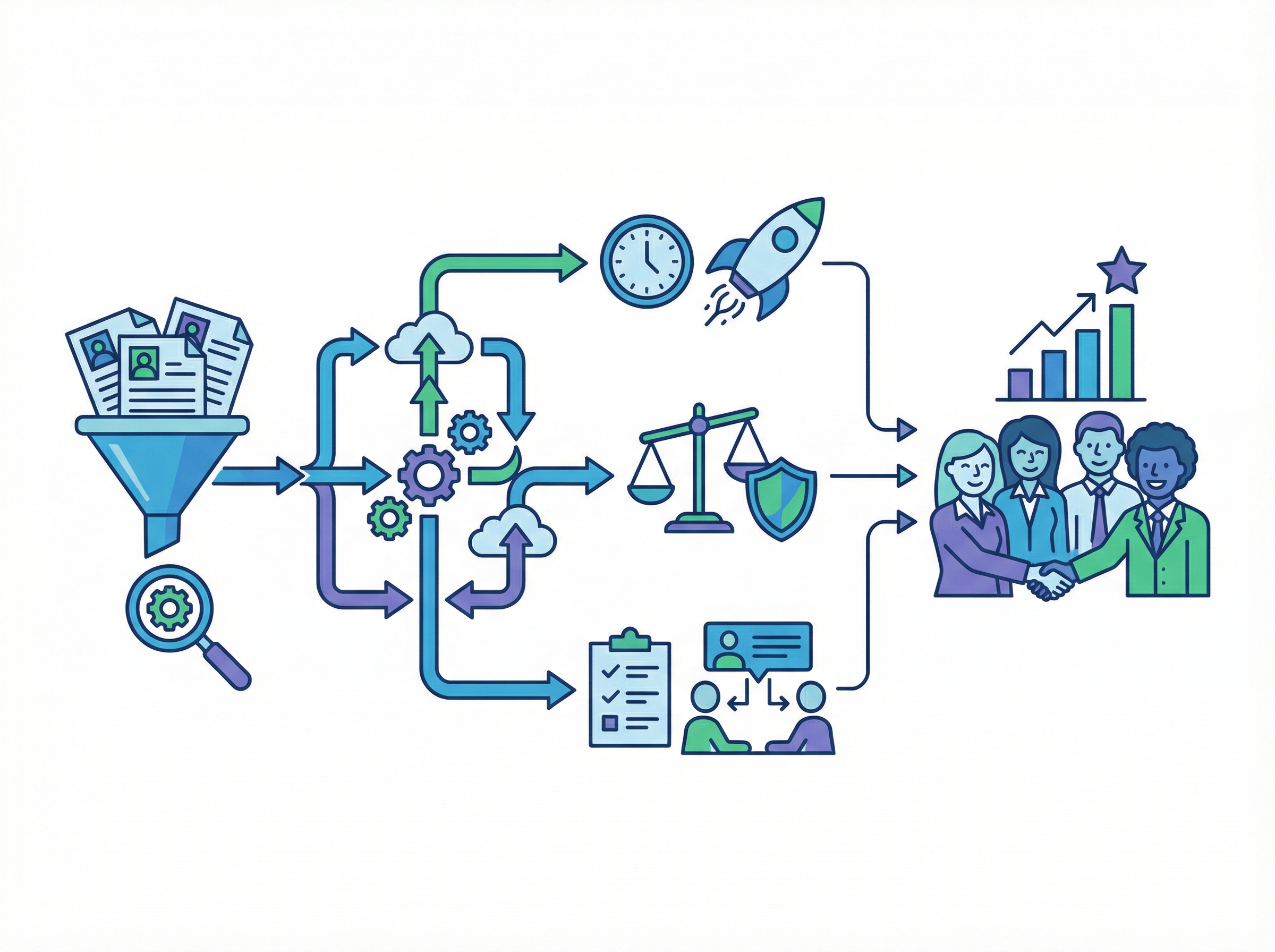
- Automated Screening: As applications arrive, the system automatically parses resumes, scoring them against "must-have" criteria. The top 20% are instantly invited to the next stage.
- AI Interview Platform: Qualified candidates receive an invite to a structured, on-demand text or video interview. They can complete this at 9 PM or 6 AM—whenever suits them.
- Self-Scheduling: Candidates who pass the AI assessment (based on calibrated scorecards) are sent a link to book time directly on the hiring manager's calendar.
- Data-Driven Decisions: The system aggregates interview scores and highlights discrepancies in interviewer feedback.
The Impact: Within one quarter, Sarah's metrics transformed. Her time-to-fill dropped from 65 days to 32 days. The "scheduling lag" disappeared effectively, and the candidate drop-off rate plummeted to under 10%. By automating the early-stage friction, she didn't replace the human element; she cleared the way for it to happen sooner.
Core Insights: Best Practices and Pitfalls
Implementing automation isn't just about buying software; it's about re-engineering your operational logic. Here are the heuristics that differentiate successful implementations from failed experiments.
5 Heuristics for Effective Automation
- Automate the "High-Friction, Low-Value" Zones: Focus automation on tasks that require zero emotional intelligence, such as calendar coordination, resume parsing, and initial FAQs. Keep humans firmly in control of negotiation and closing.
- Standardize Before You Automate: You cannot automate a mess. Ensure you have structured interviews and clear scorecards defined. If your hiring criteria are vague, your automation will simply scale your bias.
- Prioritize the Feedback Loop: Use automation to ensure candidates never fall into a "black hole." Configure your ATS to send personalized status updates at every stage transition (e.g., "Reviewing," "Interview Prep," "Decision Pending").
- Integrate Your Stack: Ensure your AI interview platform talks to your ATS bi-directionally. If a recruiter has to manually copy-paste scores from one tool to another, you haven't automated anything; you've just shifted the burden.
- Calibrate Your Scoring: Regularly audit the AI's grading against human judgment. If the AI screens out a candidate you would have hired, adjust the parameters. This "human-in-the-loop" calibration is essential for accuracy.
3 Common Misconceptions & Pitfalls
- The "Set It and Forget It" Trap: Automation requires maintenance. A common pitfall is failing to update email templates or interview questions, leading to candidates receiving outdated information or dead links.
- Over-Automating Communication: While transactional emails can be automated, high-touch moments—like rejection after a final round or the offer delivery—must remain personal. A robotic rejection letter after five interviews is a brand killer.
- Ignoring the Candidate Experience: If your automated process is clunky, mobile-unfriendly, or asks for duplicate data, you will see high abandonment rates. Test your own pipeline as a "mystery shopper" to find friction points.
Career Relevance: Positioning Yourself as an Expert
For recruiters and talent leaders, expertise in hiring pipeline automation is now a major career differentiator. Companies are no longer looking for people who can just "manage" requisitions; they need architects who can build efficient systems.
Talking About Automation in Interviews
Interviewer: "How have you applied automation to improve your recruiting outcomes?"
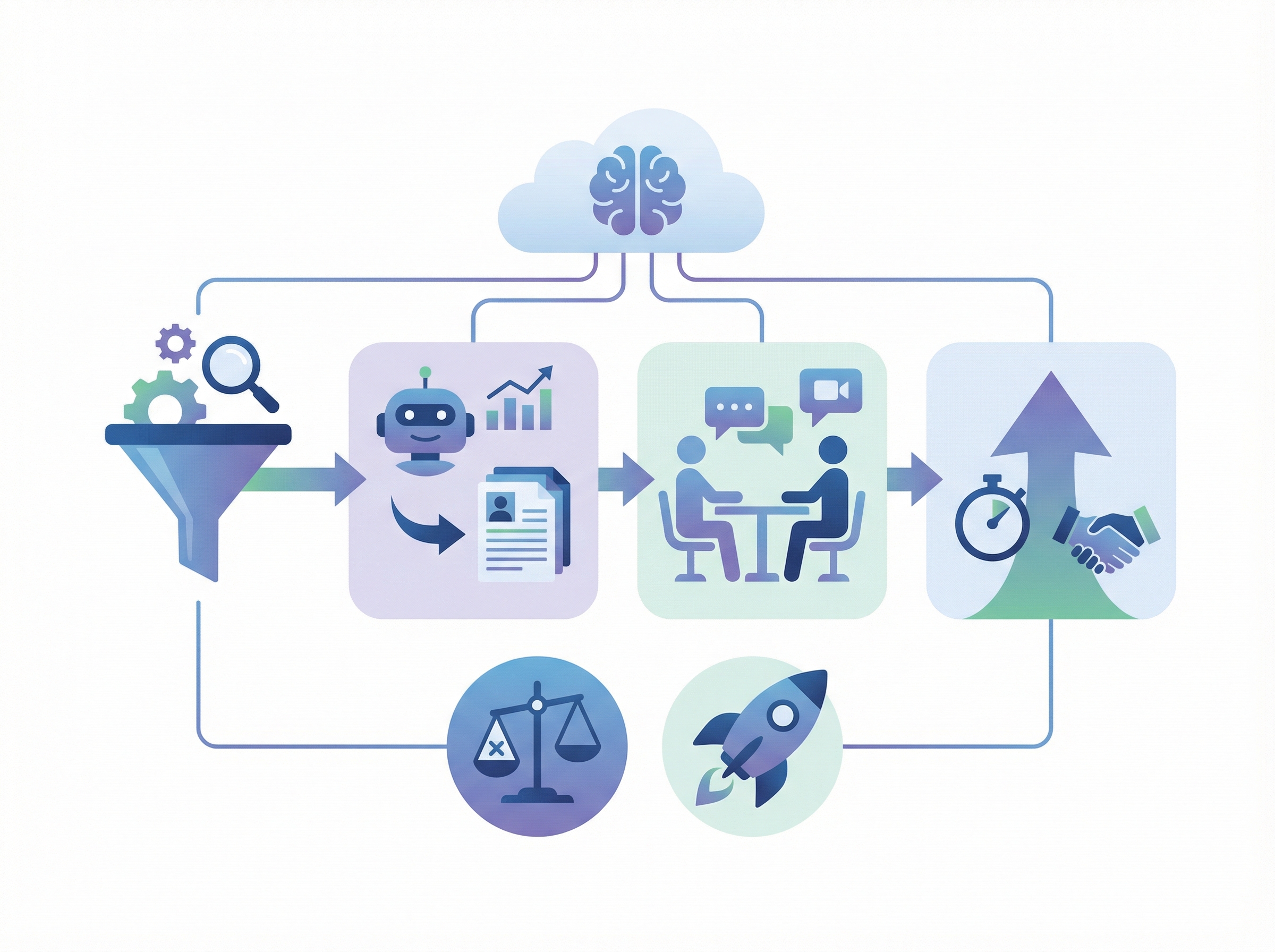
Ideal Answer: "I view automation as a lever for consistency and speed. In my last role, I implemented an automated scheduling and screening workflow that reduced our administrative load by 40%. This allowed us to institute 'calibration sessions' with hiring managers, where we reviewed structured interview data instead of gut feelings. As a result, we improved our pass-through rate from onsite-to-offer by 15% because we were only spending human time on the most qualified candidates."
Resume Boosters
If you have experience with these tools, quantify your impact using bullets like these:
- "Architected a hiring pipeline automation workflow that reduced average time-to-hire by 35% across engineering roles."
- "Implemented an AI-driven resume screening tool to process 2,000+ monthly applicants, saving 20 recruiter hours per week."
- "Standardized interview scorecards within the ATS, resulting in a 90% reduction in ambiguous feedback and improved hiring decision alignment."
Pros & Cons of Hiring Automation
| Benefit | Tradeoff |
|---|---|
| Speed & Scalability: Drastically reduces time-to-fill and allows lean teams to handle high applicant volumes without burnout. | Setup Complexity: Requires significant upfront time to map workflows, integrate APIs, and configure logic rules properly. |
| Data Consistency: Structured data inputs (scorecards) reduce unconscious bias and allow for objective comparison of candidates. | Risk of "False Negatives": Aggressive filtering parameters may screen out non-traditional candidates who could be high performers. |
| Candidate Experience: frequent updates and instant scheduling prevent "ghosting" and keep candidates engaged. | Loss of Personal Touch: If not balanced correctly, the process can feel cold and robotic, potentially alienating senior talent. |
Frequently Asked Questions
What is hiring pipeline automation?
Hiring pipeline automation is the use of software and AI to execute repetitive recruitment tasks without human intervention. This includes sourcing candidates, screening resumes, scheduling interviews, and sending follow-up communications. The goal is to increase efficiency and consistency while freeing up recruiters to focus on candidate relationships.
Can hiring pipeline automation backfire?
Yes, if implemented poorly. Over-reliance on keywords can filter out qualified candidates with non-traditional backgrounds (false negatives). Additionally, if the automation feels too impersonal—like receiving a generic rejection one minute after applying—it can damage the employer brand. It must be monitored and calibrated regularly.
How does automation impact diversity?
When combined with structured interviews and masked resume screening, automation can actually reduce unconscious bias. By focusing on data points and standardized scoring rather than "gut feeling" or demographic proxies, automation can help surface a more diverse slate of qualified candidates.
Conclusion: The Durable Advantage
Hiring pipeline automation is no longer just a "nice-to-have" for tech-forward companies; it is a fundamental requirement for any organization that wants to compete for talent in a fast-paced market. The future of recruiting belongs to those who can blend the efficiency of machines with the empathy of humans. By removing the administrative burden, you don't just fill roles faster—you create a fairer, more transparent, and more respectful experience for every candidate.
If you are ready to operationalize your strategy with structured workflows—from sourcing and resume screening to AI interviews, scorecards, and offers—consider exploring comprehensive platforms like Foundire (https://foundire.com) to build a seamless, data-driven hiring engine.