How Hiring Decision Support Stops Bad Hires

How Hiring Decision Support Stops Bad Hires
The End of the Guesswork Hire
Hiring decision support is the strategic intersection of data, AI-driven tools, and structured processes designed to validate candidate fit before an offer is made. It moves recruitment away from subjective "gut feelings" toward evidence-based outcomes. For talent leaders and hiring managers searching for this concept, the goal is almost always the same: reduce the risk of a bad hire and speed up internal consensus.
In the high-stakes environment of 2026, where the cost of a replacement hire can exceed 200% of an employee's annual salary, relying on intuition is no longer a quirk—it is a liability. Hiring decision support systems do not replace the human element; they arm the human decision-maker with objective baselines, comparative scoring, and behavioral insights that might otherwise be missed in a standard 30-minute conversation.
The High Cost of "Gut Feeling"
Consider this all-too-common story: Mark, a VP of Sales, needs to hire a regional director quickly. He interviews a candidate named Jason. Jason is charismatic, shares Mark’s love for college football, and "vibes" well during the interview. Mark ignores the inconsistent technical scores from the peer interview panel because he "trusts his gut."
Three months later, Jason is fired. He was excellent at building rapport but incapable of managing the CRM data or executing the actual sales strategy. The cost? Three months of lost revenue, a severance package, and a demoralized team. This is the "Gut Feeling Tax." Hiring decision support exists specifically to eliminate this tax by ensuring that personality never masks competence.
Scenario: The Stalled Funnel at CorpTech
To understand how decision support transforms operations, we must look at a typical breakdown in a growing organization. Let’s look at "CorpTech," a mid-sized software firm, and Sarah, their Head of Talent Acquisition.
The Workflow Bottleneck
Sarah was drowning in administrative chaos. Her recruiters were sending 15 resumes a week to hiring managers. The workflow seemed standard on paper:
- Intake: Manager describes the role.
- Screening: Recruiter chats with candidates.
- Interview: Panel meets the candidate.
- Decision: The team votes.
However, the "Decision" phase was a black box. Hiring managers would delay feedback for days, eventually replying with vague Slack messages like, "Not a fit," or "I liked her energy." There was no standardized data. Without a decision support framework, Sarah couldn't push back. She couldn't say, "You rejected her for 'energy,' but she scored 5/5 on the technical assessment you requested."
The Calibration Crisis
The impact on the funnel was catastrophic. CorpTech’s time-to-fill ballooned to 65 days. Worse, their candidate drop-off rate spiked because high-quality talent wasn't willing to wait two weeks for a decision. The problem wasn't a lack of candidates; it was a paralysis of analysis. The hiring managers didn't have a framework to make confident decisions, so they defaulted to hesitation. Sarah realized she didn't need more resumes; she needed a mechanism to support the decision-making process itself.
3 Pillars of Effective Decision Support
To fix a broken funnel, organizations must implement a system that standardizes how hiring decisions are made. This involves three core heuristics.
1. Standardizing the Signal with Scorecards
The first step in decision support is establishing what "good" looks like before the first interview occurs. This is achieved through structured interview scorecards. Instead of asking generic questions like "Tell me about yourself," interviewers must rate candidates on specific competencies (e.g., "Strategic Thinking," "Python Proficiency," "Client De-escalation") on a scale of 1 to 4.
"If you cannot score it, you cannot measure it. And if you cannot measure it, you are guessing."
By forcing interviewers to submit a scorecard before they discuss the candidate with the group, you eliminate "groupthink," where everyone simply agrees with the most senior person in the room.
2. Leveraging AI and Automation
Modern decision support relies heavily on technology to process data that humans process too slowly. This is where AI interview platforms and hiring workflow automation come into play. Tools like Foundire provide a layer of objective screening before a human ever schedules a Zoom call.
For example, an AI-driven system can:
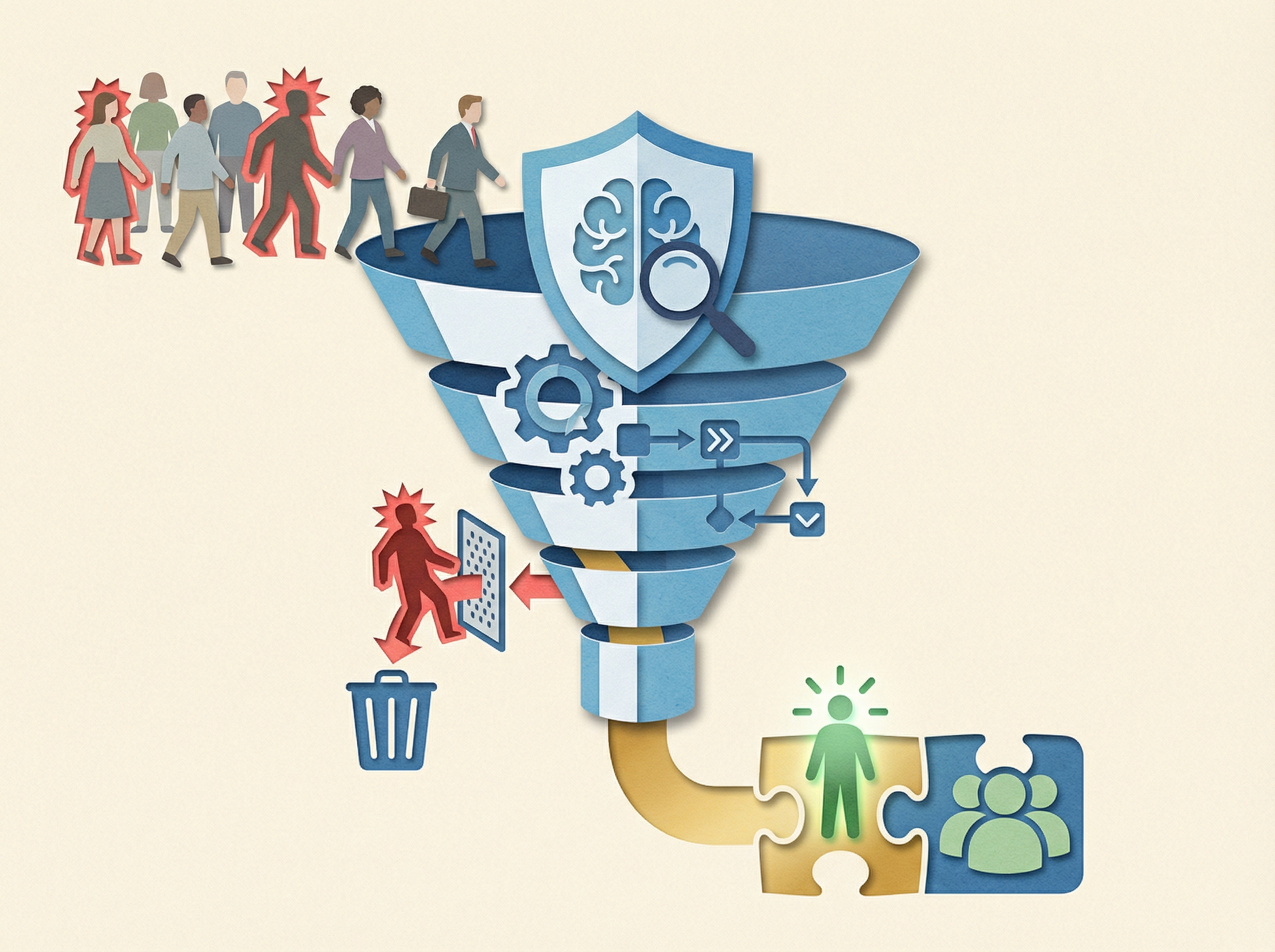
- Analyze resume keywords against actual job performance data, not just job descriptions.
- Conduct asynchronous initial interviews where candidates answer core technical questions.
- Transcribe and score responses based on sentiment, keyword usage, and problem-solving logic.
This provides the hiring manager with a "Decision Dossier"—a digest of evidence—rather than just a raw resume. It supports the decision by highlighting why a candidate is a match.
3. Avoiding Analysis Paralysis
A common pitfall when implementing decision support is over-engineering the process. If a hiring manager has to review 15 different data points and read a 10-page AI report for every junior hire, the process will grind to a halt.
The "One-Page" Heuristic: Effective decision support should culminate in a one-page summary. If the data doesn't fit on one screen (Scorecard Average + AI Assessment Summary + Background Check Flag), the system is too complex. The goal is to speed up the "Yes/No," not to create a dissertation on every applicant.
The Breakthrough: Data-Driven Clarity
Back at CorpTech, Sarah rolled out a new decision support framework. She implemented a strict "No Scorecard, No Offer" policy and integrated an AI screening tool to handle technical vetting.
The Turning Point
The breakthrough happened during a debrief for a Senior Product Manager role. The hiring manager, David, was ready to pass on a candidate named Elena because she seemed "reserved" during the Zoom call.
Sarah pulled up the decision support dashboard. "David," she said, "I understand the vibe check, but look at the data. Elena scored in the top 5% on the asynchronous case study. Her coding assessment is perfect. And three of her peer interviewers rated her 'Collaboration' skills as a 4/4 based on her past project examples. Are we rejecting a top performer because she is introverted?"
Measuring the Impact
David paused, reviewed the evidence, and agreed to move forward. Elena was hired and became the top PM within six months.
Across the organization, the metrics shifted dramatically:
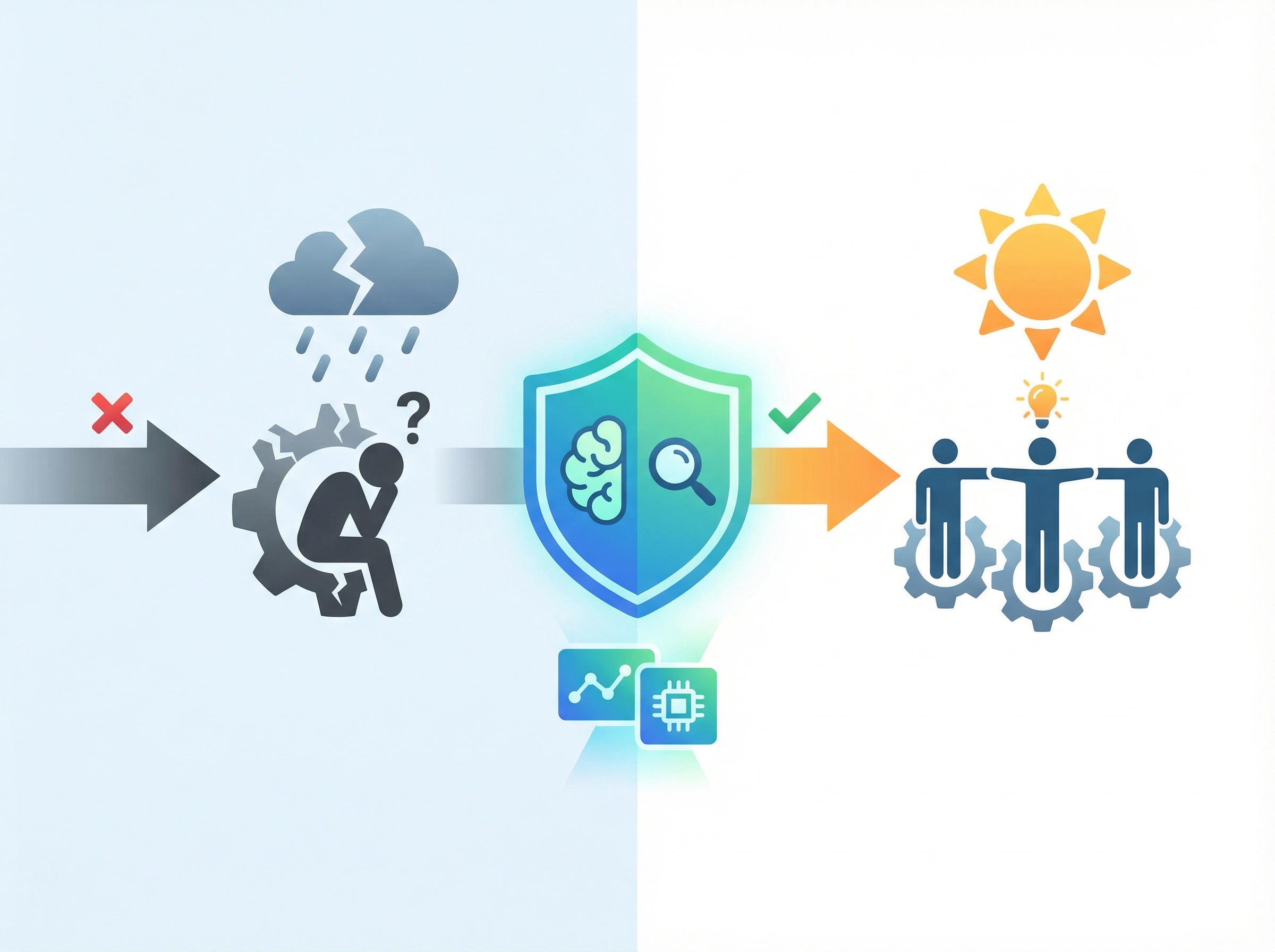
- Time-to-fill dropped by 40% (from 65 days to 39 days).
- Offer acceptance rate rose to 95% because the team could make offers days faster than competitors.
- New hire retention at the 12-month mark improved by 22%, proving that data-backed decisions led to better long-term fits.
Elevating Your Recruiter Profile
For recruiters and talent acquisition leaders, mastering hiring decision support is a career accelerator. It transitions you from an "order taker" (who just schedules meetings) to a "talent advisor" (who guides strategy).
Talking the Talk in Interviews
If you are interviewing for a Head of Talent or Senior Recruiter role, you will likely be asked how you ensure quality of hire. Here is how to answer using decision support concepts:
Q: "How do you handle hiring managers who ignore the process?"
A: "I shift the conversation from compliance to calibration. I use hiring decision support tools to present them with a gap analysis—showing them the difference between their 'gut' hires and the performance data of structured hires. By implementing calibrated scorecards and AI-assisted screening, I’ve found we can reduce bias and give managers the confidence to say 'yes' faster. In my last role, this approach reduced our interview-to-offer ratio from 6:1 to 3:1."
Resume Boosters
Add these bullets to your resume to signal your expertise in decision support:
- Designed and implemented a Hiring Decision Support framework, utilizing structured scorecards and AI assessments to reduce bias in the funnel.
- Improved 'Quality of Hire' metrics by 18% through the calibration of interviewer feedback and standardized decision matrices.
- Operationalized hiring workflows using Foundire to automate initial screening, saving 15+ hours of recruiter time per requisition.
Pros & Cons: The Balance Sheet
Is a heavy reliance on decision support right for every role? Here is the breakdown.
| Benefit (The Upside) | Tradeoff (The Downside) |
|---|---|
| Consistency & Legal Defense: Standardized data provides a clear audit trail. If a candidate claims bias, you have objective scores proving why another candidate was selected. | Setup Friction: Implementing scorecards and configuring AI tools requires upfront time. Hiring managers may initially resist the "extra homework" of filling out detailed feedback. |
| Speed to Consensus: When data is visualized, teams align faster. Arguments about "vibes" disappear when technical competency scores are visible. | False Negatives: A rigid reliance on data might screen out "wildcard" candidates—geniuses who don't interview well or have non-traditional backgrounds that algorithms might undervalue. |
| Reduced Bias: Decision support tools focus on skills and verifiable experience, stripping away unconscious biases related to age, gender, or pedigree. | Over-Reliance: There is a risk that managers stop listening during interviews and just rely on the AI score, missing crucial behavioral red flags that data didn't capture. |
Frequently Asked Questions
What is hiring decision support?
Hiring decision support refers to the systems, data, and tools used to assist recruiters and managers in making objective selection choices. It combines structured interview data, psychometric assessments, and AI-driven insights to validate whether a candidate is a true fit for the role, reducing reliance on intuition.
Can decision support tools backfire?
Yes, if the data input is flawed. If an organization uses biased historical data to train its decision support algorithms, it will replicate those biases. Additionally, if the process becomes too rigid, it can create a poor candidate experience where applicants feel they are being judged solely by robots rather than humans.
How does AI fit into hiring decisions?
AI acts as a force multiplier for data collection. It can screen thousands of resumes instantly, conduct preliminary chatbot interviews, and summarize interviewer notes. However, AI should serve as a recommendation engine—a "copilot"—rather than the final decision-maker. The human should always have the final vote on the offer.
Conclusion: Building a Durable Advantage
The era of the "Rockstar Recruiter" who can spot talent from a mile away by magic is ending. The future belongs to the "Architect Recruiter"—the professional who builds systems that make excellent hiring inevitable. Hiring decision support is not about removing the human element; it is about protecting the human decision-maker from their own blind spots.
By implementing structured data, leveraging automation, and forcing calibration, you build a hiring engine that is consistent, fair, and fast. The companies that win in 2026 will be the ones that treat hiring not as an art, but as a high-precision operation.
If you want to operationalize hiring decision support with structured workflows—from sourcing and resume screening to AI interviews and background checks—consider exploring platforms like Foundire (https://foundire.com) to bring data-driven clarity to your talent acquisition process.