How Data-Driven Hiring Decision Support Transforms Recruitment

How Data-Driven Hiring Decision Support Transforms Recruitment
Introduction: What is Hiring Decision Support?
Hiring decision support is the systematic application of data, structured interview frameworks, and scoring rubrics to evaluate candidates objectively. Unlike traditional recruitment methods that often rely on intuition, decision support systems aggregate evidence—from resume screening to interview performance—to help hiring teams make consistent, bias-free choices that predict on-the-job success.
In 2026, the cost of "going with your gut" has never been higher. According to recent industry reports, a single bad hire can cost a company between $17,000 and $50,000 in lost productivity and replacement expenses. For leadership roles, that figure can skyrocket to five times the annual salary. Yet, many teams still rely on unstructured chats and vague feedback like "good culture fit" to make these critical financial decisions.
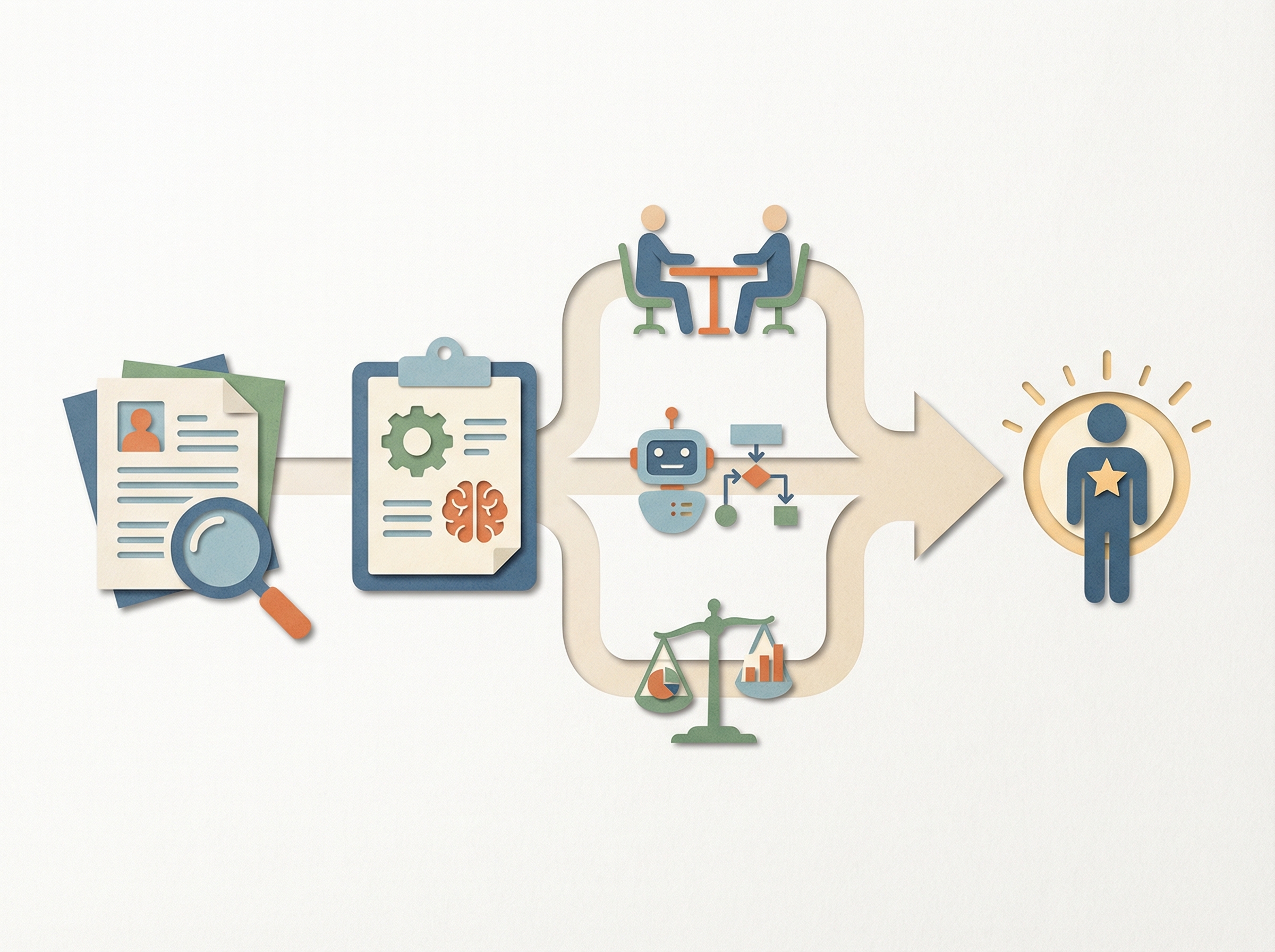
Hiring decision support isn't about replacing human judgment; it's about arming that judgment with better evidence. By operationalizing the way you assess talent, you improve three critical outcomes: speed, consistency, and quality of hire.
The Story of "The Guesswork Gap"
Imagine a typical Monday for Sarah, a VP of Engineering at a mid-sized tech firm. She desperately needs a Senior DevOps Engineer. After weeks of sourcing, she has three finalists.
Candidate A was charismatic and hit it off with the team over coffee. Candidate B had the best technical test but seemed "too quiet" during the panel interview. Candidate C was a solid all-rounder but didn't stand out in any extreme way.
When Sarah gathers her interview panel for a debrief, chaos ensues. One interviewer loved Candidate A’s energy; another thought they lacked substance. No one asked the same questions. No one used a scorecard. Sarah is left staring at a whiteboard of conflicting opinions, forced to make a six-figure decision based on vibes rather than verified skills. This is the "Guesswork Gap," and it’s where great candidates—and company budgets—go to die.
The Scenario: When Hiring Goes Dark
The Chaos of Unstructured Feedback
In Sarah’s scenario, the problem wasn't a lack of talent; it was a lack of structured data. Without a hiring decision support system, her team fell into the trap of the "unstructured interview," which research shows has a predictive validity of only ~14%—barely better than a coin flip.
Because every interviewer asked different questions, Sarah couldn't compare apples to apples.
- Interviewer 1 assessed "Cultural Fit" (subjective).
- Interviewer 2 assessed "Python scripting" (objective but narrow).
- Interviewer 3 just "chatted" about previous employers.
This misalignment creates a "black box" where bias thrives. The charismatic candidate often wins over the competent one simply because of the Halo Effect, where one positive trait (like confidence) overshadows major skill gaps.
The Bottleneck at the Decision Stage
The operational cost of this chaos is measurable. In Sarah’s case, the debate dragged on for two weeks. By the time she decided to make an offer to Candidate A (the charismatic one), they had already accepted another role.
The team had to restart the process. The metrics for this failure are stark:

- Time-to-Fill: Increased from 45 days to 85 days.
- Cost per Hire: doubled due to wasted interviewer hours.
- Team Morale: plummeted as the engineering team remained understaffed.
This specific pain point—the inability to make a confident decision quickly—is exactly what hiring decision support solves.
Core Pillars of Effective Decision Support
To move from chaos to clarity, successful talent teams implement three core pillars. These turn recruitment into a repeatable business process rather than a random event.
1. Standardization & Calibration
The foundation of decision support is the structured interview. This means every candidate for a specific role is asked the same core questions in the same order.
Heuristic: Create a "Scorecard" for every role before you open the job requisition. Define 4-6 core competencies (e.g., "System Architecture," "Conflict Resolution," "Python Proficiency") and write down exactly what a "Good," "Average," and "Poor" answer looks like. This forces interviewers to calibrate their expectations.
"Calibration meetings shouldn't happen after the interviews are done. They should happen before the first resume is even screened."
2. Leveraging AI & Automation
Modern hiring workflows utilize AI not to choose the candidate, but to surface the data needed for the human to choose. Tools in 2026 have moved beyond simple keyword matching.
- Automated Screening: Platforms can now rank candidates based on verifiable skills rather than resume keywords, ensuring high-potential talent isn't ignored.
- Interview Intelligence: AI note-takers record and transcribe interviews, flagging key moments where a candidate demonstrated a specific competency. This removes the burden of note-taking and allows the recruiter to focus on engagement.
- Workflow Automation: Systems like Foundire help operationalize this by connecting sourcing, resume screening, and background checks into a single data stream, ensuring no information is lost between stages.
3. Avoiding Common Pitfalls
While data is powerful, it can be misused. A common misconception is that decision support systems make the process "robotic." In reality, they free up mental energy for the human connection.
Common Pitfalls:
- Over-engineering scorecards: Asking interviewers to rate 20 different traits. Stick to 3-5 per session.
- Ignoring the "False Negative": Being so rigid on criteria that you reject a non-traditional candidate who could have excelled.
- Data Silos: Leaving interview feedback in email threads instead of a centralized ATS (Applicant Tracking System), making it impossible to audit past decisions.
The Breakthrough: Turning Data into Decisions
The 'Aha' Moment
Let’s return to Sarah. After losing her top candidate, she worked with a Talent Operations leader to implement a decision support framework.
For the next round, she didn't just forward resumes. She assigned specific competencies to each interviewer.
- Interviewer A was assigned "System Design" (Technical).
- Interviewer B was assigned "Cross-team Collaboration" (Behavioral).
- Interviewer C was assigned "Incident Response" (Situational).
They used a 1-4 scoring scale with clear rubrics. When the debrief happened, there was no debate about "vibes." They pulled up the dashboard. One candidate, who was quieter and less "charismatic," had scored a perfect 4 on System Design and Incident Response.
Measuring the Impact
Sarah hired the high-scoring, quieter candidate. The results were immediate and measurable:
- Decision Time: Reduced from 2 weeks to 48 hours.
- Performance: The new hire fixed a critical infrastructure bug in their first month—a skill specifically tested for in the "Incident Response" module.
- Fairness: The process was defensible. Sarah could point to specific data points justifying why she hired Candidate C over Candidate B.
According to LinkedIn data, data-driven recruiting teams are 30% more likely to be viewed as strategic partners by their leadership. By moving from intuition to evidence, Sarah didn't just fill a seat; she built a system.
Career Advantage: Mastering Decision Support
Differentiation for Recruiters
For recruiters and talent acquisition leaders, mastering hiring decision support is a career accelerator. It shifts your role from "order taker" to "talent advisor." When you can show a hiring manager why their process is failing using conversion metrics and scorecard data, you become indispensable.
Interview Q&A Snippet:
Q: "How have you applied decision support to improve outcomes?"
A: "I transitioned our team from unstructured chats to structured scorecards. By standardizing our evaluation criteria and implementing a calibration step, we reduced our time-to-hire by 30% and improved our 90-day retention rate by 25%. We moved from subjective debates to data-backed hiring decisions."
Resume Bullets for Talent Professionals:
- Designed and implemented a hiring decision support framework that standardized evaluation criteria across 15 departments.
- Leveraged AI-driven screening tools to reduce manual resume review time by 40% while increasing candidate diversity.
- Improved offer acceptance rate from 65% to 85% by optimizing the decision-making velocity using structured interview data.
Pros & Cons Analysis
| Benefit | Tradeoff |
|---|---|
| Objectivity & Fairness: Drastically reduces unconscious bias by focusing on pre-defined criteria rather than personality or affinity. | Initial Setup Time: Requires significant upfront effort to write scorecards, train interviewers, and configure tools. |
| Speed & Efficiency: Eliminates circular debates during debriefs, allowing for faster offers and fewer missed candidates. | Perceived Rigidity: Hiring managers accustomed to "casual chats" may initially resist the structure as feeling too formal. |
| Legal Defensibility: Provides a clear paper trail of objective reasons for hiring (or rejecting) candidates. | Tool Cost: Implementing advanced decision support software requires budget approval and integration with existing ATS. |
Frequently Asked Questions
What constitutes a hiring decision support system?
A hiring decision support system is a combination of tools and processes that aggregate candidate data (resumes, assessments, interview scores) to help hiring managers make objective choices. It typically includes an Applicant Tracking System (ATS), structured interview scorecards, and often AI-driven screening or analytics tools.
Can relying on data backfire in recruitment?
Yes, if the data is flawed. If your interview questions are biased or your scorecards are poorly designed, you will just be reinforcing bad decisions with data ("garbage in, garbage out"). Human oversight is essential to interpret the data and ensure the "human element" (soft skills, potential) isn't ignored.
How do AI tools integrate with human decision-making?
AI tools act as a "co-pilot." They handle high-volume tasks like screening resumes and summarizing interview notes, presenting the human decision-maker with a digest of insights. This allows the human to focus on judgment and relationship-building rather than administrative data gathering.
What is the ROI of implementing structured hiring decision support?
The ROI is typically seen in reduced turnover costs and hiring velocity. Avoiding a single bad mid-level hire saves ~$30k-$50k. Furthermore, structured interviews predict performance 2x better than unstructured ones, leading to higher revenue per employee over time.
Conclusion
The days of hiring based on a "firm handshake" or a "gut feeling" are ending. As the complexity of roles increases and the cost of mistakes rises, hiring decision support has become the critical infrastructure for modern talent teams. It bridges the gap between the chaos of human bias and the clarity of objective data.
Mastering this approach creates a durable advantage. You build teams that are not just lucky hires, but statistically probable successes. Consistency scales; luck does not.
If you want to operationalize hiring decision support with structured workflows—spanning from sourcing and resume screening to scorecards and background checks—consider exploring comprehensive platforms like Foundire to unify your decision data.