AI Interviews vs Traditional Interviews: What Recruiters Need to Know in 2026
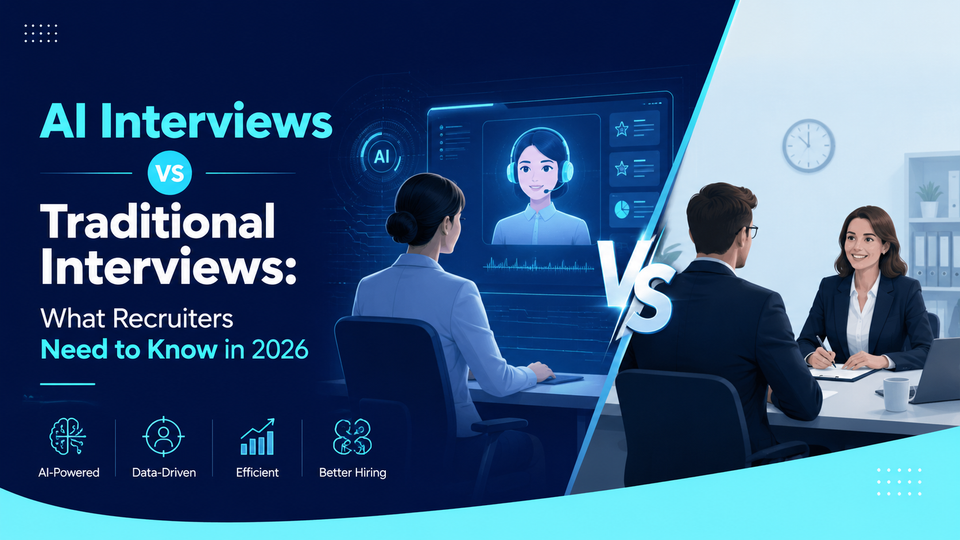
AI interviews use artificial intelligence to conduct, assist, or evaluate job interviews — while traditional interviews rely entirely on human interviewers. The core difference isn't just who asks the questions. It's consistency: AI interviews evaluate every candidate against the same criteria, while traditional interviews vary by interviewer mood, skill, and unconscious bias.
This guide compares AI interviews and traditional interviews across accuracy, speed, bias, candidate experience, and cost — and explains where each one still wins in 2026.
What is an AI interview?
An AI interview is a job interview conducted or supported by artificial intelligence. There are three main types in 2026:
- Autonomous AI interviews — The AI conducts the entire interview without a human present, asking adaptive questions and scoring responses. Foundire's AI Dialogue Interview is an example, running full first-round screens 24/7.
- AI interview copilots (video) — A human conducts the interview while an AI assists in real time, suggesting follow-up questions and capturing structured notes. Foundire's AI-Assisted Video Interview works this way on its platform.
- AI interview copilots (voice/cross-platform) — The same copilot capability, but layered over any meeting tool like Zoom, Google Meet, or Microsoft Teams. Foundire's AI-Assisted Voice Interview lets teams keep their existing setup.
Traditional interviews, by contrast, are conducted entirely by human interviewers — whether structured (same questions for every candidate) or unstructured (free-form conversation).
AI interviews vs traditional interviews: at a glance
| Factor | AI Interviews | Traditional Interviews |
|---|---|---|
| Consistency | Every candidate evaluated identically | Varies by interviewer |
| Speed | Available 24/7, instant scheduling | Limited by interviewer availability |
| Scalability | Hundreds of interviews in parallel | One at a time per interviewer |
| Bias | Reduced via standardized scoring | High in unstructured formats |
| Cost per interview | Low at scale | High (recruiter time) |
| Human rapport | Lower | Higher |
| Best for | First-round screening at scale | Final-round, culture, negotiation |
Accuracy: which predicts job performance better?
Here's what most people get wrong: the AI-vs-human debate is really a structured-vs-unstructured debate.
Decades of industrial-organizational psychology research show that structured interviews are roughly twice as predictive of job performance as unstructured ones. The landmark Schmidt and Hunter meta-analysis, synthesizing 85 years of selection research, found structured interviews score a validity coefficient of around 0.51 versus 0.38 for unstructured — and a 2022 meta-analysis by Sackett et al. put the gap even wider, at 0.42 versus 0.19.
The problem? Despite this evidence, around 44% of organizations still use unstructured interviews — essentially free-form conversations where each candidate gets a different "test."
This is where AI interviews have a structural advantage. By design, they ask consistent questions, apply the same scoring rubric to every candidate, and generate comparable data. AI interviews are inherently structured — which is exactly the format research says works best.
The takeaway: A well-designed AI interview will out-predict a typical unstructured human interview. But a well-designed structured human interview remains the gold standard for final-round evaluation.
Speed and scalability: AI wins decisively
This is the least controversial comparison. AI interviews run 24/7, require no scheduling coordination, and can conduct hundreds of first-round screens in parallel.
For high-volume hiring, the difference is dramatic. According to LinkedIn's Future of Recruiting report, recruiters using AI save roughly one full day per week. Organizations using AI-powered screening report 85% faster screening and significant reductions in time-to-hire.
Traditional interviews simply can't scale this way. Every interview consumes a recruiter or hiring manager's time — the most expensive and constrained resource in recruiting.
Bias: a nuanced picture
AI interviews reduce some biases and risk introducing others.
On the reduction side: structured AI interviews eliminate the interpersonal biases that plague unstructured human interviews — the halo effect, similarity bias, and snap judgments based on appearance or small talk. Research consistently shows unstructured interviews are significantly more susceptible to unconscious bias than structured ones.
On the risk side: AI trained on biased historical hiring data can replicate that bias at scale. This is why the EU AI Act classifies hiring AI as high-risk in 2026, requiring bias audits, transparency, and human oversight.
Best practice: Use AI interviews with structured rubrics, anonymized scoring where possible, and regular bias audits. Keep humans in the loop on final decisions. The goal isn't to remove humans — it's to remove the inconsistency that lets bias operate undetected.
Candidate experience: where traditional still leads
Traditional interviews win on human connection. A conversation with a real person builds rapport, lets candidates ask nuanced questions, and conveys company culture in ways AI can't fully replicate.
But the data is more nuanced than "humans good, AI bad." Candidates increasingly value speed and flexibility — and AI interviews deliver both. The ability to complete a first-round screen at 9 PM on a Sunday, without waiting two weeks for a recruiter's calendar to open, is a genuine experience improvement for many candidates.
The best 2026 hiring processes use AI interviews for early-stage convenience (fast, flexible, available anytime) and reserve human interviews for later stages where rapport, negotiation, and culture fit matter most.
Cost: AI scales without scaling headcount
Traditional interviews carry a hidden cost: recruiter and hiring manager time. A single role might consume dozens of hours across screening calls, panel interviews, and debriefs.
AI interviews shift that math. Once configured, an AI interview costs nearly nothing to run at scale — letting lean teams handle hiring volume that would otherwise require 5x the headcount. Foundire customers report 3x improvement in quality candidate recognition while cutting screening time dramatically.
For a deeper look at how this changes recruiting workflows, see our guide on AI hiring tools for smarter recruitment.
When to use AI interviews vs traditional interviews
The smartest recruiting teams in 2026 don't choose one or the other. They use both, strategically:
Use AI interviews for:
- First-round screening at scale
- High-volume or frontline roles
- Initial skills and qualification assessment
- Standardizing evaluation across many candidates
- 24/7 candidate convenience
Use traditional interviews for:
- Final-round evaluation
- Senior or executive roles
- Culture and team-fit assessment
- Salary negotiation and closing
- Complex, judgment-heavy decisions
Platforms like Foundire make this hybrid model seamless — AI handles autonomous first-round screening and generates structured scorecards, then human interviewers take over for final rounds with full context from the AI's evaluation.
FAQs about AI interviews vs traditional interviews
Are AI interviews better than traditional interviews?
For first-round screening at scale, AI interviews are faster, more consistent, and more scalable. For final-round evaluation, culture fit, and negotiation, traditional human interviews remain superior. The best processes combine both.
Do AI interviews reduce hiring bias?
AI interviews reduce interpersonal biases common in unstructured human interviews by applying consistent scoring. However, AI can inherit bias from training data, so bias audits and human oversight remain essential — and are required under the EU AI Act in 2026.
Are AI interviews accurate?
Well-designed AI interviews are inherently structured, and research shows structured interviews predict job performance roughly twice as well as unstructured ones. Accuracy depends on the quality of the scoring rubric and role-specific criteria.
Will AI interviews replace human interviewers?
No. AI interviews replace time-consuming first-round screening, not human judgment. Final decisions, culture assessment, and closing still require human interviewers. AI handles volume; humans handle nuance.
How do AI interviews work?
AI interviews use large language models and natural language processing to conduct structured conversations, ask adaptive follow-up questions, and generate scorecards with transcripts. Tools like Foundire offer autonomous, video copilot, and cross-platform voice copilot modes.
Are AI interviews legal?
Yes, with constraints. The EU AI Act classifies hiring AI as high-risk, and US states have specific laws (NYC Local Law 144, Illinois AI Video Interview Act). Reputable AI interview platforms maintain compliance and bias audit capabilities.
The bottom line
The AI interviews vs traditional interviews debate isn't really about replacing humans. It's about applying the right tool at the right stage. AI interviews bring consistency, speed, and scale to early-stage screening — solving the exact problems that make unstructured human interviews unreliable. Human interviews bring rapport, judgment, and connection to the stages where they matter most.
If you want to add structured, scalable AI interviews to your hiring process — across autonomous, video, and cross-platform voice modes — Foundire delivers all three in one platform, with a free plan to start today.