7 Post-Interview Write-Up Template Tips

7 Post-Interview Write-Up Template Tips
The Strategic Value of a Post-Interview Write-Up Template
Defining the Post-Interview Write-Up
A post-interview write-up template is a standardized framework used by hiring managers and recruiters to evaluate candidate performance objectively immediately following an interview. Instead of relying on vague memories or unpredictable gut feelings, this structured document forces interviewers to score specific competencies using predetermined criteria. Utilizing a post-interview write-up template matters because it fundamentally eliminates hiring bias, aligns decentralized talent acquisition teams, and replaces subjective feedback with actionable data. Ultimately, it significantly improves decision quality, accelerates hiring speed, and creates a much fairer candidate experience. By standardizing how feedback is captured and evaluated, companies can prevent costly pipeline delays, maintain engagement with top-tier talent, and confidently move the best candidates forward to the offer stage.
Consider the story of Sarah, a Senior Recruiter at a rapidly scaling enterprise tech firm. Just last year, she was constantly drowning in a chaotic feedback black hole. After carefully advancing highly specialized engineers through demanding rounds of technical interviews, she would regularly receive unhelpful, ambiguous messages from her hiring managers. Feedback would often consist of quick notes like, "I just didn't vibe with him," or "She seems okay, let's keep looking." Because this feedback was entirely unstructured and anecdotal, Sarah faced agonizing 14-day delays in finalizing any hiring decisions. The measurable problem became glaringly obvious to the entire executive team: a devastating 40% candidate drop-off rate. Highly sought-after talent was simply abandoning the process and accepting competing offers while her team deliberated in endless internal sync meetings. It was a massive cycle of wasted effort, resulting in exhausted recruiters and depleted sourcing budgets.
A Tale of Two Feedback Loops
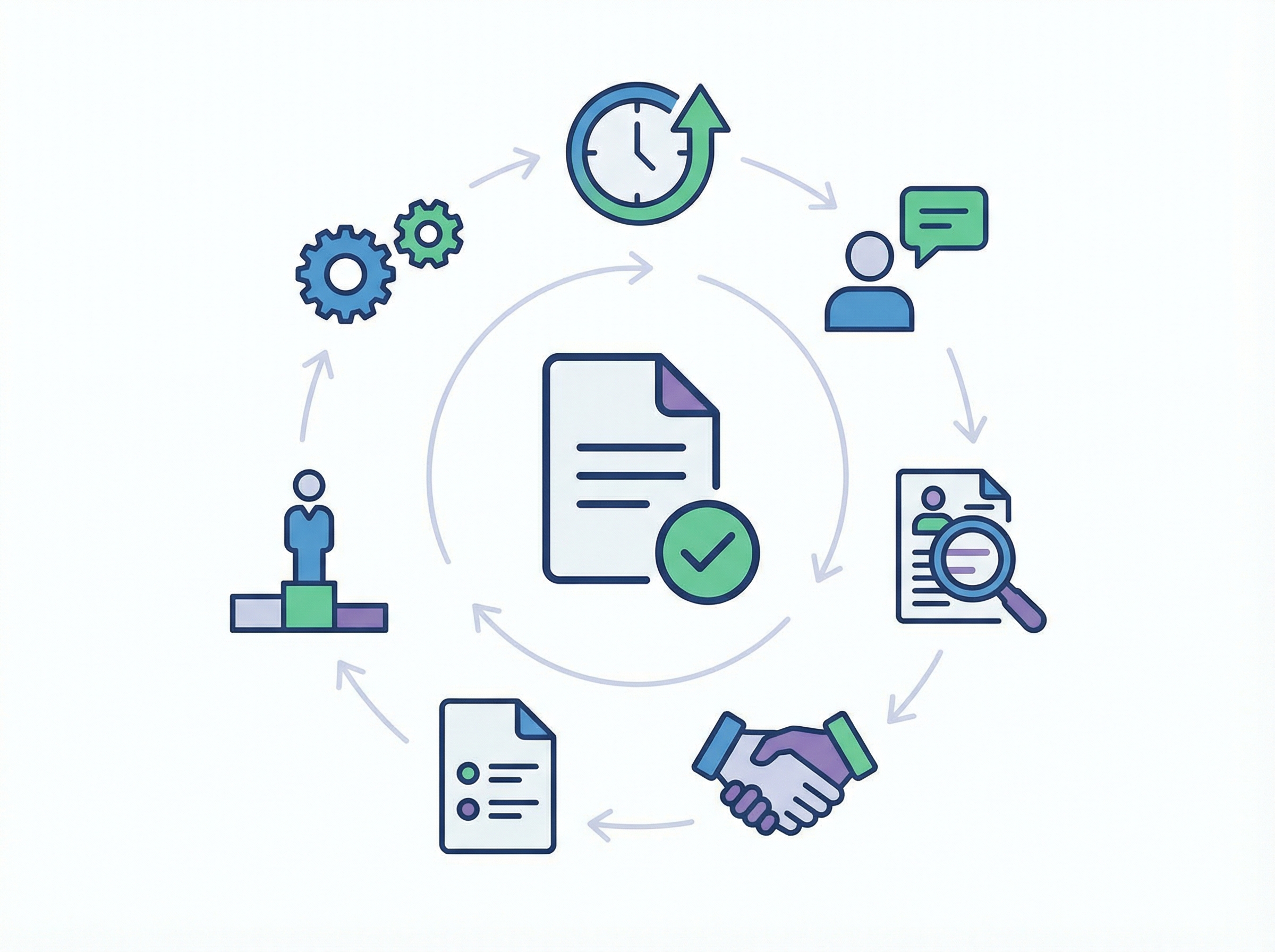
To fully understand the immense friction that Sarah experienced, we must examine the traditional, unstructured hiring workflow from end to end. In a typical talent acquisition scenario, the recruitment pipeline begins with an initial intake meeting, moves to resume screening, progresses to the actual interview, hits the internal decision phase, and finally ends with an offer and background checks. Without a structured evaluation method, this system almost entirely breaks down immediately following the interview.
Imagine the workflow for a critical Senior Product Manager role. Sarah successfully completes the strategic intake and launches her sourcing campaigns. She utilizes a modern AI interview platform for preliminary screenings to narrow down a massive applicant pool. Eventually, she pushes three stellar candidates to the final interview loop. They all complete their comprehensive panel interviews on a Tuesday afternoon. Under an unstructured, traditional feedback system, Sarah spends the next entire week chasing down four different busy interviewers. One responds on Friday with a vague thumbs-up emoji in an instant message. Another leaves a physical sticky note on her desk claiming the candidate "lacks presence." A third interviewer forgets the session entirely and requests a recording. As a result, the critical decision phase stalls completely.
According to recent 2026 data from industry hiring reports, the average time-to-hire has stretched to over 42 days, and a 25% drop-off rate at the interview stage is now the standard benchmark for inefficient teams. By the time Sarah pieces together the fragmented, subjective feedback to request approval for a formal offer, the best candidate has already signed a contract with a faster-moving competitor. The lack of structured interviews and properly documented feedback turned a robust talent pipeline into a leaking bucket, wasting countless hours of sourcing and screening.
Core Insights: Best Practices and the Breakthrough Moment
Actionable Heuristics
Transforming a broken recruitment system requires more than just launching a new digital form; it requires adopting an entirely new methodology. To effectively operationalize a post-interview write-up template, talent acquisition teams should rely on these proven heuristics to drive immediate results:
- Tie feedback directly to core competencies: Never leave blank text boxes that invite rambling or irrelevant commentary. Every single section of your interview scorecards must correspond to specific hard and soft skills defined during the initial intake meeting. For example, instead of asking "Is this person a good leader?", ask the interviewer to rate the candidate's "Conflict Resolution" and "Strategic Delegation" skills based on provided examples.
- Utilize a strict 1-4 rating scale: Avoid traditional odd-numbered scales like 1-5, which naturally allow hesitant interviewers to default to a safe, non-committal "3." Implementing a 1-4 scale forces the evaluator to lean either slightly positive (3 or 4) or slightly negative (1 or 2). This subtle psychological shift drives a definitive hiring decision rather than a passive observation.
- Integrate seamlessly with your ATS: Your post-interview write-up template should never exist as a loose document on a local desktop. It must be directly integrated into your core Applicant Tracking System (ATS) or your automated AI interview platform. This automated workflow ensures that critical feedback is instantly logged, date-stamped, and visible to the entire hiring committee without manual data entry.
- Demand behavioral evidence for every rating: Require interviewers to quickly justify their numerical ratings with concrete facts. If a candidate scores a perfect "4" in technical architecture, the interviewer must briefly note the specific project or behavioral example the candidate provided that justified that high mark.
Common Pitfalls
Even with the best intentions, implementing a new candidate evaluation process can face severe roadblocks if not managed correctly. Talent leaders must watch out for these three common pitfalls:
- Allowing "culture fit" as a valid write-up reason without definition: "Culture fit" is historically a Trojan horse for unconscious bias, allowing interviewers to reject candidates who simply do not share their personal background. If you include culture in the template, it must be broken down into specific, measurable company values rather than vague social preferences.
- Submitting feedback too late: Allowing your hiring managers to submit their write-up more than 24 hours post-interview severely degrades the quality of the data. Memory fades rapidly, leading to generic, unhelpful feedback. You must enforce a strict 24-hour Service Level Agreement (SLA) for all interview scorecards.
- Making the template too long to complete efficiently: If your evaluation form requires 30 minutes of administrative work to fill out, compliance across your hiring teams will plummet. Keep the document concise and highly targeted, aiming for a post-interview write-up template that takes no more than five to ten minutes to complete.
The Breakthrough Moment
For Sarah and her broader talent acquisition team, introducing a mandatory, streamlined evaluation template served as the ultimate breakthrough moment. By deliberately replacing subjective chat messages with structured interview scorecards, she completely transformed her organization's hiring workflow automation. When interviewers finished their scheduled sessions, they immediately received an automated ping from the ATS containing a targeted, five-question scorecard.
The operational impact was profound and almost immediate. Within a single fiscal quarter, Sarah’s time-to-fill dropped by a massive 6 days, easily outpacing industry benchmarks. Her critical candidate pass-through rates improved by 25%, drastically reducing the painful drop-offs that previously plagued her team. More importantly, decision alignment across executives became entirely objective. Instead of arguing over "vibes," hiring managers could look at a unified digital dashboard, clearly see that a candidate scored an average of 3.8 across all required core competencies, and immediately greenlight the offer and background checks phase. Subjectivity was replaced with operational certainty.
| Benefit | Tradeoff |
|---|---|
| Measurable alignment across hiring teams | Requires upfront training for hiring managers |
| Reduces bias and accelerates decisions | Can feel rigid if not customized per role |
How Mastering Write-Ups Elevates Your Recruiting Career
Standing Out as a Talent Leader
In the highly competitive world of global talent acquisition, mastering fundamental tools like the post-interview write-up template actively elevates your professional standing. The recruitment industry is rapidly shifting away from professionals who act merely as administrative order-takers or resume pushers. Today’s top-performing organizations demand strategic talent advisors who possess the capability to diagnose pipeline friction and engineer data-driven hiring solutions. By operationalizing structured scorecards and insisting on rigorously calibrated feedback loops, you position yourself as an operational leader who directly influences the company's bottom line. You transition from merely scheduling interviews to actively driving hiring quality, reducing costly post-onboarding mis-hires, and fiercely protecting the company's employer brand in the open market.
Q: "How have you applied a post-interview write-up template to improve outcomes?"
A: "I standardized our evaluation process by implementing a structured post-interview write-up template. This calibrated hiring manager feedback, streamlined our ATS workflow, and reduced time-to-decision by 30% while improving candidate quality."

Resume and Interview Examples
When updating your professional portfolio or actively preparing for a senior talent acquisition interview, you need to explicitly showcase how your operational rigor drives measurable business results. Using strong, action-oriented entity language related to background checks, candidate experience, and workflow management will properly flag your resume for modern ATS algorithms. Here are powerful, ready-to-use resume bullet examples demonstrating your direct impact:
- Standardized hiring manager feedback by designing a post-interview write-up template, reducing feedback collection time by 48 hrs.
- Calibrated structured interviews across 5 departments, increasing offer acceptance rates by 15%.
- Streamlined the hiring workflow automation, integrating interview scorecards directly into the ATS.
Frequently Asked Questions and Next Steps
Hiring Feedback FAQs
What is a post-interview write-up template?
A structured document or digital form used by interviewers to objectively score and summarize a candidate's competencies immediately following an interview. It fundamentally ensures that all candidates are evaluated against the exact same criteria, replacing subjective memory with highly quantifiable data.
Can a post-interview write-up template backfire?
Yes, if it is overly complex or redundant. Interviewers may experience significant fatigue and rush through the form, leading to low-quality data. It can also backfire if the specific competencies being measured are not directly aligned with the actual requirements of the role.
How does it integrate with AI interview platforms?
Modern AI tools can automatically pre-fill objective data based on interview transcripts, leaving human interviewers to evaluate nuance and soft skills. This seamless integration prevents redundant administrative data entry and dramatically speeds up the overall post-interview evaluation phase.
Operationalize Your Workflow
As the recruitment landscape becomes increasingly complex and top-tier candidate expectations continue to rise across all industries, relying on unstructured, "gut feeling" feedback is a guaranteed recipe for high drop-off rates and lost talent. Mastering the post-interview write-up template creates a durable, long-term hiring advantage by effectively replacing subjective guesses with swift, highly accurate, data-driven decisions. By enforcing standard evaluation practices, you protect your candidate experience and ensure the absolute best talent lands securely on your team.
If you want to operationalize a post-interview write-up template with structured workflows (Sourcing → resume screening → AI interviews → scorecards → offers → background checks), try tools like Foundire (https://foundire.com).