5 Steps to a Strong Structured Hiring Process

A structured hiring process is a standardized recruitment workflow where every candidate is evaluated against the same criteria, using the same questions, in the same order. Unlike "gut feeling" hiring, which relies on intuition, structured hiring uses data and consistent scoring to predict job performance. This approach is proven to reduce bias, improve quality of hire, and protect companies legally.
Imagine this: You have an open role. You interview five candidates. You ask the first one about their hobbies, the second about their biggest failure, and the third to solve a whiteboard problem. By the end, you aren't comparing apples to apples—you're comparing a hobbyist to a problem-solver. This is the "chaos" that leads to bad hires. Structured hiring fixes this by creating a uniform measuring stick for everyone.
Scenario: From Hiring Chaos to Clarity
Meet Alex, a Talent Acquisition Leader at a mid-sized tech firm. Last year, Alex’s team was drowning. Their "time-to-fill" was creeping up to 60 days, and worse, 25% of their new hires were leaving within the first six months. The hiring managers were frustrated, often rejecting candidates because "something just felt off" or "they didn't pass the beer test."
The Problem: Evaluation Inconsistency
Alex realized the root cause wasn't the candidate pool; it was the filter. In one instance, a brilliant engineer was rejected because she was nervous during a casual chat, while a less qualified candidate was hired because he and the manager both loved mountain biking. This lack of standardized screening meant the company was making decisions based on affinity, not ability.
The Fix: Implementing the Workflow
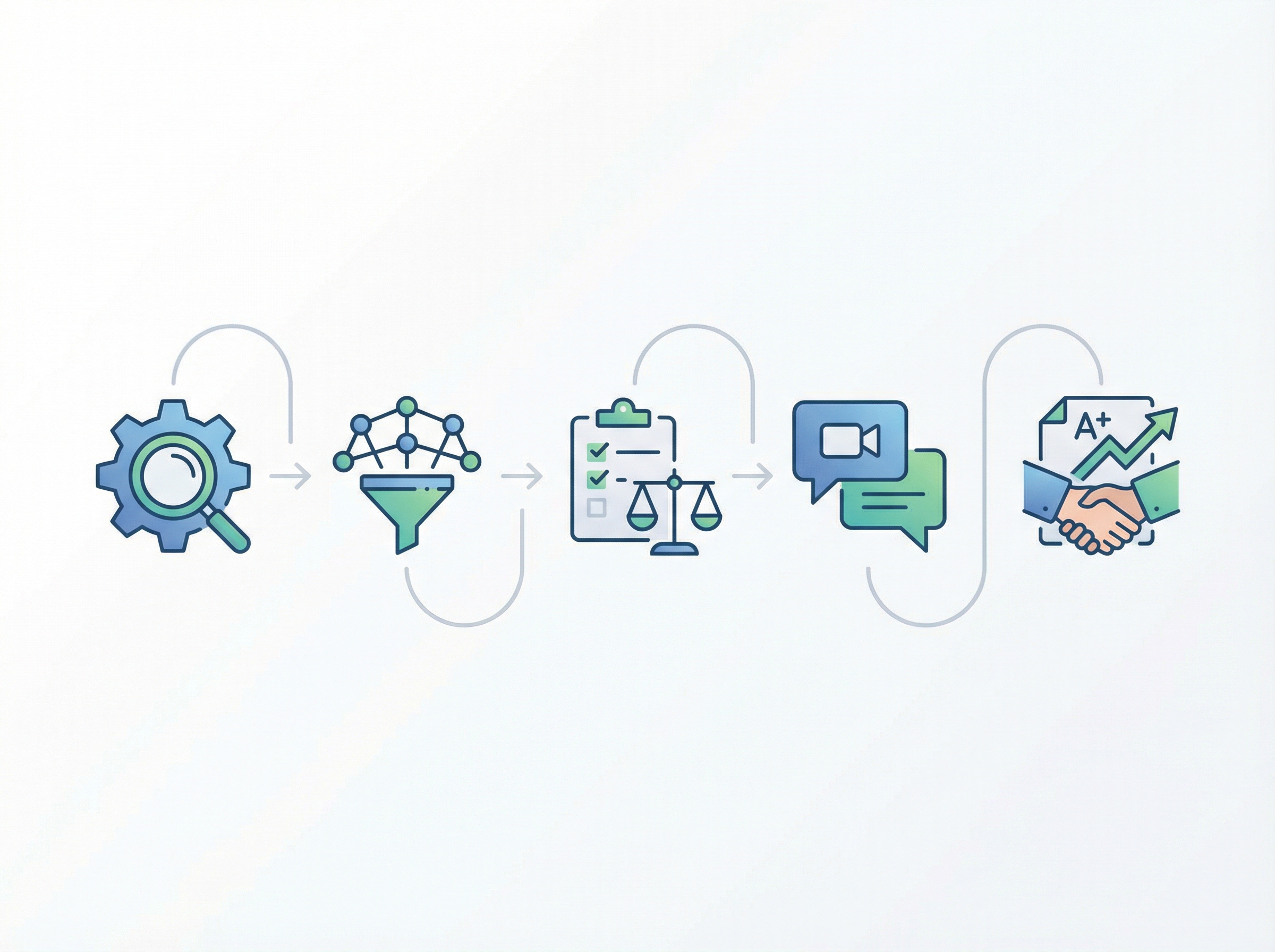
Alex decided to overhaul the system. Here is the exact 5-step workflow they implemented:
- 1. Intake Alignment: Before a job was posted, Alex forced the hiring manager to define "Success" not by tasks, but by competencies. They built a scorecard listing the top 5 skills required (e.g., "Stakeholder Management" vs. "React.js").
- 2. Standardized Screening: Instead of scanning resumes for keywords, they used an AI-assisted tool to screen for core competencies. This ensured every candidate passed the same baseline threshold.
- 3. The "Same Question" Rule: Alex created an interview guide. Every interviewer asked the exact same set of behavioral questions to every candidate. No improvisation.
- 4. Independent Scoring: Interviewers had to submit their feedback and numerical scores into the ATS before talking to each other. This prevented "groupthink" where the loudest voice in the room sways the decision.
- 5. Calibration & Offer: They held a 15-minute "debrief" meeting. They didn't discuss feelings; they compared scores. If Candidate A scored a 4/5 on Coding but a 2/5 on Teamwork, the data made the decision obvious.
The Breakthrough Moment
Three months later, the data started to shift. The "breakthrough" happened during a debrief for a Senior Product Manager. The hiring manager initially wanted to hire a candidate who was "super charismatic." However, when they looked at the scorecard, that candidate had scored a 2/5 on "Strategic Planning."
Another candidate, who was quieter but scored 5/5 on the strategy case study, was the data-backed choice. They hired the quieter candidate. Six months later, she was promoted for saving the company $200k in wasted dev time. The result? Alex’s team reduced new hire turnover by 20% and slashed the interview-to-offer ratio by half.
Core Heuristics and Common Pitfalls
Implementing a structured hiring process isn't just about paperwork; it's about behavior change. Here are the core heuristics (rules of thumb) to make it stick.
3 Best Practices for Structure
- Anchor Your Ratings: Don't just ask interviewers to rate 1-5. Define what a "5" looks like. (e.g., "A '5' answer cites a specific example of conflict resolution involving a senior stakeholder, with a clear positive outcome.")
- Calibrate Early: Don't wait until the final round to align. Have the hiring team score a "dummy" answer or the first candidate together to ensure everyone agrees on what "good" looks like.
- Audit Your Questions: Periodically review your interview guides. Are you asking questions that actually predict performance? Use situational (hypothetical) and behavioral (past action) questions, as they have the highest predictive validity.
Misconceptions and Mistakes
Pitfall #1: The "Robotic" Interview.
Hiring managers often complain that reading from a script feels unnatural.
The Fix: Train them to use the script as a skeleton, not a cage. They can still build rapport and dig deeper with follow-up questions ("Tell me more about that..."), as long as the core evaluation criteria remain consistent.
Pitfall #2: Over-Engineering.
Some teams create scorecards with 20+ competencies. This leads to decision fatigue. Stick to 4-6 core competencies per role.
Pitfall #3: Ignoring the "Why".
If you don't explain why this process matters (reducing bias, legal protection), managers will view it as HR bureaucracy and find ways to bypass it.
Career Impact: Operationalizing Structure
For recruiters and talent leaders, mastering structured hiring is a massive career differentiator. It moves you from being an "order taker" to a "talent advisor."
Acing the "Process" Interview Question
If you are interviewing for a Head of Talent or Senior Recruiter role, you will likely be asked: "How do you ensure quality of hire?"
Don't say: "I look for culture fit and good vibes."
Do say: "I operationalize a structured hiring process. I start by aligning with the hiring manager on a competency-based scorecard. I ensure we use standardized interview guides to minimize unconscious bias, and I enforce independent scoring before debriefs. In my last role, this approach reduced our 90-day churn by 15%."

Resume Boosters
Add these bullet points to your resume to signal your expertise:
- Designed and implemented a structured interview framework across engineering and sales departments, resulting in a 30% increase in offer acceptance rates.
- Standardized evaluation criteria using competency scorecards, reducing interviewer bias and improving underrepresented minority hiring by 18%.
- Led interviewer training workshops on calibration and scoring, increasing the predictive validity of hiring decisions.
Pros & Cons of Structured Hiring
| Benefit (The Why) | Tradeoff (The Cost) |
|---|---|
| Predictive Consistency: Structured interviews are up to 2x more predictive of job performance than unstructured ones. | High Upfront Investment: Creating scorecards, guides, and rubrics takes significantly more time before you even open the role. |
| Legal Defensibility: Standardized questions protect the company against discrimination claims by proving every candidate was treated equally. | Rigidity Perception: Hiring managers may feel restricted or "handcuffed" by the inability to ask random "get to know you" questions. |
| Reduced Bias: Focusing on competencies rather than "fit" minimizes unconscious biases (like affinity bias or the halo effect). | Training Load: Requires ongoing training to ensure interviewers actually stick to the script and score correctly. |
Frequently Asked Questions
What is a structured hiring process?
A structured hiring process is a recruitment method where all candidates are assessed using the same pre-determined criteria, questions, and scoring system. This standardization removes subjectivity, ensuring hiring decisions are based on data and competencies rather than "gut feelings" or personal biases.
Can a structured process backfire?
Yes, if it becomes too rigid. If interviewers feel they cannot ask follow-up questions or have a natural conversation, they may miss nuances or turn off candidates who feel they are being "interrogated." The key is structured flexibility—standard questions with room for organic follow-up.
Does structured hiring take longer?
Initially, yes. Setting up the scorecards and guides takes time. However, it often speeds up the later stages by reducing the need for endless "tie-breaker" interviews and preventing bad hires that force you to restart the search entirely.
How does AI support structured hiring?
AI tools can automate the creation of interview guides, screen resumes against competencies objectively, and even record and transcribe interviews to ensure the structure was followed. Platforms like Foundire help operationalize these workflows to keep the process consistent at scale.
Mastering the structured hiring process creates a durable advantage. It turns talent acquisition from a slot machine into a supply chain—predictable, reliable, and high-quality. By committing to structure, you aren't just filling seats; you are building a fairer, stronger company.
If you want to operationalize these workflows—from sourcing and resume screening to AI interviews and scorecards—try tools like Foundire (https://foundire.com) to automate and enforce your new structured standard.